

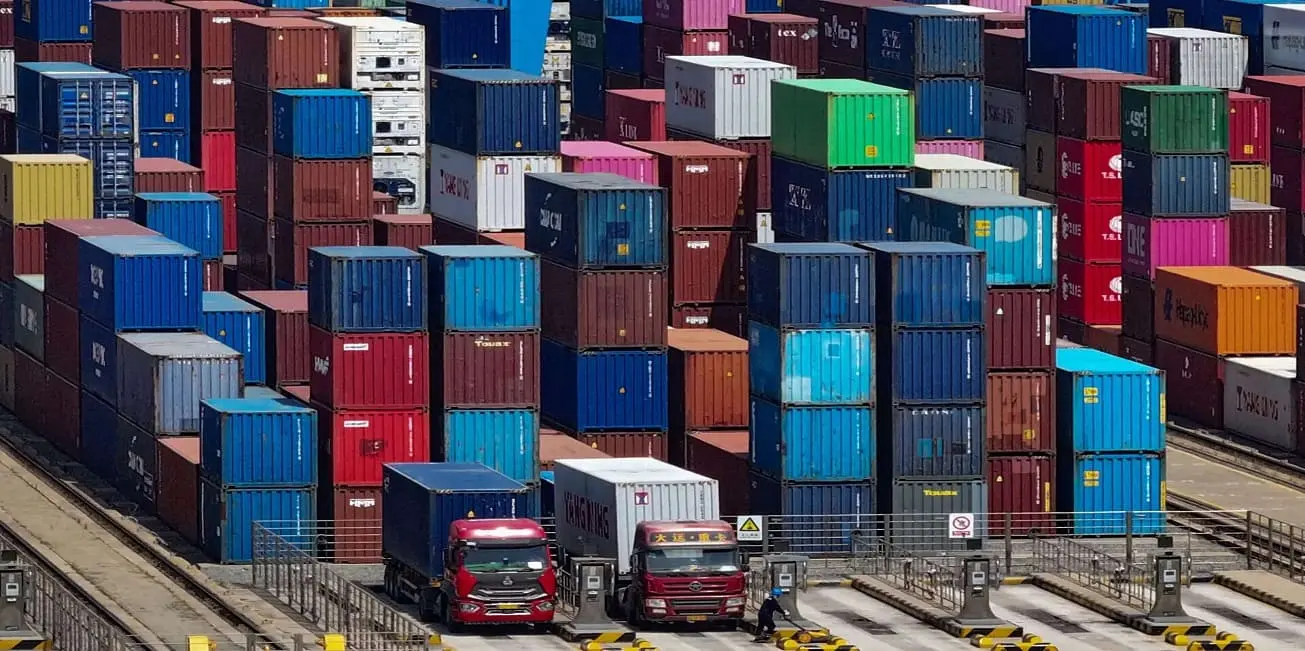
The global container shipping fleet has grown from 4.5 million TEU in 2000 to 33.6 million TEU in 2025.
reports the Paris-based Alpha liner consultancy.
Consolidation in the 2010s concentrated 84 percent of ship capacity in the hands of the top 10 carriers, up from 61 percent at the start of the millennium, it said.
The number of ships rose from 2,622 to 7,492 over the past quarter century, while average vessel size increased from about 1.700 TEU to 4,500 TEU.
The current newbuilding pipe-line stands at close to 11 million TEU, more than twice the size of the world fleet in 2000.
Alpha liner data shows the fleet grew almost linearly from 2003 to2023, adding about one million TEU annually.
In the past two years, growth accelerated to more than two million TEU per year.
Transatlantic capacity injection overtakes demand
Container lines injected more vessels into the transatlantic in 2025, pushing capacity beyond market demand and leaving carriers with little leverage to raise rates, reports New York’s Journal of Commerce.
US importers frontloaded cargo ahead of threatened 30 percent tariffs on EU goods, driving a March surge with imports from North Europe peaking at 219,560. TEU, up 14.3 percent year on year.
But volumes slowed after a July trade deal capped tariffs at 15 percent, leaving growth through November at just 2.5 percent.
Carriers added capacity with larger ships. Mediterranean Shipping Co (MSC) extended its Asia-Mediterranean Dragon service to the transatlantic using vessels averaging 13,000 TEU, compared with the previous maximum of 9,600 TEU.
Average ship size on the route rose to 6,200 TEU in the third quarter from 5.500 TEU at the start of the year.
Spot rates from North Europe to the US east coast have been stuck at US$1,400 per FEU since November, down from $2,000 in March.
Carriers plan record deployments of 435,000 TEU in January and 390,000 TEU in February, according to Copenhagen’s eeSea.
EU member states have been slow to approve the new trade agreement, citing concerns it favours the US.
Analysts warn congestion from resumed Suez Canal transits could spill into European ports and disrupt transatlantic flows.
Importers are advised to build inventories to mitigate risks.
IATA warns converging risks to shape air cargo in 2026
The International Air Transport Association has outlined a matrix of global vulnerabilities that could weigh on air freight networks in 2026, highlighting policy fragmentation, climate disruption, financial fragility and geopolitical uncertainty, reports London’s Air Cargo Week.
IATA said fragmented regulations, including divergent customs regimes, carbon-pricing frameworks and regional taxation, will raise compliance costs and erode network efficiency.
Climate volatility, from extreme weather to agricultural disruption, is expected to strain temperature-sensitive supply chains such as perishables and pharmaceuticals.
The report also flagged cyber threats, with AI-enabled attacks posing systemic risks to cargo operations integrated with airports, handlers and customs systems.
A single breakdown could cascade across continents, making cybersecurity a competitive differentiator for carriers.
Oil market shifts may support margins through lower fuel prices, but structural uncertainty around fossil supply poses long-term planning risks for freighter operators.
IATA stressed that resilience in 2026 will depend on adapting to these overlapping pressures.
MSC unit takes over 14,000-TEU vessel order
LC Logistics said its subsidiary Lehang Boundless has novated rights to a 14,000-TEU containership under construction to Blue Anchor, a Liberian company owned by Mediterranean
Shipping Company, reports Melbourne’s Baird Maritime.
The vessel, identified as hull number H2872, is being built at to Jiangnan Shipyard.
Blue Anchor will pay US$170 million for the order, with $68.64 million going to Lehang Boundless and $101.36 million directly to the shipyards.
The agreement, signed with China Shipbuilding Trading Company and Jiangnan Shipyard, replaces Lehang Boundless as purchaser.
The consideration includes the original $144.8 million price plus a $25.2 million premium, based on independent valuation.
LC Logistics said the disposal will generate a gain of about $20.1 million.
Proceeds will be used to expand operations and strengthen cash flow.
Market reports show newbuilding prices for 15,000-TEU ships currently range between $160 million and $195 million.
CMA CGM offers February Oz/NZ-US east coast loop
CMA CGM will begin a new Oceania-US east coast service in February under a space charter agreement with Maersk, reports New York’s Journal of Commerce.
The KEA service will start with the 3,752-TEU Spirit of Melbourne departing Sydney in early February.
The South Pacific rotation includes Melbourne, Port Chalmers and Tauranga in New Zealand.
Americas calls will cover Balboa and Manzanillo in Panama, Cartagena in Colombia, and US ports Philadelphia and Charleston.
CMA CGM is promoting KEA as a fast service for fresh fruits and frozen food from Oceania to the US east coast.
CMA CGM and Maersk filed the charter agreement with the Federal Maritime Commission this month.
CMA CGM will purchase 350 TEU, equal to 4,900 tonnes of space, including 100 reefer plugs, on each roundtrip sailing of Maersk’s OC-1 service.
The carrier said KEA will complement its Panama Direct Line, offering full US east coast coverage and transshipment options to northern Europe.
Oceania imports to the US east coast have grown steadily since 2021.
PIERS data shows volumes reached 108,198 TEU in 2024, with year-to-date imports through November 2025 up nine percent.
Philadelphia has captured nearly two-thirds of the trade, reflecting its strength in refrigerated cargo.
Services cut while Korea braces for rate drop
Korean shipping companies are cutting services while expanding capacity to prepare for falling freight rates, reports Seoul’s ChosunBiz.
Carriers are increasing blank sailings and reorganising routes to cope with weak market conditions.
Drewry said 75 blank sailings were announced globally this month, up more than 50 percent from a year earlier, with 35 already set for January.
Alliances including Premier, Gemini and Ocean have reduced services on Asia-Europe routes.
The Shanghai Containerised Freight Index stood at 1,656.32 on December 26, down 32.7 percent from last year despite a weekly gain.
Rates have declined as newbuild deliveries boost supply.
Container throughput is expected to rise 3.5 percent to 255 million TEU this year, while capacity will grow 6.6 percent to 32.8 million TEU, widening the gap between demand and supply.
The Ocean Alliance plans to resume Suez Canal transits soon, which could push rates back to pre-Red Sea crisis levels.
The Korea Maritime Institute projected the SCFI could fall to around 1,100 in 2026.
Despite the outlook, carriers are ordering new ships.
Linerlytica said containership orders in 2025 reached 5.08 million TEU a record high.
HMM’s capacity rose 8.6 percent to 970,000 TEU in the third quarter, with more vessels due in 2026.
Sinokor Merchant Marine ordered four 13,000-TEU ships, while SM Line continues to expand midsize capacity.
Industry officials said carriers’ stronger finances compared with 2015-2016 mean they are unlikely to trigger cutthroat competition.
HMM’s debt ratio fell to 25 percent this year from 362 percent in 2016, while SM Line and Sinokor also improved balance sheets.
Analysts said environmental rules could ease oversupply if older ships are scrapped.
Jinjiang Shipping approves US$270 million feeder plan
Shanghai Jinjiang Shipping has secured board approval to invest up to CNY 1.94 billion (US$270 million) in new feeder containerships, reports Amsterdam area’s Breakbulk News.
The programme covers four firm 1.800-TEU vessels with options for four more, subject to shipyard selection and tender pricing.
The resolution, passed on December 26, does not require shareholder approval as it is not a related-party transaction or major restructuring.
The ships are designed as modern intra-Asia workhorses, replacing older tonnage and improving fuel efficiency.
Specifications include a length of about 147.9 metres, beam of 23.25 metres, draft of 8.5 metres, service speed of 18.5 knots and about 145 refrigerated plugs.
The order reflects confidence in feeder demand across North- east and Southeast Asia, where availability has remained tight.
Jinjiang said construction costs are covered by the investment ceiling, with final values to be set after competitive tendering.
Management described the programme as incremental capacity to optimise fleet structure and strengthen Silk Road Express services linking China with Southeast Asia.
Analysts noted the 1,800- TEU segment offers flexibility for ports with draft or berth limits while capturing economies of scale.
Financing will combine internal funds and external capital, with payment schedules finalised once contracts are signed.
The company said the project will not materially affect near-term financial stability.
The move comes amid record container ship ordering in 2025, with Chinese yards taking the bulk of contracts.
While ultra-large vessels dominate headlines, feeders in the 1,800- to 4,500-TEU range are central to renewal plans as carriers adapt to tighter efficiency rules from the International Maritime Organisation.
Ports and logistics providers expect modern feeders to improve schedule integrity and equipment availability, though questions remain about long-term capacity balance if demand softens.
Contract awards and yard selections will signal delivery timing and Jinjiang’s expansion pace.
