
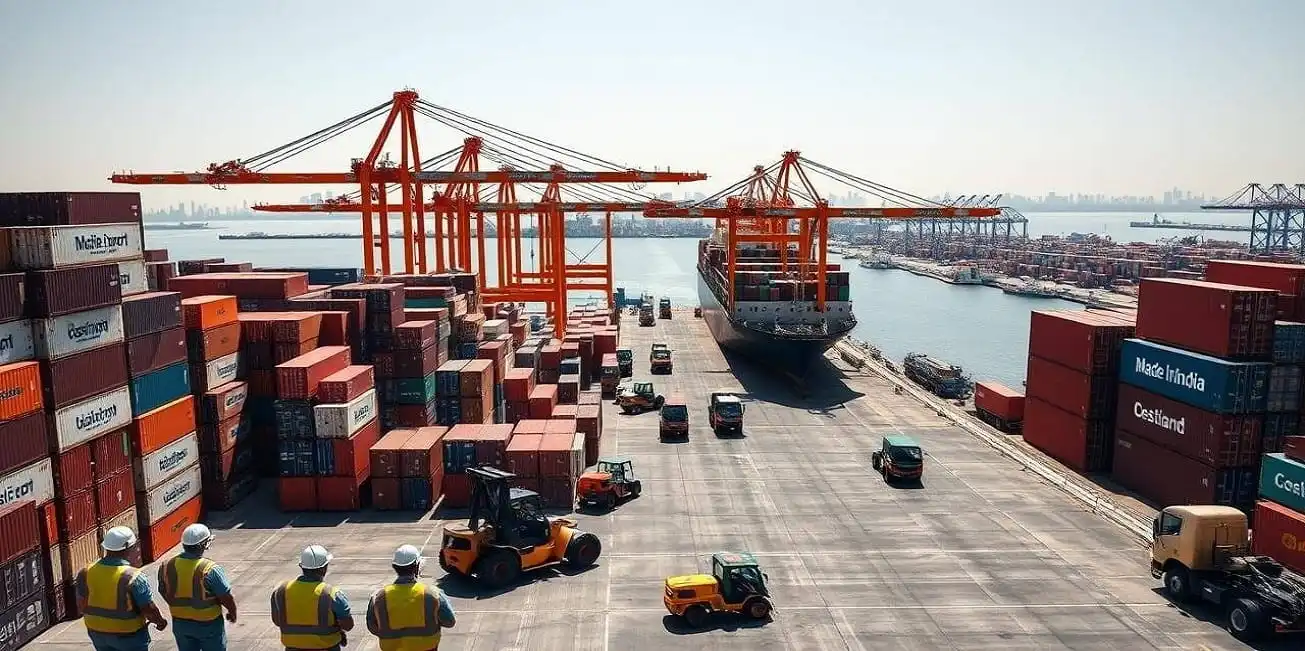
US containerised imports rose two percent in December to 2.23 million TEU, though year-on-year volumes slipped 0.4 percent as frontloading earlier in 2025 showed in the data, reported Singapore’s Splash 247.
Imports from China were 706,000 TEU, down one percent month-on-month and 31 percent below the July 2024 peak of 1.02 million TEU.
Planned US tariffs on furniture were delayed, providing relief for a category that accounts for 16 percent of imports from China.
Despite erratic threats of tariffs on EU countries and Canada, transpacific trade has held up.
Freight rates rose by about US$500 per FEU in early January, reaching $2,675 to the US west coast and $3,928 to the east coast, levels last seen in July 2025.
Spot rates on Far East-Europe routes began 2026 at $3,000 per feu, the highest since August, before easing to $2,925 by January 21.
Analysts expect a return to Suez Canal transits this year, which ding could lower long-term rates.
Asia-North Europe freight fell one percent in January to $457 per FEU, while shortages of charter ships have prompted negotiations for vessels not due until 2027.
There are now 203 megamax ships of over 18,000 TEU in service, with 175 more on order.
Transatlantic rates have remained stable, with US-Europe freight at $457 per FEU on January 21, little changed from the start of the month.
Rates from Europe to South America also held steady.
The Freightos global average was $2,406 per feu on January 21, up 13 percent from December 19. January monthly average of $2,443 is the strongest since July 2025, though below the $3,945 recorded in January last year.
The global fleet of 6,800 ships totalling 33 million TEU remains fully employed despite seven percent capacity growth in 2025.
Orderbooks stand at nearly 1,100 ships of 10.7 million TEU, with demand strong for panamax and feeder sizes.
Analysts expect liner companies to post higher-than-forecast profits for 2025, with funds available for newbuildings to meet Europe’s FuelEU maritime regulations requiring low-emission capable ships.
Air cargo volumes continue strong start to 2026
Global air cargo volumes rose 5 percent year-on-year in mid- January, with tonnages recovering after the post-Christmas slowdown, reports London’s Air Cargo News.
Data provider WorldACD said chargeable weight is now close to pre-holiday levels, though still 10 percent below the mid-December peak.
Gains were recorded from most origin regions, led by Middle East South Asia at 15 percent, Africa nine percent, Asia Pacific six percent, Central and South America five percent, and North America two percent.
Europe was down one percent.
WorldACD noted that chargeable weight patterns over the past five weeks closely mirror last year, with elevated tonnages compared to the same period in 2025.
Improvements this year are partly explained by last year’s slow start
and the later timing of the Chinese New Year holiday, which falls on 17 February compared with 29 January in 2025.
Demand is rising faster from Asia Pacific to Europe than to North America.
Week three tonnages to Europe were up 19 percent year-on-year, with strong growth from China (17 percent), Hong Kong (30 percent), Taiwan and Southeast Asia, including Thailand (32 percent) and Malaysia (26 percent).
Japan fell three percent and South Korea rose one percent.
Asia Pacific to US volumes increased six percent year-on-year, but with sharp disparities.
Shipments from China and Hong Kong fell 12 percent, while South Korea, Taiwan and Southeast Asia posted strong gains.
Volumes from Vietnam and Thailand to the US were up about 50 percent, continuing several months of growth.
Billund Airport launches DKK80m cargo hub project
Denmark’s Billund Airport will invest DKK80 million (US$12.8 million) in a new 8,700 square metre air cargo and cross-docking facility, marking the first step in its Airport City vision, reported London’s Air Cargo Week.
Developed with long-time partner HT Transport, the facility will feature 54 truck docks, a major expansion from the current six to eight, and is scheduled for completion in Q2 2027.
The project aims to improve truck handling times, support annual cargo volumes of nearly 90,000 tonnes, and strengthen Billund’s role as a freighter-focused hub.
Senior manager Kaspar Andreas Nissen said the northern side of the airport will remain passenger-focused, while the southern side is dedicated to logistics.
He noted the new facility will provide flexibility during peak periods and add value for customers by saving time.
Chief development officer Ronny Kristian Lilienvald highlighted HT Transport’s role, saying the family-owned company will benefit from modern handling processes and new office facilities.
The project also includes road upgrades, with Hedevej realigned to provide direct truck access to the airport, reducing traffic near Billund and tourist destinations such as Legoland.
Nissen said municipal support has been crucial to the Airport City plan.
Billund Airport envisions Airport City as a broader ecosystem of logistics, aviation services, hotels and businesses, with future investments potentially exceeding DKK2 billion over the next 10 to 15 years.
Mr Lilienvald said the expansion will help position Billund as a Northern European cargo gateway.
Evergreen adds US$1.5 billion order in ship deal
Evergreen Marine has approved contracts with two Chinese shipyards worth up to almost US$1.5 billion for 23 new vessels, reported New York’s Journal of Commerce.
The larger order, valued between $736 million and $896 million, was placed with CSSC Huangpu Wenchong Shipbuilding for 16 container ships of 3,100 TEU capacity.
A second contract with Jiangsu New Yangzi Shipbuilding covers seven 5,900 TEU ships, worth between $469 million and $574 million.
Evergreen did not disclose fuel type, delivery dates or deployment plans.
Shipbrokers said the vessels are likely to join the fleet in 2028 and 2029.
The carrier previously announced plans to deploy 3,000 TEU ships on Caribbean services by 2030.
The new deals follow Evergreen’s November contracts worth nearly $3 billion for 14 LNG- powered container ships of 14,000 TEU.
Evergreen’s order backlog now stands at 926,000 TEU, lifting its combined fleet and orderbook to almost 2.85 million TEU.
This makes it the world’s fifth-largest container line, according to Sea-web data.
The carrier remains behind fourth-placed Cosco Shipping Holdings, which with affiliate OOCL has 4.2 million TEU in service and on order.
The latest Evergreen orders also push the global container ship orderbook to 1,275 vessels totalling 11.5 million TEU, equal to more than 34 percent of the existing fleet, scheduled for delivery between 2026 and 2030, according to Clarksons.
Containership demolition hits 20-year low
Containership scrapping fell to record lows in 2025 as carriers held onto older tonnage amid strong demand and high charter rates.
reported Fort Lauderdale’s Maritime Executive.
Alpha liner said only 12 ships totalling 8,172 TEU were scrapped last year, with three more sold but not yet demolished.
This compares with 95,607 TEU recycled in 2024 and a record 655,000 TEU in 2016.
The global fleet now numbers more than 7,500 vessels with capacity nearing 34 million TEU.
The ships scrapped were among the oldest and smallest, aged 20 to 45 years, with an average of 30 years.
Ten of the 12 were below 1,000 TEU, while the largest was the 45-year-old Horizon Enterprise at 2,400 TEU.
Analysts expect carriers will eventually dispose of older tonnage to meet efficiency and environmental rules.
BIMCO forecasts recycling of 750,000 TEU in 2026- 2027, but warned a 1.8 million TEU overhang exists after only 272,000 TEU were recycled in the past five years.
Concerns over oversupply are heightened by a surge in newbuilding orders and expectations the Suez Canal-Red Sea corridor will reopen, releasing capacity currently diverted around South Africa.
Linerlytica said the orderbook, at end-2025 stood at 1,267 vessels totalling 11.7 million TEU, equal to 35 percent of the fleet.
Orders rose 36 percent year-on-year, with 671 ships contracted in 2025.
CMA CGM forms global terminals deal with Stone peak
French shipping giant CMA CGM has launched a global marine terminals joint venture with private equity firm Stone peak, involving 11 port assets across the US, South America, Europe and Asia, reports London’s S&P Global.
Stone peak will pay US$2.4 billion for a 25 percent stake in the venture, United Ports LLC, while CMA CGM will retain 75 percent and operational control.
The deal values the terminals at $9.6 billion.
CMA CGM chief executive Rodolphe Saade said the partnership strengthens the carrier’s ability to invest in port terminals, secure access to key gateways and improve service quality.
Stone peak has the option to contribute US$3.6 billion in future projects, while CMA CGM will reinvest proceeds from the sale into its core business.
The venture follows Mr Saade’s 2025 White House meeting with US President Donald Trump, where CMA CGM pledged $20 billion over four years to expand its US logistics presence.
US assets in the JV include Fenix Marine Services in Los Angeles and Port Liberty Terminals in Bayonne, New Jersey, and Staten Island.
Spanish terminals, CSP Valencia, CSP Bilbao, Terminal Maritima de Guadalquivir and TTI Algeciras are also included, along with Brazil’s Santos, Taiwan’s Kaohsiung, India’s Nhava Sheva Freeport and Vietnam’s Gemalink.
Stone peak, which owns TRAC Intermodal and has investments in Lineage, Textainer and Logistec said container terminals are vital infrastructure assets that are difficult to replicate.
CMA CGM operates 41 terminals worldwide, handling over 17 million TEUS annually.
It also controls Terminal Link, a joint venture with China Merchants Port Holdings, which runs 21 terminals handling 29 million TEUS.
Much of CMA CGM’s portfolio has been built since the pandemic, including acquisitions of Fenix Marine and Global Container Terminals’ leases in Bayonne and Staten Island.
CMA CGM also formed a joint venture in 2022 with India’s JM Baxi Group for a 30-year concession at Nhava Sheva, and last year launched a US$2.3 billion tender offer for the remaining stake in Brazil’s Santos terminal.