
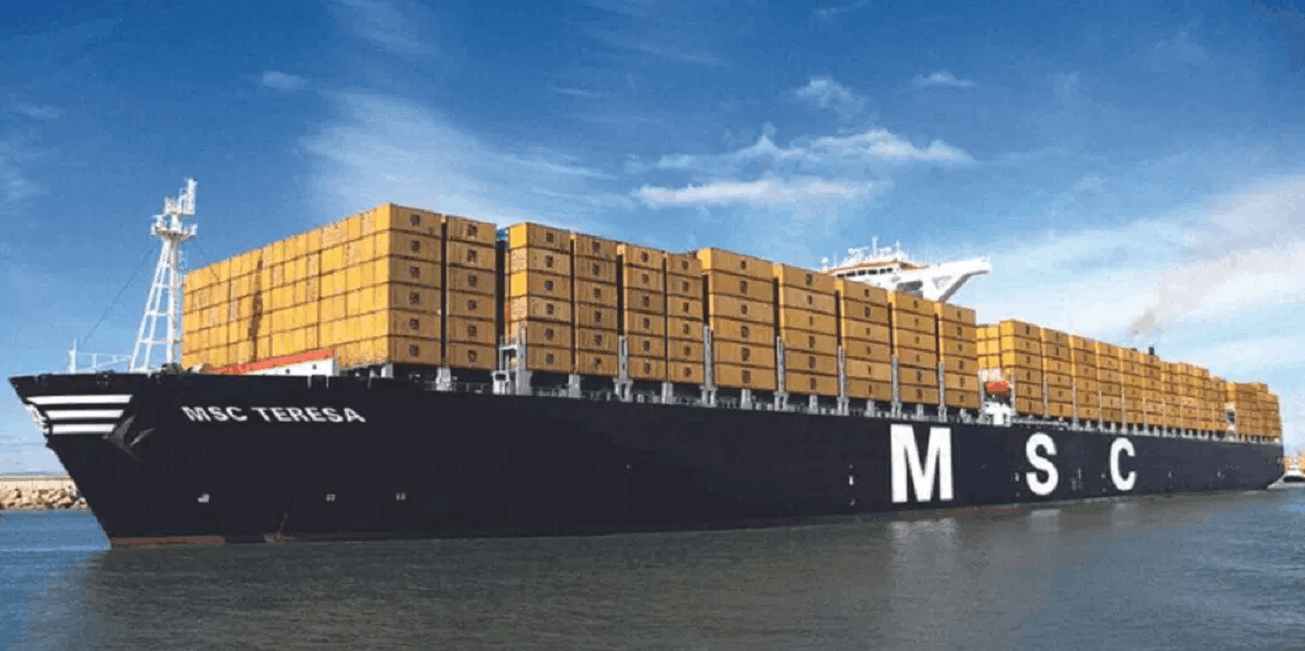
The Mediterranean Shipping company (MSC) Group has signed a 45-year concession agreement with Niger dock to develop a new container terminal at Snake Island Port (SIP) in Lagos.
The group has also finalised an Engineering, Procurement, and Construction (EPC) contract with ITB Nigeria Ltd. and DEME Group to deliver the project.
The investment forms part of MSC Group’s broader commitment to Nigeria’s infrastructure and logistics sector, totalling over $1 billion.
The terminal is designed with a 910-metre quay capable of handling ship-to-shore (STS) cranes and Mobile Harbour Cranes (MHC) for both deep-sea vessels and barges.
Initial dredging will reach-16.5 metres Chart Datum (CD), matching the existing navigation channel depth.
A 30-hectare yard is planned with room for expansion and hybrid rubber-tyred gantries (RTG).
The terminal design is reportedly scalable, allowing a final depth of -18 metres CD to accommodate larger vessels.
Diego Aponte, President of MSC Group, said: “Completing this key phase in the development of Snake Island Container Terminal with Niger dock and our trusted partners demonstrates MSC Group’s commitment to providing excellent service to our customers in Nigeria and throughout Africa.
“The new terminal will open up opportunities, enhance efficiency, and elevate Snake Island Port as a major global shipping center.
Together with our Group’s other long-term investments in Nigeria, it will generate many local jobs and significantly increase economic revenue and resilience.”
Recently, MSC outlined inland routing options for Gulf bound cargo as security concerns persist across the Middle East.
DP World expands port capacity to 109 million TEUS in 2025
DP World posted record results for 2025, with revenue up 22 percent to $24.4 billion and adjusted EBITDA up 18 percent to $6.4 billion (margin 26.3 percent), led by Ports & Terminals and Logistics.
Total group throughput rose 5.8 percent to 93.4 million TEU, while profit increased 32.2 percent to $1.96 billion.
Operating cash flow was $6.3 billion, up 14 percent.
H.E. Essa Kazim, Chairman, said: “In an environment defined by heightened uncertainty and changing trade dynamics, our diversified portfolio, disciplined capital allocation and focus on high-yield cargo enabled us to deliver resilient earnings and strong cash flow. These results reflect the strength of our integrated platform and our ability to adapt supply chains reconfigure.”
Yuvraj Narayan, Group CEO, added: “Ports & Terminals performed strongly, supported by healthy volumes, improved yield and disciplined cost management, with like-for-like revenue per TEU he easing by 8.5 percent.
In 2025, we unified our Marine Services business under a single DP World brand, strengthening our position as a fully integrated global logistics provider.
Across Logistics and our broader trade platform, we continued to scale capabilities and deepen collaboration through our ‘One DP World’ operating model.”
Return on capital employed rose from 8.9 percent in 2024 to 9.9 percent.
Capital expenditure was $3.1 billion in 2025, up from $2.2 billion, increasing port capacity to109 million TEU.
For 2026, capex is expected to be around $3 billion, focused on projects at Jebel Ali Port, Drydocks World, Tuna Tekra Port, London Gateway, Ndayane Port, and Jeddah Islamic Port.
Scope 1 and 2 emissions fell 14 percent versus 2022, and about 67 percent of global electricity now comes from renewables.
Recently, DP World launched Insetify, a carbon inset trial designed to help ocean freight forwarding customers in Belgium, Portugal and Sweden reduce Scope 3 emissions across key European trade lanes.
ICTSI launches $800m South Luzon Container Terminal
International Container Terminal Services Inc. (ICTSI) has officially launched the South Luzon Container Terminal (SLCT) as construction begins on what will become the Philippines’ second-largest container terminal.
The $800 million facility is located around 110 kilometres south of Manila within the Bauan International Port in Batangas.
Once completed, the terminal is expected to expand container handling capacity in Southern Luzon while supporting the country’s broader trade and logistics network.
The launch ceremony was led by Transportation Acting Secretary Giovanni Z. Lopez and Bureau of Customs Commissioner Ariel F.
Nepomuceno, alongside several national and local officials.
Christian R. Gonzalez, ICTSI Executive Vice President, led the company’s delegation and acknowledged the support of government agencies and local authorities involved in the project.
“It’s never easy to take the first step.
Having a vision is one thing, but making it happen on the ground requires strong partnership with local leaders who are committed to delivering critical infrastructure,” he said.
“We hope that what we unveil today will inspire everyone and demonstrate what can be achieved through long-term collaboration and commitment.”
SLCT is situated within a naturally protected cove on Batangas Bay.
The site is expected to offer operational stability as the project progresses towards its target completion in 2028 and prepares to handle ultra-large container vessels.
At full development, the terminal will feature an 800-metre quay, 38 hectares of yard space, and an 18-metre berth depth.
Annual capacity is projected to exceed 2 million TEUS.
Phase I includes marine works and the construction of a 425- metre quay designed for super post-Panamax operations.
Construction is scheduled to take place between May and September 2027, with equipment delivery and installation targeted for August 2027.
The terminal is also planned as a smart technology facility, equipped with eight remote-controlled ship-to-shore cranes, 20 rail-mounted gantries, and 32 diesel-hybrid carriers and handlers.
Road access to the terminal will be provided through the Bauan- San Pascual-Batangas-STAR route and major South Luzon tollways, with additional connectivity under consideration through the Cavite-to-Bauan corridor.
The project forms part of Philippine President Ferdinand R. Marcos Jr.’s Build Better More infrastructure programme.
Maersk to launch dry port services at Hungary's EWG terminal
Intermodal logistics in Eastern Hungary is set to expand following a cooperation agreement between East-West Intermodal Logistics Plc.
(EWG) and A.P. Moller – Maersk.
The partnership was formally presented during a ceremony at the EWG intermodal terminal in Fényeslitke, where representatives of both companies signed a long term agreement covering container depot and dry port services at the site.
US import volumes seen lower in early 2026
Imports at major US container ports are expected to remain below last year’s levels in the first half of 2026 amid tariff uncertainty, though it is too soon to assess the impact of the conflict in Iran, reported the National Retail Federation.
NRF vice president Jonathan Gold said the Supreme Court’s ruling against IEEPA tariffs had been followed by new measures, including a temporary 10 percent tariff under Section 122 of the Trade Act of 1974.
He warned that tariffs raise costs for businesses and consumers and urged a more strategic approach.
Hackett Associates founder Ben Hackett said the immediate impact of the Iran conflict on US- bound container traffic was limited, as little cargo originates from the region.
But he cautioned that rising oil and gasoline prices could fuel inflation, squeeze consumer spending and reduce imports if the conflict persists.
US ports handled 2.08 million TEU in January, up 3.8 percent from December but down 6.4 percent year on year.
Global Port Tracker projected February at 2.01 million TEU, March at 1.91 million TEU, April at 2.03 million TEU, May at 2.09 million TEU and June at 2.1 million TEU.
Those figures would bring the first half of 2026 to 12.21 million TEU, down 2.5 percent from 12.53 million TEU in the same period of 2025.
Imports in 2025 totalled 25.4 million TEU, down 0.3 percent from 2024.
Port of Rotterdam revenue rises but profit slips in 2025
The Port of Rotterdam increased revenue but saw profit edge lower in 2025, as higher costs and a one-off impairment offset income gains while the organisation continued investing in infrastructure and energy transition projects.
The annual report outlines developments across areas including occupational safety, biodiversity and climate, along-side a summary of financial results.
Revenue rose 6.6 percent to 940.4 million ($1.07 billion), while also increased, notably personnel, operating expenses and depreciation, alongside the one- off impairment.
Net profit fell by 7.8 million ($8.9 million) to +266 million ($304 million). Under revised agreements with shareholders, the Municipality of Rotterdam and the State, 186.2 million ($213 million) of that was paid out in dividends.
Stable finances allowed the Port Authority to continue investing in the port’s future, committing 291.4 million ($333 million) in 2025.
The Porthos project, which will transport CO2 from industrial companies in the port and store it in depleted gas fields beneath the North Sea, made significant progress.
Several shore power installations were commissioned, while construction began on a new rail yard at Maasvlakte Zuid.
The organisation also set out its longer-term direction through its corporate strategy, ‘Port Vision 2050’, published in 2025, along- side its Climate Transition Plan.
Social initiatives included closer engagement with the city and region, such as support for the Youth Education Fund and the opening of the Portlantis port experience centre.
The report also highlights the need for closer cooperation to address challenges, including the investment climate, resilience and the energy transition.
It outlines work with customers, government bodies, knowledge institutions and local residents, and includes interviews offering additional perspective on issues affecting the port and surrounding communities.
The report also sets out initiatives aimed at keeping the port sustainable, competitive and safe.
In February, the Port of Rotterdam published its integrated approach to reducing greenhouse gas emissions in a new climate transition plan.
New Pakistan, UAE feeder service launched
Federal Minister for Maritime Affairs, Muhammad Junaid Anwar Chaudhry announced on Friday the launch of a new feeder shipping service from Karachi Port to the United Arab Emirates, marking a key step toward transhipment capabilities.
In a statement. Junaid Anwar Chaudhry said that Karachi Gateway Terminal (Private) Limited (KGTL), which is KPT’s major business partner, will be supported by a dedicated feeder service linking Karachi with the UAE ports of Fujairah and Khor Fakkan, strengthening maritime connectivity for Pakistan’s trading community amid evolving regional shipping dynamics.
Junaid Chaudhry said the new service establishes a regular shipping link between Karachi and two of the region’s key transhipment hubs, enabling Pakistani importers and exporters to maintain reliable access to global container shipping networks.
The service will call at KGTL, part of AD Ports Group’s international operating arm, Noatum Ports.
The first vessel of the service arrived at KGTL on the evening of 11 March, officially marking the start of regular operations,” the minister added.
Junaid Chaudhry noted the new feeder link supports supply chain continuity through KGTL and helps ensure Pakistan’s trade maintains dependable access to international markets.
Shipping & Logistics.
Cargo routed through Fujairah and Khor Fakkan will benefit from seamless connectivity to regional and international shipping networks, supported by the UAE’s advanced logistics infrastructure.
Containers can be efficiently transferred via integrated road and rail corridors to major commercial hubs and logistics centres across the UAE.
Talking on the new feeder service, Rear Admiral Shahid Ahmed (Retd.), Chairman, Karachi Port and Trust said, “The introduction of this feeder service further enhances Karachi Port’s connectivity with key regional hubs and supports Pakistan’s growing trade requirements and added.
“Strengthening maritime links with the UAE will help facilitate smoother cargo movement while providing greater flexibility for the of country’s trading community as per the vision of Federal Minister for Maritime Affairs Muhammad Junaid Anwar Choudhry.”
Khurram Aziz Khan, Chief Executive Officer of Karachi Gate way Terminal (Private) Limited (KGTL), said, “The commencement of this feeder service reflects KGTL’s continued commitment to strengthening Pakistan’s maritime connectivity and supporting the country’s trading community. By linking Karachi directly with major UAE transhipment hubs, this service provides importers and exporters with reliable access to global shipping networks while reinforcing the role of Karachi Gateway Terminal as a key gateway for international trade. “Maritime Transport.
Federal Minister Junaid Chaudhry concluded, saying Pakistan’s economy relies heavily on maritime trade, and strengthened connectivity with regional transhipment hubs provides additional resilience for exporters.
importers and supply chains.