
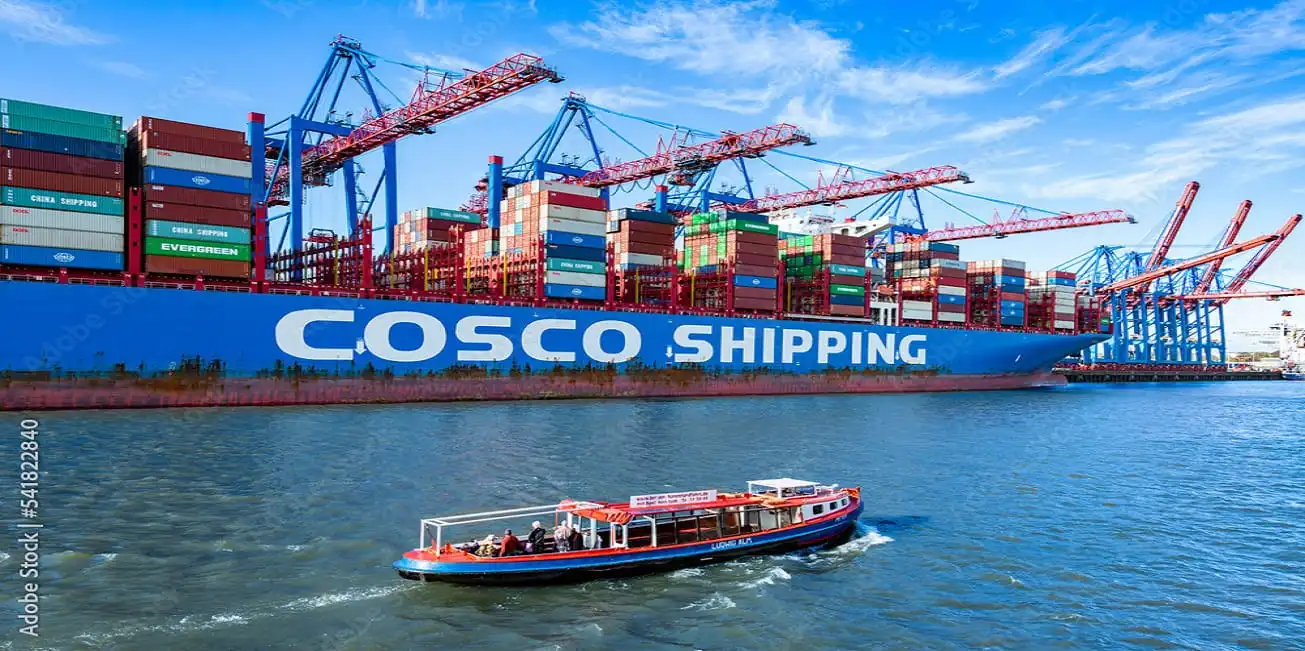
China’s state-run shipping Cosco is close to finalizing a order for up to 12 LNG dual- fuel container vessels worth more than US$2 billion, reports Singapore’s Splash 247.
Market sources said Cosco is in advanced talks with CSSC’s Hudong-Zhonghua Shipbuilding for a series of 14,000-TEU neopanamax ships.
Pricing is understood to be US$170 million to US$190 million per vessel, taking the overall contract value to about US$2 billion to US$2.3 billion.
The new builds are expected to be deployed by Orient Overseas Container Line, Cosco’s Hong Kong-based liner arm.
No delivery schedule has been disclosed, but the deal would expand Cosco’s already large orderbook and deepen its commitment to LNG as a marine fuel.
Earlier this year, Cosco booked about US$2.7 billion of new tonnage, including 12 LNG dual-fuel 18,000 TEU vessels at Jiangnan Shipyard and six smaller conventionally fuelled ships at Cosco Zhoushan.
The group has also pursued methanol-capable designs, with OOCL ordering 14 methanol dual-fuel 18,500-TEU ships in 2025 at DACKS and NACKS.
OOCL has added chartered tonnage, signing for six 13,000- TEU ships from Seaspan, with deliveries scheduled from late 2026 through early 2028.
If confirmed, the Hudong order would push Cosco’s newbuilding pipeline higher.
Including OOCL, the group ranks as the world’s fourth-largest liner operator, with a fleet of about 555 vessels and capacity of 3.6 million TEU.
Fleet data show Cosco could have more than 120 ships on order, totalling over 1.4 million TEU, if the latest deal proceeds.
Box shipping profits reach US$15.4b in '25
Global container carriers recorded combined EBIT of US$15.4 billion in 2025, signalling moderation in earnings but avoiding a sharp downturn, reports London’s Port Technology International.
Sea-Intelligence analysis showed profits fell from US$35.4 billion in 2024 and remain well below the highs of 2021 and 2022.
However, performance continues to exceed pre-pandemic bench-marks, with all major carriers reporting operating-level profitability.
COSCO led with EBIT of $4.93 billion, followed by Evergreen at $2.36 billion, OOCL at $1.54 billion and Maersk at $1.39 billion.
ONE and Yang Ming posted $459 million and $472 million respectively.
Earnings per container declined across the board compared with 2024.
ONE saw the steepest drop, with EBIT per TEU falling to $36.
Despite reductions, figures remain strong against historical levels, with ZIM at $277 per TEU, HMM at $257 and OOCL at $195.
COSCO reported $180 per TEU, Yang Ming $107, while Hapag-Lloyd and Maersk returned to more typical ranges at $83 and $54 per TEU.
Analysts said the sector has moved past exceptional profitability but remains above prepandemic conditions.
Two giant cranes sail for DP World Southampton
Two fully assembled STS the cranes built by ZPMC are enroute from China to DP World’s Southampton terminal aboard the heavy-load vessel Zhen Hua 28, reported Rotterdam’s Project Cargo Journal.
The cranes form part of a GBP60 million (US$79.4 million) investment announced last year, which includes four STS units.
DP World said the new cranes will match or exceed the capacity of Europe’s largest quay cranes.
The units are delivered fully assembled.
Designed to handle the world’s biggest container ships, the cranes promise faster turnaround times, and smoother cargo flows.
They have a safe working load of 65 tonnes and an outreach of 72 metres.
DP World said they will be capable of quad lifts, moving two 40-foot containers simultaneously, with an operational lifespan of 25 years.
The first two cranes are scheduled to arrive at Southampton at the end of May, with the remaining two expected in August.
Southampton is one of two deep water ports operated by DP World in the UK, alongside London Gate-way.
The Southampton terminal covers nearly 100 hectares and features 14 STS cranes along a 1.92 km deep-water quay, with depths of up to 16 metres, accommodating vessels up to 430 metres in length.
DP World said its Southampton terminal handled more than two million TEU in 2025, while London Gateway surpassed three million TEU, boosted by a new berth and calls from Gemini Cooperation’s Asia-Europe routes.
The three million TEU milestone marked growth of more than 52 percent from 2024, taking DP World’s UK container total to over half of the national nine million TEU market.
Japanese yards deliver two 13,932-TEUers to ONE
Japan’s Imabari Shipbuilding group has delivered two 13,932 TEU sister container ships to Ocean Network Express (ONE), reports Miami’s Datamar News.
Imabari Hiroshima delivered the ONE Shine, while Imabari Marugame handed over the ONE Simplicity.
These are the ninth and tenth units in a 15??hip series scheduled for delivery across 2025 and 2026, according to Alpha liner.
ONE’s order book includes 47 container vessels, with 27 in the 14,000 TEU compact neo??anamax class.
Orders are split between Imabari, CSSC Jiangnan and Yangzijiang Shipbuilding.
In addition, Hyundai Heavy Industries is building 16,000 TEU dual??uel LNG ships for the line.
Industry sources said ONE is negotiating up to 22 additional newbuilding orders in the 14,000- TEU and 16,000-TEU segments.
The latest vessels measure 336 metres in length, with a beam of 51 metres and deadweight of about 160,000 tonnes.
The ships are powered by MAN B&W 7G95ME engines delivering 48,000 kW, enabling speeds of up to 22 knots.
Following delivery, the ONE Shine joined the Asia-West Coast South America service with Hapag- Lloyd and MSC, while the ONE Simplicity sailed for Shanghai to join a similar joint service with MSC.
China-Kazakhstan base handles 20,000 TEU
The China-Kazakhstan (Lianyungang) Logistics Cooperation Base has processed more than 20,000 TEU of cargo since the start of 2026, reports Hong Kong’s Bastille Post Global.
Nanjing Customs said over 240 China-Europe (Central Asia) freight trains have been dispatched this year.
Since its launch in July 2014, the base has operated more than 7,744 trains carrying 667,000 TEU.
The facility now runs six inter- national rail routes covering Central Asia, China-Kyrgyzstan- Uzbekistan, China-Russia and the Trans Caspian corridor, with access to five outbound ports including Alashankou and Khorgos.
Cargo transported includes automobiles and auto parts, chemical products, household appliances, textiles and garments, and electronic equipment.
Officials said the base plays a vital role in stabilising industrial and supply chains for Belt and Road partner countries and continues to support high-quality economic development across Eurasia.
Services exports up by 18.38%
The export of various services witnessed 18.38 percent increase during the first eight months (July-February) of the current fiscal year as compared to the corresponding months of last year, Pakistan Bureau of Statistics (PBS) reported.
According to the latest PBS data, Pakistan earned $6.463 billion from the export of services during July-February 2025-26 as compared to services’ export of $5.459 billion in July-February 2024-25.
Economic policy insights the services’ imports also witnessed an increase of 14.17 percent during the months under review and were recorded at $8.604 billion as compared to the imports of $7.536 billion in July-February 2024-25.
Based on the figures, the services’ trade deficit increased by 3.08 percent during the months under review as compared to the corresponding months of previous year.
The services trade deficit was recorded at $2.140 billion during current months against the deficit of $2.076 billion during same months of last year.
Meanwhile, on year-on-year basis, the exports of services in February 2026 increased by 16.89 percent to $812.25 million from $694.90 million in February 2025.
On the other hand, the imports declined by 4.43 percent by going down from $952.19 million to $910.02 million, according to PBS data.
On month-on-month basis, the export of services decreased by 7.33 percent in February 2024 when compared to the exports of $876.48 million in January 2026.
The imports of services also declined by 20.87 percent in February 2026 compared to imports of $1,150.06 million in January 2026, PBS reported.
China takes top spot from Japan in Oz car sales
China overtook Japan as Australia’s largest source of imported vehicles for the first time in February, ending Japan’s decades-long lead, reports Caixin.
Australia imported 22,300 vehicles from China in February, giving China a 25 percent share, according to the Federal Chamber of Automotive Industries.
Japan ranked second with 21,600 units, followed by Thailand with 19,400.
Japan had been the top supplier since 1998.
Chinese-made vehicles have steadily climbed the rankings since 2020, overtaking South Korea in 2023 and Thailand in 2025 before taking the top spot.
FCAI chief executive Tony Weber said Australia is one of the world’s most open and of competitive auto markets, with new entrants driving price and technology competition.
Nine of the 10 brands that entered since 2020 are Chinese, including BYD, Geely and XPeng.
Chinese electric vehicle makers also posted a strong rebound in March sales as subsidies and financing incentives drew in first-time buyers, reported Hong Kong’s South China Morning
Post.
BYD, the world’s largest electric-car maker, delivered 300,222 units in March, up 57.9 percent from February.
Leapmotor reported 50,029 deliveries, a 78.3 percent jump, while Nio sold 35,486 EVs, up 70.6 percent.
Other major players, including Geely Auto and Li Auto, also recorded solid gains.
The founder of Shanghai-based data provider CnEVPost said the sweeping improvement in deliveries revived hopes for a steady market after weak sales in January and February.
Analysts said the rebound would restore confidence in China’s EV sector.