
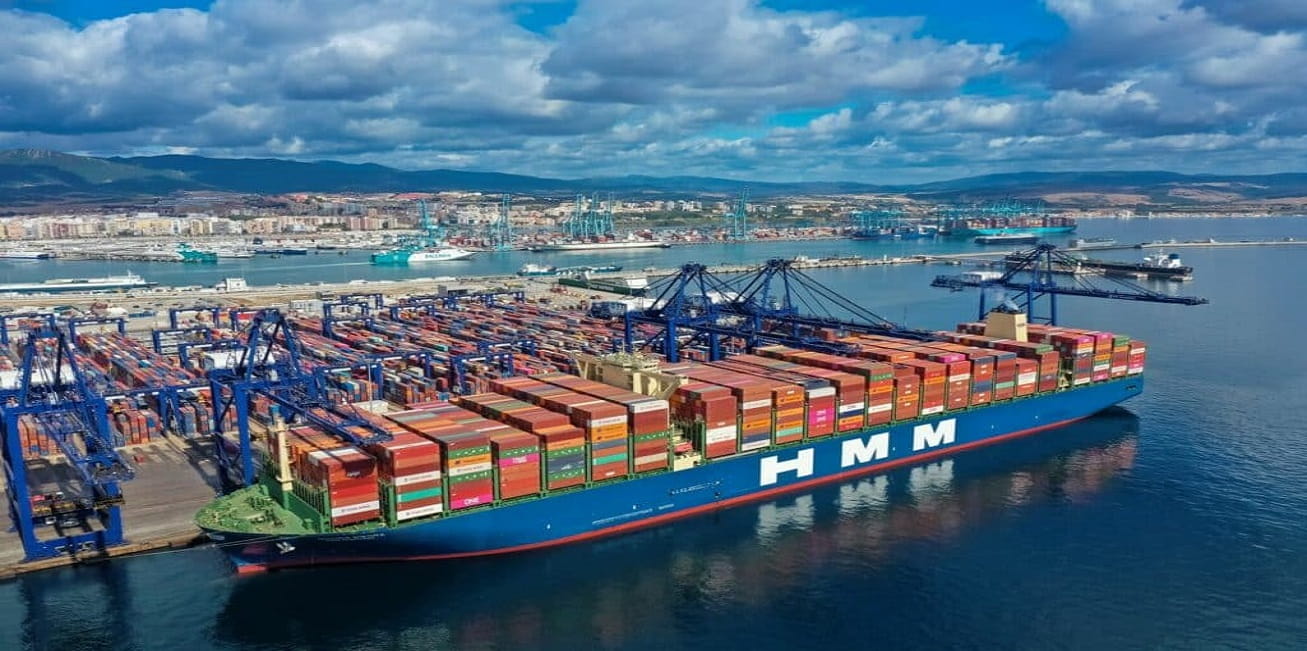
HMM has unveiled a new Mediterranean-West Africa Service (MA2), reinforcing its hub- and-spoke strategy and strengthening connectivity between major transhipment hubs and emerging African markets.
The service, set to begin in July 2026, will utilise Algeciras as a central Mediterranean hub, linking it with key West African ports.
The structure is designed to improve port connectivity and operational efficiency, while integrating with HMM’s main east-west trade lanes.
Operated in partnership with Ocean Network Express (ONE), the MA2 service will deploy five 2,800 TEU vessels.
The inaugural sailing is scheduled for the second week of July from Algeciras, with a full round voyage of 35 days.
The port rotation includes Algeciras, Tangier, Dakar, Tema, Lekki and Abidjan, forming a loop aimed at supporting cargo flows across strategically important West African gateways.
From a port and terminal perspective, the service is expected to enhance utilisation at hub locations while improving feeder access into regional markets, particularly as demand for intra-regional and intercontinental connectivity continues to grow.
An HMM official said: “The MA2 service will serve as a strategic gateway, effectively linking HMM’s core main-haul services with the high-potential emerging markets of Africa.
Grounded in our hub-and-spoke strategy, we will continue to build a more comprehensive global network and grow alongside our customers by delivering differentiated value.”
The launch comes amid a broader expansion of HMM’s feeder capacity, with the carrier securing 24 vessels over the past six months.
This includes newbuild orders and second-hand acquisitions ranging from 1,800 TEUS to 2,800 TEUs, supporting its wider network development and port connectivity strategy.
Recently, HMM’s senior management visited TTI Algeciras to review terminal operations, technology updates, and expansion plans, focusing on container handling and the port’s role in Mediterranean transhipment.
ONE revises LUX service rotation for reliability
Ocean Network Express (ONE) will adjust the rotation of its Latin East Coast Europe Express (LUX) service, removing Felixstowe and southbound calls at Paranaguá as part of measures to enhance schedule reliability and strengthen its network offering.
The revised rotation will take effect from the M/V Navios Vermilion (v. 163S/N), ETA Rotterdam 6 May 2026.
The updated loop will operate as follows:
Rotterdam-Hamburg -Antwerp – Lisbon – Algeciras – Santos – Buenos – Aires Montevideo – Itajaí – Paranaguá – Santos – Rio de Janeiro – Algeciras-Rotterdam.
Under the revised structure, the last vessel on the previous rotation to call Felixstowe will be the M/V NYK Diana (v.022N/023S), ETA 23 April 2026, while the final southbound call at Paranaguá under the existing schedule will be the M/V Brooklyn Bridge (v.0179S/N), ETA 23 May 2026.
ONE said the adjustments are intended to improve service consistency and reinforce reliability across its Latin America-Europe corridor, while enhancing overall network efficiency and customer performance.
Recently, ONE introduced a new Mediterranean-West Africa service aimed at strengthening connectivity between Asia, Europe and African markets.
China's first quarter GDP growth hits 5pc
China’s economy expanded five percent year-on-year in the first quarter, reported Hong Kong’s South China Morning Post, citing data from the National Bureau of Statistics.
The figure surpassed market expectations despite global uncertainty linked to the US-Israel war in Iran.
The GDP growth rate released Thursday by the NBS beat the 4.86 percent forecast by economists polled by financial data provider Wind.
It also accelerated from the 4.5 percent recorded in the final quarter of 2025, which had been the weakest quarterly performance in three years.
Analysts said the stronger- than-expected result signals a solid start to 2026.
Ding Shuang, chief economist for Greater China and North Asia at Standard Chartered, noted Beijing is unlikely to introduce immediate policy measures given the robust showing.
MSC now has a fleet of 1,000 containerships
Mediterranean Shipping Company (MSC) has become the first container line to operate a fleet of 1,000 vessels, reported Bangalore’s Marine Insight, citing consultancy Linerlytica data.
The milestone was achieved with the delivery of the 11,480 TEU MSC Migsan from Zhoushan Changhong shipyard in China.
MSC’s fleet capacity now stands at about 7.3 million TEU, making it 57 percent larger than rival Maersk.
The company’s capacity is nearly equal to the combined fleets of Hapag-Lloyd, Ocean Network Express, Evergreen Marine and HMM.
Analysts said MSC’s growth since 2020 has been driven mainly by organic expansion rather than acquisitions.
The sector faces uncertainty from Middle East tensions affecting global trade routes.
At the same time, MSC confirmed a leadership change, with founder Gianluigi Aponte transferring ownership to his son Diego Aponte and daughter Alexa Aponte.
Mr Aponte, 85, will remain executive chairman.
Founded in Naples in 1970, MSC now has 675 offices across 155 countries, operates on 300 trade routes, calls at more than 520 ports and carries about 30 millionTEU annually.
The MSC Group, which also runs cruise and logistics businesses, employs about 200,000 people.
Alpha liner data showed the global container fleet reached 7,528 active ships with a combined 34 million TEU capacity as of April 14,2026.
MSC’s operations extend beyond container shipping to inland transport, logistics, terminals and passenger services, reinforcing its position as the world’s largest carrier.
Cosco Shipping Bulk enters container trade
Cosco Shipping Bulk has launched its first dedicated container liner service, marking a strategic expansion beyond bulk shipping, reported the UK’s Seatrade Martime News.
The vessel Guo Yun Hai made its maiden call at Nansha Port Area, Guangzhou, inaugurating a direct multipurpose route linking South China with North Africa.
The service connects Qingdao, Incheon, Shanghai, Ningbo, Nansha, Suez á Canal, Port Said West, Benghazi, Misrata and Valencia.
The new corridor strengthens trade between the Guangdong Hong Kong Macao Greater Bay Area and North Africa, offering a 21-day transit from Nansha to Libya, the fastest currently available.
Officials said the service enhances logistics efficiency and market connectivity.
Designed for flexibility, the service can carry dangerous goods containers including new energy vehicles, lithium batteries and energy storage units.
It is equipped with 220 reefer plugs to support diverse export cargo, with Cosco highlighting its advantages of economy, efficiency and reliability.
Long Beach edges Los Angeles in Q1
The Port of Long Beach handled more containers than the Port of Los Angeles in the first quarter of 2026, reported Amsterdam area’s Breakbulk News, raising the prospect of ending Los Angeles’s 25-year reign as the busiest US container gateway.
Long Beach moved 2.39 million TEU in Q1, just ahead of Los Angeles at 2.38 million TEU, a margin of 1,382 TEU.
The difference is less than a single average vessel call, underscoring how finely balanced volumes have become as carriers adjust services across the US West Coast.
Los Angeles has held the annual crown for 25 years, though Long Beach and New York-New Jersey have occasionally overtaken it on monthly tallies since the pandemic.
A sustained lead through 2026 would mark the first full-year shift in a generation.
March figures showed Long Beach at 774,935 TEU, down 5.2 percent year-on-year but still ahead of Los Angeles at 752,520 TEU, said Noel Hacegaba, chief executive of Long Beach.
The lead has changed hands each month, with Los Angeles ahead in February.
Dr Hacegaba said no single event drove the swing, describing carrier service moves as routine.
He noted MSC plans to optimise its west coast network this year, including dropping Oakland calls.
Underlying data showed Los Angeles handled more loaded imports, while Long Beach moved more empty exports, with 889,779 TEU of empties against 799,453 TEU at Los Angeles.
Jonathan Gold, vice president of the National Retail Federation, said US retail sales are forecast to grow 4.4 percent in 2026 despite geopolitical risks.
He cited the war in Iran, oil prices and tariff uncertainty but said retailers are maintaining inventories for the summer season.
Carriers continue to adjust capacity across San Pedro Bay, Oakland and the Pacific Northwest.
With the annual gap now measured in fractions of a vessel call, second quarter allocations by major alliances may decide whether Los Angeles retains its crown.