
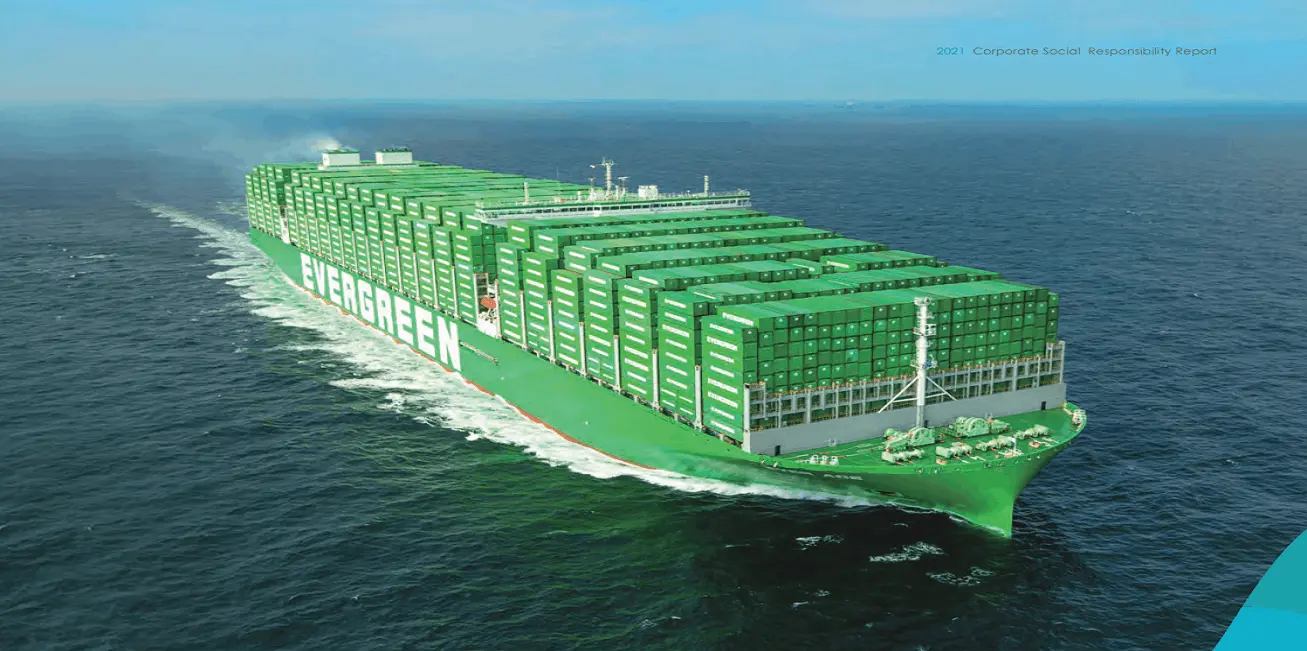
Evergreen Marine Corporation is set to launch a new SAF” service on 28 May 2026, strengthening direct connectivity between the Far East and South Africa.
The new loop is designed to expand the carrier’s network reach while enhancing port coverage and service frequency across key Asian and African gateways.
It will also complement Evergreen Marine Corporation’s existing South Africa offerings, reinforcing links for container flows between major export hubs and African markets.
The SAF service will be jointly operated with Pacific International Lines (PIL), deploying eight vessels with a nominal capacity of 5,500 TEUs.
The rotation reflects a focus on high-volume terminals and transhipment hubs, supporting more efficient cargo routing and schedule reliability.
The maiden voyage is scheduled to depart Shanghai on 28 May 2026, with arrival in Durban expected on 25 June 2026.
The service will operate on a fixed 63-day round trip.
Port rotation is as follows:
Shanghai- Ningbo – Kaohsiung – Shekou – Singapore – Durban – Cape Town – Singapore – Shanghai.
On 6 March 2026, Evergreen Marine Corporation temporarily suspended the acceptance of new bookings for a number of Middle East ports due to the situation in the Strait of Hormuz.
Evergreen said the decision was taken “in order to safeguard the safety of our crew members, vessels, and customers’ cargo”.
ONE posts $338m FY2025 net profit
Ocean Network Express (ONE) has reported full-year FY2025 results, posting revenue of $16,620 million and a net profit of $338 million for the period April 2025 to March 2026.
Revenue for the fourth quarter stood at $4.042 billion, rounding off a year defined by continued volatility across global container trade and fluctuating demand conditions on key routes.
The carrier attributed its performance to disciplined cost control and improved operational efficiency, which helped offset market instability, particularly in the latter part of the financial year.
Jeremy Nixon, Chief Executive Officer of Ocean Network Express, said: “Despite heightened volatility in the fourth quarter of FY2025, our disciplined cost control and operational efficiency enabled us to deliver a profitable full-year result.
“We continue to navigate a complex and volatile global environment as we enter the new fiscal year, and the safety of our people as well as the security of our operations and customers’ cargo remain our top priorities.
Supported by our new leadership structure and enhanced services in FY2026, we will sustain a reliable network and leverage a lean and agile operating model to deliver better service to our customers.”
Recently, ONE announced that it will adjust the rotation of its Latin East Coast Europe Express (LUX) service.
First transhipment cargo vessel arrives at Karachi Port Trust
ISLAMABAD: The first-ever fully transhipment cargo vessel arrived at the Karachi Port Trust (KPT) on Friday, marking Pakistan’s evolution into a premier regional transhipment hub.
The ship MV Erlin carried general cargo, bulk and breakbulk cargo, and vehicles.
In a statement, Maritime Affairs Minister Muhammad Junaid Anwar Chaudhry described the new development as a “quantum leap”.
reflecting the impact of recent maritime reforms and thereby enhancing efficiency, trade competitiveness, and business opportunities.
“In the past, Karachi Port handled only container transhipment.
Today marks a historic shift, with the arrival of transhipment carriers for general cargo, breakbulk, and vehicles,” the minister stated.
As MV Erlin has brought a diverse cargo, from steel coils to shifting to large buses destined for different countries, the operators of Pakistani ports have equipped themselves to handle all types of transhipment and transit trade cargo.
This achievement strengthens Pakistan’s position as a premier regional maritime hub, bridging global trade routes and partnering in progress,” the minister added.
The transhipment activities have increased significantly at Pakistani ports after the US-Israeli aggression against Iran on Feb 28, subsequently leading to the closure of the Strait of Hormuz.
As a result, transhipment cargoes destined for Jebel Ali Port in Dubai, the largest in the Middle East and a premier global hub, and Khalifa Port in Abu Dhabi began shifting to other ports, including Salala Port in Oman, ports in India, and Sri Lanka.
To attract transhipment cargo, the government has made major concessions on port charges and tax reliefs.
Karachi Port has experienced an extreme increase in transhipment, with roughly 11,000 containers processed in March, Port Qasim managed 3,485 containers, and Gwadar Port also handled its first dedicated transhipment.
Meanwhile, KPT Chairman retired Rear Admiral Shahid Ahmed expressed confidence that transhipment activities will continue at Pakistani ports even after the Gulf crisis ends, as marine lines always maintain alternative options.
OOCL orders 12 LNG dual- fuel 13,600 TEU vessels
Orient Overseas Container Line Ltd. (OOCL) has placed an order for 12 LNG dual-fuel 13,600 TEUS container vessels.
The contracts were signed on 29 April 2026 with Hudong-Zhonghua Shipbuilding (Group) Co., Ltd., with a formal ceremony held in Shanghai the following day.
The vessels will be fitted with dual-fuel main engines capable of operating on LNG and conventional fuels, and will mark the first LNG-powered ships to enter OOCL’s fleet upon delivery.
The move reflects a strategic response to tightening environmental regulation and evolving fuel pathways, with LNG positioned as a transitional solution amid ongoing uncertainty around long-term zero-carbon fuels and global bunkering infrastructure.
Tao Weidong, Chief Executive Officer of OOCL, said: “The order of 13,600 TEU class LNG dual-fuel container vessels demonstrates OOCL’s commitment to supporting the green transition and sustainable development of the shipping industry, while also ensuring flexibility in vessel types and diversification of the fleet.”
Beyond decarbonisation, the additional capacity is expected to support OOCL’s deployment strategy across emerging, regional and third-country markets.
The carrier aims to optimise global capacity allocation while maintaining service coverage in a shifting demand environment.
Recently, OOCL unveiled a new China-Indonesia Service, expanding its intra-Asia network and strengthening links between South China and key Indonesian ports.
Asia-Europe volumes jump 48.5 percent in February
Asia-Europe container exports rose sharply in February to 1.66 million TEUs, up 48.5 percent year on year, according to data compiled by the Japan Maritime Center using figures from the Container Trades Statistics.
The increase was driven in part by the earlier timing of the Lunar New Year in 2025, with volumes also marking a fourth consecutive monthly gain and setting a new February record.
In the first two months of the year, total exports reached 3.54 million TEUS, up 22.4 percent year on year.
China and Hong Kong accounted for the bulk of outbound volumes at 1.32 million TEUS, up 65.1 percent.
Northeast Asia remained broadly stable at 137,433 TEUS, while Southeast Asia rose 11.7 percent to 200,531 TEUS.
On the receiving side, North Europe handled 1.01 million TEUS, up 56.7 percent.
The Western Mediterranean recorded 310,394 TEUS, up 37.8 percent, while the Eastern Mediterranean reached 334.492 TEUS, up 36.7 percent.
Europe-Asia backhaul volumes remained under pressure.
Imports fell 3 percent year on year in February to 484,057 TEUS, marking a third consecutive month of decline.
Year-to-date volumes stood at 907,067 TEUs, down 5.2 percent.
North Europe imports declined 9.4 percent to 321,084 TEUs.
The Western Mediterranean rose 2.5 percent to 82,454 TEUS, while the Eastern Mediterranean increased 24.9 percent to 80,519 TEUS.
By destination in Asia, imports into China rose 3.1 percent to 240,719 TEUs.
Northeast Asia fell 8.7 percent to 98,189 TEUs, and Southeast Asia declined 8.2 percent to 145,144 TEUS.
The data points to continued imbalance across the trade, with strong eastbound demand contrasting with weaker westbound flows and persistent regional divergence across Asian import markets.
By destination in Asia, imports into China rose 3.1 percent to 240,719 TEUs.
Northeast Asia fell 8.7 percent to 98,189 TEUs, and Southeast Asia declined 8.2 percent to 145,144 TEUS.
The data points to continued imbalance across the trade, with strong eastbound demand contrasting with weaker westbound flows and persistent regional divergence across Asian import markets.
In March, Sea-Intelligence pointed to a growing split in transit time performance across Asia- Europe services.
Port of Gdansk volumes surge 13.6 percent in Q1 2026
The Port of Gdansk has reported a strong start to 2026, with total cargo throughput reaching 20.9 million tonnes in Q1, up 13.6 percent year on year.
Liquid fuels remained the dominant segment, accounting for 47.7 percent of total volumes.
Nearly 10 million tonnes were handled in the first quarter, marking a 7 percent increase compared to the same period in 2025.
Dorota Pyc, President of Port of Gdansk Authority SA, said: “The Port of Gdansk’s performance for the first quarter of 2026 confirms the port’s resilience, pragmatically built through the implementation of well-planned and well-considered investments.
“In conditions of continuing geopolitical tensions, unpredictable changes in international maritime trade and supply chains, affecting raw material security, the Port of Gdansk remains a key transhipment hub and transport node, guaranteeing the stability of supplies and security.
“General cargo volumes rose 15.7 percent to more than 7.2 million tonnes, representing 34.6 percent of total throughput.
Within this segment, containerised cargo recorded particularly strong growth.
The port handled 761,896 TEUS in Q1, an increase of 22 percent, while container tonnage climbed 17.2 percent to exceed 6.5 million tonnes.
Pyc added: “A significant growth in general cargo throughput, including record growth in the container segment, is a clear sign of an increasingly robust economic activity and the resilience of the Polish economy to global disruptions.”
Bulk segments showed mixed performance.
Coal volumes surged by 70 percent to nearly 2 million tonnes, driven by seasonal energy demand during a prolonged winter.
Ore throughput more than doubled, rising 111 percent, signalling increased activity in heavy industry.
Timber and grain volumes also recorded gains of 89 percent and 21 percent respectively, pointing to growing agri-food exports.
Declines were noted in other bulk cargo, down 11 percent, and RoRo traffic, which fell 29.6 percent.
Looking ahead, the port signalled cautious optimism for the remainder of the year.
Pyc noted: “It is necessary to be cautious in the estimates and follow a pragmatic approach, bearing in mind that the key results occur after three quarters of a given year.
It is only in October or November that we will be able to better estimate where we are in terms of the implementation of the annual plan.
“I analyse the results of throughput on a daily basis, in fact, and it is already clear that there is some real chance of breaking the record.””
In 2025, the Port of Gdansk handled a total of 80.4 million tonnes of cargo, an increase of nearly 4 percent year-on-year, compared with 77.4 million tonnes in 2024.