
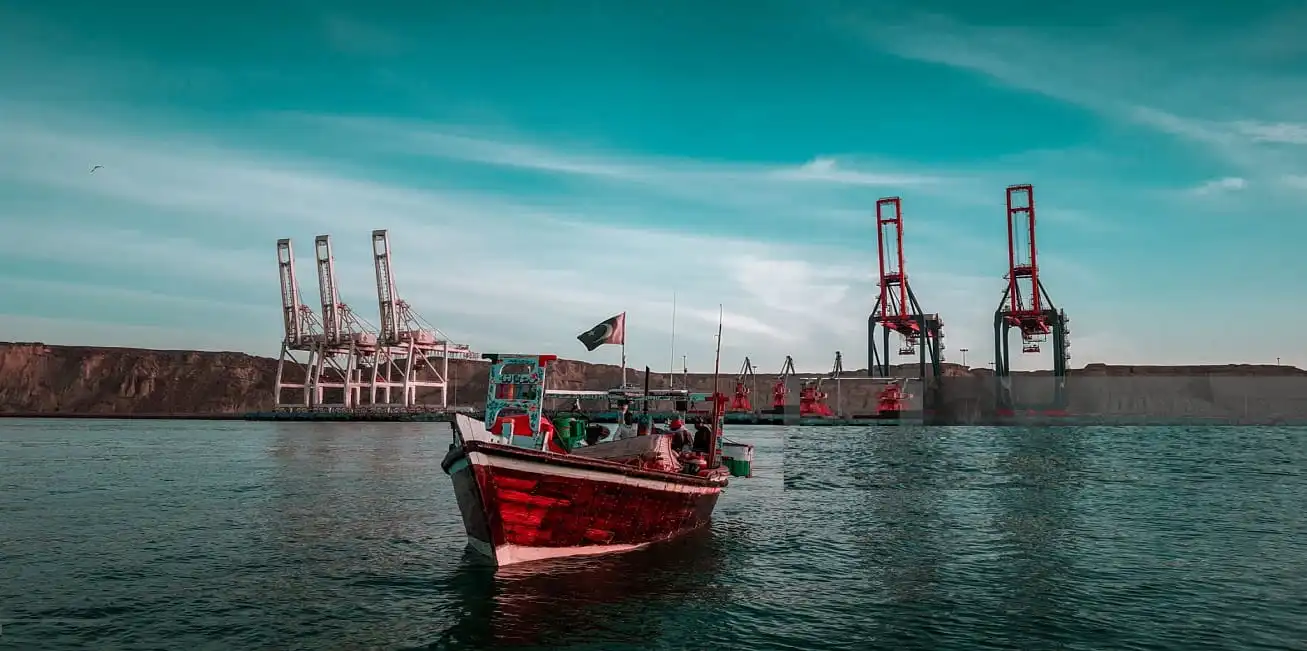
Federal Minister for Maritime Affairs Muhammad Junaid Anwar Chaudhry on Monday announced sweeping reductions in tariff rates at Gwadar Port aimed at strengthening the deep-sea facility’s position as a competitive regional logistics and transshipment hub.
Shipping & Logistics
In a statement, the minister said the revised policy is designed to significantly increase transit and international transshipment container traffic through Gwadar, attract global shipping lines, and enhance overall port activity.
“Under the revised tariff structure, berthing for container vessels and ships carrying transit or transshipment cargo have been reduced by 25 percent.
Charges on international transshipment container cargo have been slashed by 40 percent, while transit container cargo charges have been cut by 31 percent,” he said.
In a major incentive aimed at improving cargo handling efficiency, the port will also provide one month of free storage for general cargo, compared to the standard five-day allowance at other national ports.
“These incentives take effect immediately, and further adjustments will be reviewed in phases based on operational data and market response,” the minister added, noting that cargo trends, regional competition, and
sustainability considerations would guide future revisions.
He said that amid rising demand for low-cost and congestion-free shipping routes, Gwadar is well placed to capture a larger share of regional trade flows.
The revised tariff regime, he added, is expected to reduce operational costs for shipping lines, encourage new transshipment and feeder services, and increase cargo throughput.
“This initiative will stimulate economic activity in the country, generate employment opportunities, and expand Pakistan’s logistics and maritime sectors,” Junaid Chaudhry said.
Hapag-Lloyd Q1 earnings hit by freight rate slump
Hapag-Lloyd has reported weaker first-quarter results for 2026, with lower freight rates and operational disruption linked to severe weather and the blockage of the Strait of Hormuz weighing on earnings.
The carrier posted Group EBITDA of 422 million ($494 million) in Q1 2026.
Group EBIT fell to a loss of 134 million ($157 million), while Group profit declined to a loss of 219 million ($256 million).
In the liner shipping segment revenues dropped to 4.1 billion ($4.8 billion), driven primarily by a lower average freight rate of $1,330 per TEU, compared to $1,471 per TEU in the same period last year.
Transport volume reached 3.2 million TEUs, remaining broadly in line with Q1 2025 despite adverse weather conditions across Europe and North America, which disrupted terminal operations and wider supply chains. The blockage of the Strait of Hormuz also affected cargo flows during the quarter.
Liner shipping EBITDA decreased to 382 million ($447 million), while EBIT fell to a loss of 149 million ($174 million).
The group’s Terminal & Infrastructure segment recorded stronger performance, with revenues increasing to 144 million ($168 million).
Growth was supported by the full consolidation of J M Baxi’s container business for the first time, alongside higher volumes in Latin America and India.
Segment EBITDA rose to 40 million ($47 million), while EBIT totalled 15 million ($18 million).
Rolf Habben Jansen, CEO of Hapag-Lloyd AG, said: “The first quarter of 2026 was unsatisfactory for us, with weather-related supply chain disruptions and pressure on freight rates leading to significantly lower results.
“At the same time, our Gemini network has proven its resilience even under difficult conditions, helping us maintain a reliable service offering for our customers.
We will stay firmly focused on our Strategy 2030 and the next milestones for the successful completion of our merger agreement with ZIM while we maintain our rigorous cost management as we navigate the volatile market environment.”
For the full 2026 financial year, the company continues to forecast Group EBITDA between 0.9 billion and 2.6 billion ($1.1 billion to $3.1 billion), with Group EBIT expected to range from a loss of 1.3 billion to a profit of 0.4 billion (a loss of $1.5 billion to a profit of $0.5 billion).
Recently, Hapag-Lloyd and Kuehne+Nagel expanded their long-standing partnership to include emission-reduced ocean freight solutions.
Global air freight over- supply hits market
The logistics sector is entering a transitional phase as global air freight capacity oversupply in 2026 reshapes pricing and routing strategies, reported Al Copilot.
Global air cargo demand is forecast to grow at a moderate 2.6 to 2.7 percent year on year, but capacity expansion continues to outpace volume gains.
This imbalance is shifting market leverage to shippers despite geopolitical complexities.
The recovery of international passenger networks has injected belly cargo space expected to outgrow freighter capacity throughout 2026.
Consumer demand has stabilised after years of ecommerce spikes, while carriers are reallocating excess capacity from transpacific routes to Asia-Europe lanes, intensifying regional pricing pressures.
Temporary disruptions, such as Middle East airspace rerouting, have shown that localised capacity can tighten quickly and spike spot rates.
However, the broader oversupply presents opportunities for shippers to secure favourable terms.
Industry experts advise logistics professionals to use the deflationary rate environment to negotiate index-based long-term contracts.
Diversifying transport modes and securing reliable space across shifting corridors will be critical to balancing cost and speed.
Port of Keelung posts record cargo and TEU volumes
Taiwan’s Port of Keelung reported record cargo and container throughput in 2025, supported by efficiency gains and digital upgrades, reports London’s Port Technology International.
The port group, which includes Keelung, Taipei and Suao, handled 143.36 million revenue tonnes and 3.06 million TEU, with operational revenue reaching TWD$5.635 billion (US$179.31 million).
Container throughput was key driver, with Keelung’s yards processing 594,000 TEU, a 21 percent increase year on year.
Taipei Port saw ecommerce volumes expand, handling 265 million kg through sea express services.
A new handling centre at Keelung was launched to improve facility utilisation and diversify cargo streams.
Smart port initiatives advanced in 2025 included an intrusion detection system integrating AIS and AI to enhance vessel tracking and navigational safety.
Truck scale upgrades at Taipei and Suao digitised documentation, reducing waiting times and emissions.
A unified passenger and vessel information system was also introduced.
Infrastructure projects are ongoing.
Shore power installation at Keelung’s East Wharf No 4 is scheduled for completion in 2026.
Land reclamation works at Taipei Port are using recycled industrial materials to cut projected carbon emissions while expanding capacity.
Taiwan International Ports Corporation said it will continue to prioritise safety, digitalisation and decarbonisation while strengthening terminal operations.
In December 2025, the sit operator completed a major infrastructure upgrade at Keelung’s western wharves to improve reliability and resilience.
Port of Los Angeles posts second-strongest April on record
The Port of Los Angeles handled 890,861 TEUs in April, representing a 5.7 percent increase year-on-year.
The figure marked the port’s second-busiest April on record despite continued uncertainty surrounding tariffs and trade policy.
During the first four months of 2026, the port processed 3.27 million TEUS, 2 percent above its five- year average for the period but 2 percent below the elevated volumes recorded last year, when cargo owners accelerated shipments amid supply chain concerns.
Port of Los Angeles Executive Director Gene Seroka said: “April was our strongest month this year and the highest cargo volume we’ve seen since last August, a clear sign that the American consumer remains resilient.
“Retailers and manufacturers are continuing to move goods despite uncertainty, and based on what we’re seeing in Asia, the next wave of imports, from back-to-school to early holiday merchandise, is already beginning to build.”
The port reported that operations continued without major congestion issues or delays across terminals and inland transport links.
Seroka added: “That kind of fluidity and consistency speaks to the strength of this port – and the teamwork behind it.
Our longshore workforce, terminal operators, trucking companies and rail partners are keeping the Port of Los Angeles operating at a high level.”
Joining the briefing was Ambassador Katherine Tai, former U.S. Trade Representative, who discussed the current trade environment, including tariff measures, global supply chain conditions and the outlook for US trade policy.
Loaded imports totalled 459,825 TEUS in April, up 5 percent compared to the same month last year and 21 percent higher than March volumes.
Loaded exports reached 127,726 TEUs, a marginal decline of 0.5 percent year-on-year, while empty containers rose 10 percent to 303,310 TEUS.
On 24 April, the Port of Los Angeles permanently closed part of Avalon Boulevard as its advanced construction of the Avalon Pedestrian Bridge and Promenade Gateway Project in Wilmington.
China's April trade growth beats forecasts
China’s exports and imports sharply in April, outpacing expectations on strong demand for semiconductors and computing equipment linked to global Al investment, reported Caixin.
Customs data showed exports climbed 14.1 percent year-on-year in dollar terms, while imports surged 25.3 percent.
The figures beat forecasts in a Caixin survey of 12 financial institutions, which had projected average growth of 7.1 percent for exports and 16.1 percent for imports.
Growth in exports was concentrated in technology products.
High-tech shipments rose 40 percent, with integrated circuits and automatic data processing equipment up 99.6 percent and 47.3 percent, respectively.
Imports also reflected strong demand for technology.
Mechanical and electrical product imports increased 33.5 percent, while integrated circuits and automatic data processing equipment rose 54.7 percent and 90.6 percent, respectively.