
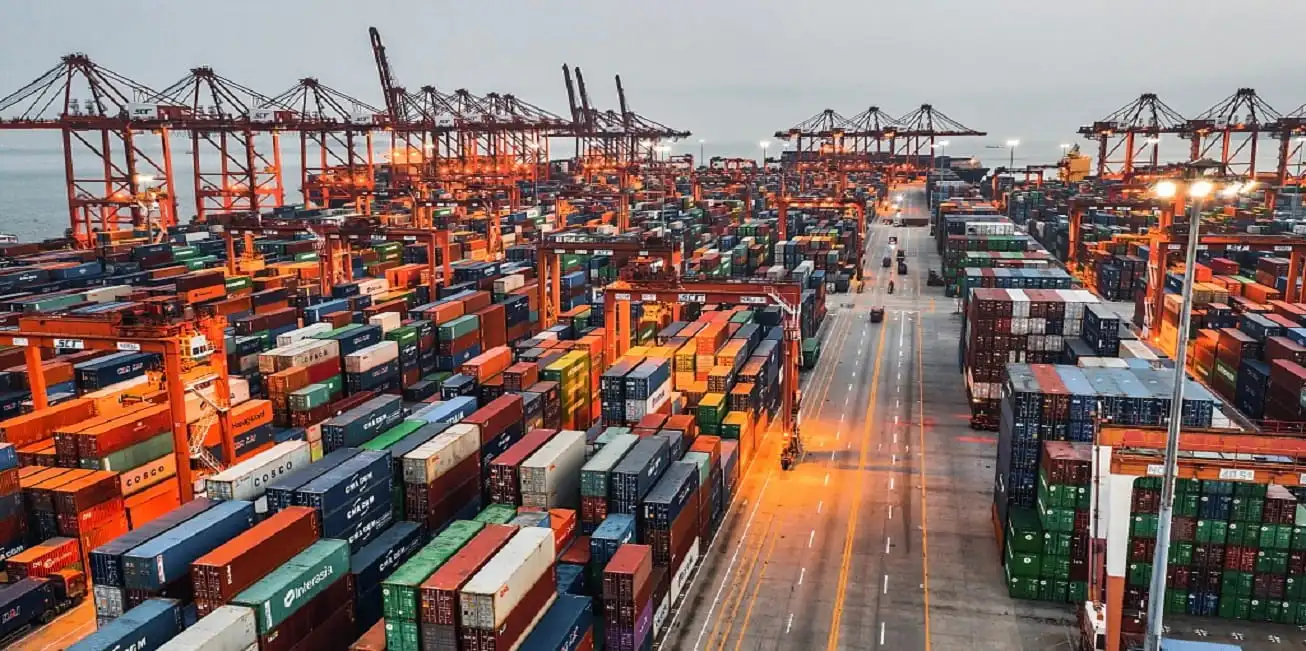
According to a statistical report compiled and published by the Japan Maritime Center based on raw data from the United Kingdom’s Container Trade Statistics, cumulative container exports from Asia to Europe reached 10.77 million TEU in the first half of 2026, representing a year-on-year increase of 12.6% and establishing a new record high for the corresponding period.
By origin, China emerged as the dominant force in Asia’s container exports to Europe.
Chinese container exports to Europe totalled 8.53 million TEU in the first half of the year, rising 14.6% year-on- year- a growth rate that outpaced the broader Asian average.
Southeast Asia contributed 1.38 million TEU in exports to Europe, while other Northeast Asian economies recorded 858,200 TEU, a modest year-on-year decline of 3.7%.
By destination, all major Asia- Europe trade lanes registered steady growth during the first half of 2026.
The Asia-North Europe lane recorded 6.54 million TEU, up 12.1% year-on-year; the Asia- Western Mediterranean lane posted 2.05 million TEU, up 14%; and the Asia-Eastern Mediterranean lane reached 2.18 million TEU, up 12.6%-affirming a broad-based recovery across all three principal trade corridors.
Import flows likewise trended positively.
Total container imports into Asia from Europe reached 3.02 million TEU in the first half of 2026, advancing 1.2% year-on- year, reflecting a sustained strengthening of two-way trade activity across the Asia-Europe corridor.
Among Europe’s origins of container exports to Asia, Northern Europe led by volume.
The region dispatched 2.00 million TEU to Asia in the first half of the year, a marginal decline of 1% year-on- year; the Western Mediterranean contributed 496,900 TEU, up 1.3%; while the Eastern Mediterranean delivered 516,200 TEU, surging 10.8% year-on-year – the standout performer among European origin regions.
In terms of the distribution of European container imports across Asian destinations, China received 1.47 million TEU, up 2.1% year-on-year, Southeast Asia absorbed 921.100 TEU, advancing 5.2%; and other Northeast Asian markets received 633,400 TEU, declining 5.8% year-on-year.
On a monthly basis, Asia’s container exports to Europe in June 2026 reached 1.90 million TEU, a year-on-year increase of 16.8% marking the eighth consecutive month of year-on-year growth and setting a new single- month record for June.
By sub lane, exports to North Europe to-Europe-service vessels also arrived in concentration, collectively discharging more than 35,000 TEUs.
Confronted with two overlapping peak surges, the Haicang Joint Operations Centre consolidated critical information across all terminals – vessel movements, berth occupancy, and yard inventory – and implemented a concurrent load-and-discharge protocol, staggering multi-vessel windows to extract maximum efficiency from a finite number of berths.
In the wake of typhoon passage, vessels converged on the port in rapid succession, driving empty container yards toward saturation and placing pressure beyond the absorption capacity of any single terminal zone. The Group responded by integrating the resources of both the Dongdu and Haicang port areas: sup-
DP World targets 2.1 million TEUS at Santos
DP World has reiterated plans to increase annual container-handling capacity at its Santos terminal to 2.1 million TEUS as it continues an investment programme at the Brazilian port.
In an update published on 8 September, the company said it is investing R$1.6 billion ($314.40 million) at Santos as part of its ongoing expansion.
DP World said annual container capacity is expected to reach 1.7 million TEUS by the end of 2026, with plans for a further increase to 2.1 million TEUS.
The R$1.6 billion investment itself is not a new announcement.
DP World approved the investment cycle in December 2025, when to increase it said the programme would increase total handling capacity by 25 percent to 2.1 million TEUs by 2028.
At the time, the company said the programme followed more than RS3 billion invested in its Brazilian operations since it began operating at Santos in 2013.
The September update was issued as DP World announced that it had joined the American Chamber of Commerce for Brazil.
Alongside its container terminal at Santos, DP World operates six logistics offices in Brazil, located in Santos, São Paulo, Campinas, Itajaí, Curitiba and Porto Alegre.
The company said these operations provide freight forwarding, contract logistics and multimodal services across Brazilian trade and industrial centres.
DP World’s Santos facility includes 1,100 metres of quay, 1,000 reefer connections and a 20,000- squaremetre rail yard.
It also has 7,000 square metres of general warehouse space, 35,000 square metres dedicated to pulp handling and 131,000 square metres designated as an expansion area.
The company said its port and logistics activities in Brazil connect inland transportation, freight forwarding and contract logistics with access to ocean shipping networks.
The ongoing Santos development is intended to expand the terminal’s container-handling capacity as DP World continues to develop its Brazilian port and logistics operations.
Xiamen Port Growth
Xiamen Port Holdings records over 25% year-on-year growth in foreign trade container volume as Haicang terminal sustains peak operations.
In August, Xiamen Port Holdings Group completed container throughput exceeding 980,000 TEUS, representing a year-on-year increase of more than 12%.
Of this total, terminals within Xiamen handled a cumulative volume surpassing 930,000 TEUS – a year-on- year growth of over 15% – while foreign trade containers reached nearly 680,000 TEUS, surging more than 25% year-on-year, a clear demonstration that export momentum continues to strengthen.
During the second half of August, the Haicang Songyu operational zone repeatedly accommodated three large container vessels berthed simultaneously, with gantry cranes in continuous motion and container trucks traversing the terminal in an unbroken rhythm-a sustained picture of full-capacity operations.
During this period, eight Maersk vessel calls were completed with precision, among them the Elly Maersk, which handled a single-vessel load and discharge of 18,800 TEUS.
Mediterranean Shipping Company’s ported by maritime, customs, border inspection, and pilotage authorities, all operational zones coordinated closely to unlock latent capacity, advancing cross-zone repositioning of empty containers and the consolidated storage of dangerous goods containers -systematically resolving yard congestion pressure point by point.
On 25 August, the 150,000- tonne vessel MSC Irenia, then awaiting berth, faced a particularly acute situation: three large vessels were simultaneously conducting berthing and departure operations within the same port zone, all available Haicang tugs had been fully deployed, and the operational window was severely constrained by both tidal deadlines and an approaching typhoon.
Under the efficient coordination of the Xiamen Seaport Integrated Dispatch and Command Centre, multiple agencies convened for joint consultation and precise scheduling.
Hong Kong Port Records Marginal 1% Year-on-Year Cargo Growth in First Half
On 3 September, the Census and Statistics Department of Hong Kong released port statistics for the second quarter of 2026 During the quarter, Hong Kong Port handled 42.3 million tonnes of cargo, representing marginal year-on-year decline of 0.2%.
For the first half of the year, cumulative cargo throughput reached 84.4 million tonnes, up 1% year-on-year – a result that masks divergent performance across transport modes, with seaborne cargo declining 2.7% and river trade cargo advancing 7.3%.
Examining the composition of inbound cargo, goods originating from Mainland China grew 10% year-on-year in the first half, emerging as the primary driver of growth.
By contrast, cargo volumes from Singapore (down 28.1%), Chile (down 19.4%), South of Korea (down 17.7%), Taiwan – (down 14.4%), and Vietnam (down 13.9%) each recorded double-digit declines, reflecting a notable structural divergence in regional cargo sources.
On the container side, Hong Kong Port processed 3.24 million TEUS in the second quarter, a year-on-year increase of 1.1%. Laden containers rose 2.5% to 2.64 million TEUS, while empty containers contracted 4.4% to 600,000 TEUS.
For the first half of the year, cumulative container throughput stood at 6.38 million TEUS, down 3.0% year-on-year, comprising 5.17 million TEUS of laden containers and 1.21 million TEUS of empty containers.
MSC to Deploy Megamax Vessels on operates Sentosa Service to Long Beach
Mediterranean Shipping Company (MSC) is revising its Sentosa service to introduce regular weekly calls by “megamax” container ships of more than 23,000 TEU at the Port of Long Beach.
The first vessel is scheduled to arrive in September 2026.
The change marks a milestone for Southern California, where regular weekly calls by ultra-large container vessels on the transpacific trade would establish a new benchmark for vessel size at one of the region’s principal gateways.
The Sentosa service links Southeast Asia with the US West Coast.
Its rotation has included port calls at Port Klang, Singapore, Laem Chabang, Vung Tau, Busan, Long Beach, and Oakland, positioning the loop as a direct connection between key Asian manufacturing hubs and the North
American market.
MSC’s decision reflects growing confidence in the Port of Long Beach’s capacity to accommodate the largest vessels afloat.
Port leadership has cited the performance of Total Terminals International, which has demonstrated its ability to handle ultra-large ships without operational disruption.
The terminal recently processed approximately 41,000 vessel lifts in a single week, according to port officials.
The deployment aligns with a wider industry trend.
Ocean carriers are increasingly concentrating megamax tonnage on transpacific routes served by ports with the berth depth, crane reach, and terminal throughput required to work vessels of this scale efficiently.
As global fleets add larger ships, gateways capable of handling them are drawing a rising share of cargo volumes.
For cargo owners, the revision carries implications for both capacity and reliability.
Larger vessels can increase available space on the Southeast Asia-US West Coast lane, though the concentration of high volumes at fewer calls places added weight on terminal productivity and inland connections. Shippers routing goods through Long Beach will monitor berth availability, discharge times. and dray and rail capacity to gauge the impact on end-to-end transit performance.
The introduction of megamax calls on the Sentosa service underscores the continuing evolution of the transpacific trade, where vessel upsizing and port readiness are increasingly shaping how cargo moves between Asia and North America.