
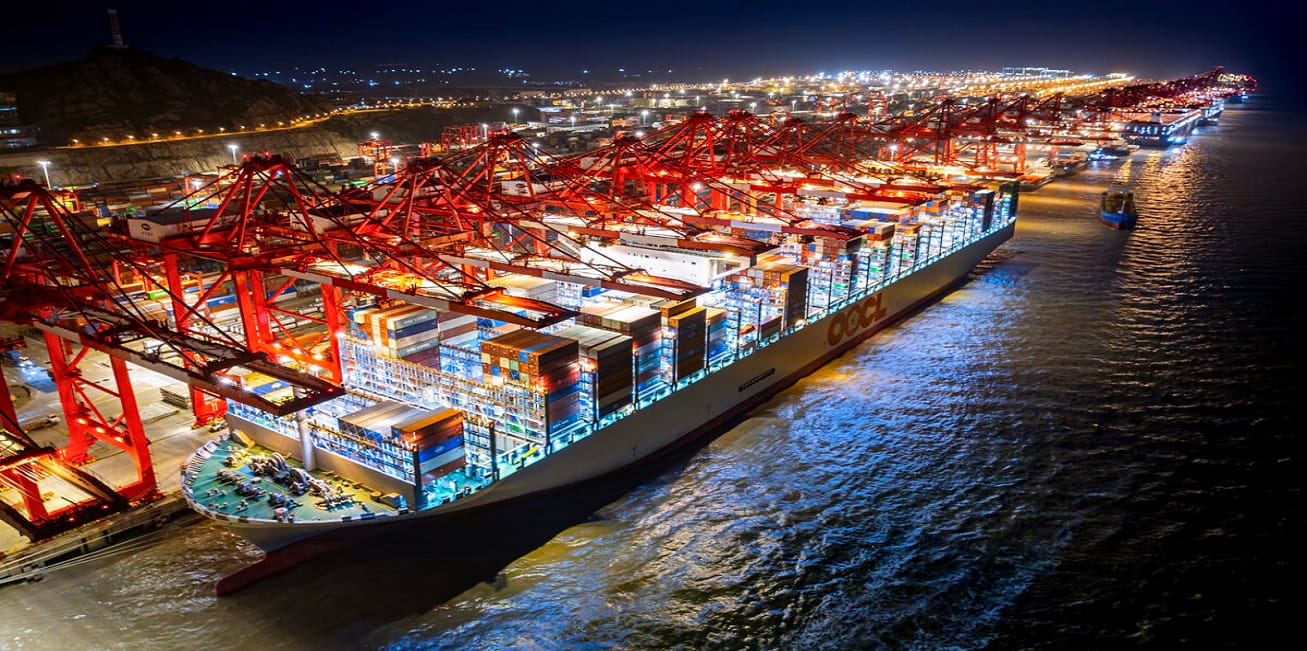
Asia-Europe container freight rates are falling as congestion at Asian ports pushes carriers to route more services back through the Suez Canal, according to Sogese’s September Europe Container Market Update.
Drewry’s World Container Index recorded the Shanghai-Genoa rate at US$4,368 per 40ft container on September 3, down 10% week on week.
The Shanghai-Rotterdam rate fell 5% over the same period to US$4,092 per 40ft container.
The market is also signaling more available capacity in the weeks ahead.
Blank sailings on the Asia-Europe route are expected to fall from four this week to one next week, a shift that typically points to loosening supply on the corridor.
For cargo owners, the movement carries a practical message: global fleet figures may no longer reflect the capacity available on a specific trade lane or at a specific port.
Rates, demand, and vessel supply are increasingly diverging route by route, raising the value of lane-level visibility for cost control and planning.
Asian port congestion has reached 4.3 million TEU, according to Linerlytica data, surpassing the 4.0 million TEU stranded at the pandemic peak.
Diversions around the Cape of Good Hope are absorbing an estimated 5% to 7% of global container capacity, roughly 1.7 to 2.4 million TEU.
MSC, Maersk and Hapag- Lloyd have each announced partial retuns to the Suez Canal in recent weeks.
Because the Suez routing shortens voyage times, it can effectively add capacity on R Asia-Europe services without deploying more vessels – a factor that helps explain the softer rates now emerging.
“The container market is becoming increasingly fragmented by trade corridor, with freight rates, cargo demand and available capacity moving in different directions across major routes,” said Andrea Monti, CEO of Sogese S.r.l. “Asia-Europe rates have started to soften from their mid-year highs while transpacific markets remain firmer, prompting carriers to adjust individual services and vessel deployments rather than manage capacity uniformly across their networks.”
Monti added that the selective resumption of Suez transits introduces another variable, since shorter voyages can lift effective capacity on the route without additional tonnage.
Recent network changes reflect this route-by-route approach.
Ocean Alliance has revised its CPNW and MTE transpacific services, removing Qingdao, Ningbo and Kwang yang from CPNW in favour of Kaohsiung and Yantian, while MTE will drop Haiphong and add Port Klang.
Maersk’s seasonal TPX service, launched in May to meet peak-season demand between Vietnam, South Korea and the US West Coast, is scheduled to end at the close of the third quarter.
The next phase of the market, Monti said, is likely to be shaped less by global supply and demand and more by how and where carriers deploy capacity and cargo.
For shippers, forwarders and importers managing cost and reliability across multiple lanes, that frag-mentation reinforces the need to track conditions corridor by corridor rather than relying on headline global figures.
Alpha liner Revives 'Gigamax-25' Concept, sees 27,500-TEU Ships Viable by the 2030s
Shipping consultancy Alpha liner has revived its cade, “Gigamax” vessel concept, forecasting that container ships of roughly 27,500 TEU could become commercially viable during the 2030s.
The projection would push past the 24,000-TEU “Megamax” ceiling that has defined the largest ships for much of the past decade, with direct implications for the freight rates, sailing schedules, and network reliability that cargo owners depend on.
In its latest weekly report, Alpha liner attributed the shift to advances in ship design, rising fuel costs, and carbon pricing mechanisms.
The firm first floated the Gigamax” idea in 2021 and says renewed market optimism at the 32nd SMM trade fair in Hamburg, Germany, has brought it back into focus.
Chinese shipyards, according to Alpha liner, have fielded fresh inquiries from major carriers about very large new buildings.
The proposed “Gigamax-25” would measure approximately 414 meters in length and 63.3 meters amid in beam, compared with about 400 meters by 61 meters for today’s largest Megamax-24 ships.
Alpha liner says the design would use a 25-row container layout and an additional cargo hold area at the bow to carry more than 27,000 TEU.
The vessel would run on a liquefied natural gas (LNG) dual- fuel propulsion system and be designed for a service speed of 18 knots or below.
According to Alpha liner, the optimized design would burn only slightly more fuel than a 20,500-TEU Megamax while carrying roughly 7,000 additional TEU-a ratio that could lower the per-container cost of moving goods on high-volume trades.
A central point in the analysis is that the larger dimensions would not necessarily require major terminal upgrades.
Alpha liner estimates that the extra 14 meters of length and 2.5 meters of beam could be accommodated at many terminals that already handle 24,000-TEU ships, drawing on existing crane reach, berth length turning basins, and fairway depth That assessment matters for ship pers and forwarders planning around port rotations, since fewer infrastructure constraints support steadier schedules.
Alpha liner named Danish carrier Maersk, currently the world’s second-largest liner operator, as the company most likely to trial the Gigamax-25.
Th consultancy noted that Maersk is the only carrier among the top eight that has never ordered a 24,000-TEU ship.
The average capacity of its 31 largest vessels is about 19,600 TEU, so a move to Gigamax-25 tonnage could lift its core fleet capacity by roughly 40 percent.
Maersk’s “Gemini Cooperation” hub-and-spoke network. which concentrates main-line services on fewer port calls, is also better suited to operating very large ships, Alpha liner said.
The firm cited Mediterranean Shipping Company (MSC) and COSCC Shipping as additional candidates Vessels of this size are not purely theoretical.
At the 2024 SMM, the Shanghai Ship Research and Design Institute (SDARI), part of China State Shipbuilding Corporation, unveiled 27,500-TEU LNG dual-fuel container ship design and received an Approval in Principle (AIP) from classification society DNV.
Maersk Imposes Emergency Freight Charge as Hormuz Crisis Deepens
A.P. Moller-Maersk has imposed a sweeping emergency freight charge on cargo moving to and from the upper Gulf, as intensifying security risks around the Strait of Hormuz force operators to reroute, store and insure shipments at added cost.
The surcharge applies to existing bookings and cargo already in transit.
Maersk has set the rate at US$1,800 per 20-foot dry container and US$3,000 per 40-foot dry container.
For reefer, special, and dangerous-goods containers, the charge rises to US$3,800.
A further US$1,000 per container applies to any vessel transiting the Strait of Hormuz a fee layered on top of charged costs for the emergency rate.
The measures reach across nearly every major upper-Gulf gateway.
Cargo loading from or destined for ports in Iraq, Kuwait, Saudi Arabia’s Dammam and Jubail, Bahrain, Qatar, the United Arab Emirates and Oman falls within scope.
Only Salalah, on Oman’s southern coast outside the strait, is excluded.
For freight forwarders coordinating multimodal moves across the region, the charges reshape cost calculations on live shipments and complicate quotes already extended to clients.
Shippers protecting cargo value and importers watching total landed cost now face a fresh variable on any consignment routed through one of the world’s most critical trade chokepoints.
Maersk said the emergency freight rate covers alternative routing to the final destination, including potential storage and additional charters.
It also covers transportation from temporary storage to the final destination once conditions allow the voyage to be completed safely.
The separate US$1,000 transit fee covers the direct risks of passing through the strait itself.
“Any vessels transiting the Strait of Hormuz will incur an additional fee of USD1000/container,” the company said in an advisory.
“The fee would cover added costs for e.g. insurance premiums and crew risk compensation and replace our separately charge costs for our current land bridge solution.
The 1000 USD fee would be on top of the Emergency Freight Rate, which covers the added costs for onward transportation to the upper Gulf.
” The company cautioned that the rate may be adjusted as the situation develops a signal to forwarders and cargo owners alike that current figures represent a moving baseline rather than a fixed ceiling.
The charges arrive amid a sharp escalation in the conflict between the United States and Iran.
On September 8, the US military said it had destroyed five Iranian oil tankers in response to missile attacks on a US Navy warship.
The following day, Iran said it had struck 10 vessels near the Strait of Hormuz – including two US- linked vessels and eight oil tankers accusing them of using unauthorized routes.
At least one seafarer was reported killed and another missing.
The exchange has pushed commercial traffic through the waterway to exceptionally low levels.
According to Reuters ship tracking data, seven vessels transited the strait on Wednesday, down from 12 the previous day and well below the 10-day average of 14. Of the seven, four exited and three entered.
Some ships may be sailing with transponders switched off and would not appear in the totals, meaning true traffic could differ from the recorded figures.
Etihad Rail, AD Ports debut direct Fujairah-ICAD route
Etihad Rail and AD Ports Group have partnered to launch a direct rail service connecting Fujairah Terminals with the Industrial City of Abu Dhabi (ICAD).
The service links Fujairah, one of the UAE’s East Coast maritime gateways on the Gulf of Oman, with Abu Dhabi’s industrial base via a dedicated rail freight route and a customs-enabled inland cargo gateway.
Cargo arriving at Fujairah can now be transported directly by rail approximately 200km to ICAD, where customs clearance, inspection and cargo release take place
ICAD has been designated its own UN LOCODE, “AECAD, registering it as a recognised international logistics location within global shipping and trade systems.
Shipping lines, freight forwarders and cargo owners can now book cargo directly to ICAD as the destination and clearance Group, point, reducing the number of handling steps between vessel ways arrival and final release.
The service is aimed at importers, exporters, manufacturers, distributors and logistics providers operating in Abu Dhabi, moving cargo closer to warehouses and production facilities rather than requiring collection from the
port.
It runs three times per week and is positioned as an alternative to long-haul trucking on the route, with implications for road congestion and carbon emissions on the corridor.
Omar Alsebeyi, Chief Executive Officer.
Etihad Rail Freight, said: “The launch of our new Fujairah-ICAD rail service represents another important step in unlocking the full potential of the UAE National Rail Network for our customers.
Through our partnership with AD Ports Group, we have created an innovative logistics solution that goes beyond transportation by bringing key port services closer to where cargo is ultimately needed.”
Saif Al Mazrouei, Chief Executive Officer, Ports Cluster, AD Ports Group, stated: “Strong trade corridors are built by connecting gateways with the industrial and commercial ecosystems they serve.
The integrated service brings together Fujairah Terminals, the UAE National Rail Network and ICAD (AECAD) as part of a more connected system, extending the reach of our port infrastructure beyond the terminal and bringing essential services closer to customers.”
The launch reflects a broader push across the UAE to strengthen multimodal freight corridors, reducing reliance on long-haul road transport while positioning inland logistics hubs as extensions of the country’s maritime gateways.
Five Carriers, Five Port Strategies, One Destination
The world’s largest container carriers have spent decades competing on fleet size.
That contest is now shifting ashore.
Maersk, MSC, Hapag-Lloyd, CMA CGM and COSCO – five operators that together move most global containerized trade – are each advancing a distinct strategy to control the ports, terminals and inland infrastructure their networks depend on.
The approaches differ in structure and capital, yet they converge on a single conclusion: terminal control is becoming the decisive competitive frontier.
For shippers, freight forwarders and importers, understanding these five models offers a clear view of where reliability and capacity will be secured in the years ahead.
Maersk: terminals inside an integrated logistics network
Maersk anchors its port strategy in an integrated logistics model, with APM Terminals supporting the group’s ocean network while linking shipping services to warehousing, rail, road transport and wider supply-chain products.
The Gemini Cooperation illustrates the design.
Maersk and Hapag-Lloyd rebuilt their east- west network around a smaller number of highly productive hubs supported by dedicated shuttle services, with the original structure comprising 58 services and more than 6,000 port-to-port combinations.
The mainline network was deliberately centered on hubs owned, controlled or closely associated with the two partners.
APM Terminals owns eight of the selected hubs, including Rotterdam Maasvlakte II, Bremerhaven, Algeciras, Tangier, Port Said, Salalah and Tanjung Pelepas.
To support Gemini, APM Terminals is increasing-capacity at the relevant hubs by 30%, a program expected to deliver around 19 kilometers of quay and more than 200 ship-to-shore cranes once complete.
Investments in equipment, processes and technology have already reduced average vessel stay times across the portfolio by 15% to 20%.
The group is also expanding in emerging markets, advancing the Lien Chieu container terminal in Da Nang, Vietnam, alongside Hateco Group – a project exceeding $1.7 billion in planned investment with annual capacity projected above 5.7 million TEU after full development.
The financial contribution is substantial.
In the second quarter of 2026. Maersk reported 55 terminals within its financial reporting perimeter, including 29 consolidated operations, and its terminals division generated EBIT of $458 million at a margin of 31.6%.
Maersk is using terminals not simply to handle boxes, but to stabilize its ocean network and connect it to a broader range of inland logistics services.
MSC keeps ocean shipping at the center of its business, yet the sheer scale of a fleet that has passed 1,000 vessels has deep-ened its dependence on efficient terminals, transshipment hubs and inland connections.
Terminal Investment Limited (TIL), the group’s dedicated terminal platform, holds positions in more than 70 container terminals, including projects under development.
Under the wider reporting boundary of MSC’s Cargo Division – which also captures terminal interests connected with Africa Global Logistics and inland specialist MEDLOG the group was operating or investing in more than 114 terminals by the end of 2025.
The Hamburg partnership shows how MSC links equity investment to future cargo commitments.
The City of Hamburg retains 50.1% of HHLA while MSC holds 49.9%, and the two shareholders have agreed to provide EUR450 million in equity to support future investment.
MSC has committed to raising cargo throughput at HHLA terminals to at least one million TEU annually from 2031, giving the operator access to long-term cargo and capital while securing MSC a deeper and position at one of Northern Europe’s most important gateways.
The logic is direct: continued fleet growth must be matched in by berth capacity, efficient transshipment and inland infrastructure, or a larger fleet produces more waiting time rather than greater – transport efficiency.
Evergreen Marine Expands IoT Reefer Fleet
Evergreen Marine show cased its smart cold chain copabiles at Asia Fruit Logistica 2026 positioning its expanded reefer feet as a bid to reduce spoilage and improve visibility for perishable cargo shippers
At the center of the company’s presentation was a fleet of roughly $8,000 refrigerated containers, all equipped with Internet of Things (IoT) technology.
According to Evergreen, each, unit transmits data in real time, allowing the carrier to monitor location, temperature, humidity, and operating status around the clock.
The company said the system issues automatic alerts when it detects temperature deviations, unauthorized door openings, or equipment malfunctions.
That capability, Evergreen argued, shifts cold chain oversight from after- the-fact inspection to real-time exception detection-a priority for cargo owners who depend on reliability and delivery commitments to protect high-value goods.
Evergreen also detailed a predictive maintenance program built on big data analytics.
By assessing the condition of reefer units through remote diagnostics, technicians can identify potential faults before they cause a break- down, the company said.
The approach aims to shift reefer management from reactive repair to proactive prevention, reducing the risk of cold chain disruption during long ocean transits.
For temperature-sensitive produce such as bananas, avocados, and grapes, the carrier promoted its Controlled Atmosphere (CA) reefer service.
The technology regulates oxygen and carbon dioxide levels inside the container to slow respiration and ripening, which Evergreen said helps cargo retain quality over long distances and can extend selling windows in more distant markets- a factor of interest to importers weighing lead times and landed costs.
Sustainability featured promnently in the company’s messaging.
Evergreen said its newer reefer containers are progressively adopting high-efficiency variable-speed compressors that adjust operation to actual cooling demand, lowering energy consumption.
The company linked reduced spoilage directly to lower food waste and associated carbon on emissions.
“A fresh produce supply chain is not merely about moving cargo from its place of origin to the market,” an Evergreen Marine representative said. “More importantly, it is about maintaining consistent product quality throughout a long ocean journey.”
Evergreen said it intends to continue integrating its global service network with smart reefer containers, controlled atmosphere e- technology, real-time monitoring, and predictive maintenance to help customers reduce cargo loss and strengthen supply chain resilience.
Asia Fruit Logistica is one of the region’s largest trade events for the fresh produce industry, drawing importers, exporters, logistics providers, and buyers from across Asia and beyond.
Maersk Confirms Order for 26 New Vessels, Marking Significant Fleet Expansion
Maersk has officially announced its order for 26 new container vessels, each with a capacity of 18,600 TEU and equipped with dual-fuel engines capable of running on liquefied natural gas (LNG).
Scheduled for delivery between 2029 and 2030, this marks Maersk’s largest fleet expansion in recent years.
While the contract details, including the shipyards and total value, remain undisclosed, this move represents a shift from Maersk’s traditional focus on fleet renewal to active capacity growth.
The combined capacity of these vessels will reach approximately 484,000 TEU, surpassing the company’s original Triple-E programme, which introduced 20 vessels with a total capacity of 360,000 TEU in 2011.
Maersk currently operates around 730 ships with a combined capacity of 4.73 million TEU.
The new vessels will align with Maersk’s energy transition goals while significantly boosting its deployable capacity.
Notably, it remains unclear whether this order includes the eight 18,600 TEU vessels Maersk announced earlier this year from New Times Shipbuilding.
This decision reflects a broader strategic shift.
After years of restrained newbuilding activity, Maersk’s leadership has emphasized the need for additional tonnage to address market volatility and future growth.
CEO Vincent Clerc has highlighted the importance of expanding capacity to manage fluctuating demand and avoid supply shortages.
By unifying the order with dual-fuel technology, Maersk reinforces its commitment to fleet modernization and sustainability while preparing for long-term capacity needs.
Deployment of these vessels is expected to focus on Asia-Europe trade lanes, where Maersk’s existing Triple-E series already operates.
However, the new capacity will allow Maersk to reallocate vessels across its network, including Asia-North America routes, facilitated by its Gemini partnership with Hapag-Lloyd.
This flexibility positions Maersk to adapt to shifting market conditions.
Though the vessels won’t enter service until 2029, this order signals increasing competition among major carriers amid ongoing market volatility.
Elevated newbuilding activity worldwide raises the risk of overcapacity if supply growth outpaces demand, potentially pressuring freight rates and increasing idle capacity.
Maersk’s investment signals a long-term structural shift in its fleet strategy, balancing renewal with aggressive growth to address global supply chain challenges and future demand fluctuations.
This order sets the stage for significant changes in the company’s network and market positioning in the years ahead.