
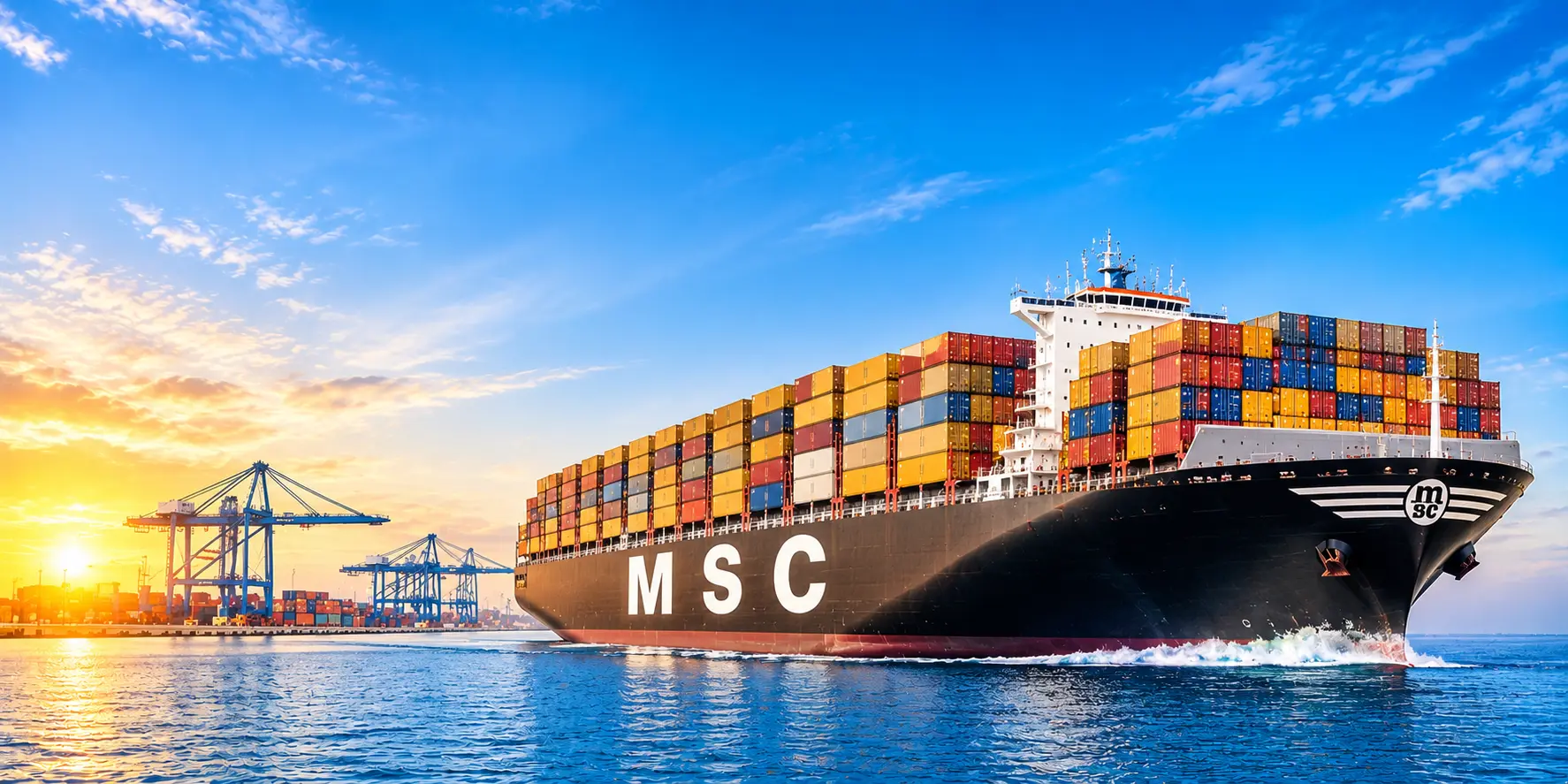
Mediterranean Shipping Company has announced the introduction of the Jasmine service, a new standalone liner offering operated independently by MSC.
The service is designed to strengthen connectivity between China, Singapore, and Indonesia, providing direct and expedited transport options between East China, South China, and Southeast Asia.
Through a port rotation encompassing Shanghai, Ningbo, Shekou, Singapore, Surabaya, and Semarang, the Jasmine service establishes a structured transport corridor linking China’s principal export gateways with Indonesia’s key ports, reducing intermediate transhipment requirements and enhancing regional connectivity.
According to information released by MSC, the inaugural voyage of the Jasmine service will be performed by the vessel MSC WIND II under voyage number HF645A, with an expected arrival in Shanghai on 4 November.
The full port rotation is as follows: Shanghai-Ningbo Shekou – Singapore – Surabaya – Semarang -Singapore-Shanghai.
This rotation indicates that, following calls at East and South China ports on the outbound leg, the service transits Singapore before proceeding to Surabaya and Semarang in Indonesia, then returns via Singapore to Shanghai, completing a closed-loop operation.
From a market perspective, trade activity between China and Southeast Asia has remained robust in recent years.
Indonesia, as a major Southeast Asian economy, continues to sustain growing seaborne demand for electrical and mechanical goods, daily consumer products, and industrial intermediate goods.
MSC’s deployment of a dedicated direct service on the China-Indonesia corridor stands to expand booking options for freight forwarders operating from East and South China origin ports, while also introducing new transhipment routing combinations via Singapore.
For exporters serving the Surabaya, Semarang, and surrounding Indonesian markets, a direct service reduces the length of the transport chain; however, actual transit performance will require assessment against post-inauguration schedules, cargo cut-off times, and destination port operational efficiency.
Shippers and freight forwarders with relevant cargo interests are advised to monitor the inaugural sailing schedule, available capacity, and booking cut-off requirements for the Jasmine service, verifying origin ports, destination ports, and port rotation on a shipment-by-shipment basis, and evaluating the service’s suitability against their delivery timelines.
T.S. Lines Revenue Climbs 17.2% in First Three Quarters
T.S. Lines has released unaudited operating data for the first three quarters of 2026, revealing revenue of approximately USD 1.13 billion – a year-on-year increase of 17.2%.
Key operating metrics showed a divergence between volume and rate performance: carried volume for the period reached 1.181 million TEU, a decrease of 4.1% year on year, while the average revenue
per TEU rose to USD 956, up approximately 22.1% from USD 782 in the prior-year period.
Revenue growth was primarily driven by the and part of the improvement in per-box rates, with the drag from lower volumes fully offset by the upward movement in freight pricing.
T.S. Lines sustained double digit revenue growth through the first three quarters despite a modest year-on-year decline in carried volume, a result that reflects the company’s strengthened earnings sensitivity in an environment of improving rate levels.
The approximately 22.1% year-on-year increase in average revenue per TEU served as the primary support for top-line performance.
For regional liner operators, shifts in the combination of volume and rate are typically linked to route composition, cargo base distribution, and supply-demand adjustments across served markets.
Against a backdrop of elevated rate benchmarks, carriers are positioned to maintain revenue and earnings stability through periods of volume fluctuation by optimising route deployment and capacity allocation.
According to the latest Alpha liner data, T.S. Lines ranks 20th among the top 100 container shipping companies by capacity globally, operating a fleet of 46 container vessels comprising 37 owned ships and 9 chartered vessels, with total capacity of 129,100 TEU.
The carrier’s relatively high proportion of owner-operated tonnage strengthens its ability to manage capacity costs through charter market cycles and enhances the flexibility of fleet deployment.
T.S. Lines additionally holds an orderbook of 16 newbuilding vessels totalling 68,484 TEU – equivalent to approximately 53% of current deployed capacity – establishing a meaningful capacity reserve to support future route expansion and fleet renewal.
From the perspective of freight forwarders and international logistics practitioners, the first-three-quarter performance profile of T.S. Lines characterised by revenue growth, volume moderation, and rate improvement reflects the structural shifts underway in regional liner markets as freight pricing recovers.
Ongoing attention is warranted with respect to newbuilding delivery schedules, route deployment adjustments, and the impact of rate movements on available capacity.
Practitioners engaged in booking and partnership planning are advised to verify pricing and space arrangements against specific routes, vessel schedules, and container types, while continuing to monitor the carrier’s capacity deployment and route optimisation activities in order to assess developments in transportation cost and service reliability.
Guangzhou Port Reports Q3 Net Profit Growth Despite Revenue Decline
Guangzhou Port Company Limited announced its Q3 2026 results, highlighting a net profit rise of 20.67% year-on-year to RMB 237 million, despite a revenue drop of 24.62% to RMB 3.206 billion.
This divergence reflects improved business efficiency and earnings quality.
For the first nine months, cumulative revenue stood at RMB 9.770 billion, down 12.47%, while net profit grew 5.98% to RMB 793 million.
Operationally, Container throughput for the first three quarters rose 4.8% year-on-year to 21.074 million TEUs, while total cargo throughput grew 3.8% to 447.91 million tonnes.
The faster growth in container volumes highlights the port’s ongoing cargo optimisation, with containers playing a key role in boosting overall productivity.
This resilience in shipping demand reinforces stable export pathways, though operational efficiency and space availability depend on specific routes and schedules.
Guangzhou Port is deepening partnerships to enhance its role in the Guangdong-Hong Kong- Macao Greater Bay Area’s international shipping hub.
Recent initiatives include advancements in multimodal transport, automotive logistics, and clean energy bunkering.
- Multimodal Transport: A The strategic partnership with Minsheng Shipping, China Rail way Intermodal, and PSA International aims to build the Chongqing/Chengdu-Guangzhou Port sea-rail intermodal corridor.
This network will strengthen connections between South and Southwest China, the Yangtze River Economic Belt, and global markets, offering a more stable export route for inland cargo
- Automotive Export Services: Guangzhou Port and Sinotrans South China have launched a joint venture to optimise automotive supply chain services.
With growing exports of new energy vehicles, this platform will enhance efficiency across vehicle consolidation, customs clearance, vessel loading, and delivery.
- Clean Energy Bunkering: In partnership with CNOOC Guangdong Marine Clean Energy, Guangzhou Port is advancing green shipping fuel bunkering.
This initiative supports the port’s low-carbon transition and competitiveness in the decarbonising global shipping industry.
Cargo Throughput at Hai Phong Seaport Surges Over 12% in First 10 Months of 2026
Hai Phong’s seaport system handled 182.4 million tons of cargo in the first 10 months of 2026.
That is a 12.11% increase over the same period last year.
The volume represents 76.6% of the annual plan, which gives the city’s port services a strong foundation as they enter the critical final stretch of the year.
The result reflects a clear recovery in import and export activity and in maritime trade across the northern gateway.
Ship reception and cargo handling capacity at key ports have continued to improve.
Port operators attribute these gains to optimized service processes and wider use of technology in warehouse and infrastructure management.
A stable flow of goods through the northern sea gateway keeps port operations on schedule and strengthens Hai Phong’s, appeal to major international shipping routes.
Freight forwarders, shippers and importers moving goods through northern Vietnam stand to benefit from these gains.
Steadier throughput and faster vessel handling support more dependable planning across the supply chain.
Hai Phong Port Joint Stock Company remains a key operator in the regional port system.
It continues to play a central role in sustaining operations and driving overall growth.
Mr. Le Hong Quan, General Director of Hai Phong Port Joint Stock Company, said the logistics market now demands ever-higher speed and service quality.
To increase output and strengthen competitiveness, the company is focusing on three priorities: Modernizing its management and operational systems, digitizing the cargo handling process through ePort and Smart Gate, and applying technology to manage berths, container yards, and equipment coordination
These steps position the company to deliver faster, more accurate service to the logistics partners and cargo owners who rely on the port every day.
At berths 3 and 4 in the Lach Huyen port area, HTIT Port is implementing a modern container handling management system.
The system is being rolled out together with upgrades to infrastructure, equipment, processes, and human resources.
The goal is a smart port model that meets international standards.
OOCL launch new China Indonesia Service (CIS4) to strengthens Trade Links Between North and South China and Indonesia
OOCL announced the launch of its new China Indonesia Service (CIS4).
The service strengthens connectivity between North and South China and Indonesia.
CIS4 will begin operations on November 22, 2026, providing direct connections between Qingdao, Shanghai, Nansha, Jakarta, and Surabaya.
Headquartered in Hong Kong and part of the COSCO SHIPPING group, OOCL has served international trade for more than five decades.
CIS4 extends that legacy into one of Asia’s most active trade corridors.
It gives cargo owners a dedicated route linking major Chinese manufacturing and export hubs with Indonesia’s two leading commercial centers.
The CIS4 service will operate on the following rotation:
Qingdao-Shanghai – Nansha -Jakarta – Surabaya – Singapore – Qingdao
The rotation combines three Chinese gateways, two Indonesian destinations, and a call at Singapore on the return leg.
Qingdao serves northern China. Shanghai anchors the Yangtze River Delta, and Nansha serves the Pearl River Delta in southern China.
In Indonesia, Jakarta and Surabaya serve as the primary commercial and industrial gate ways for Java, the country’s most populous island.
CIS4 is designed to improve flexibility, connectivity, and service reliability for cargo moving between China and Indonesia.
Direct port pairings help shippers reduce dependence on transshipment for these lanes.
This lowers the number of handling points cargo passes through between origin and destination.
The launch reflects OOCL’s continued investment in intra- Asia trade.
With CIS4, the company reinforces its commitment to providing dependable, direct ocean connections that help customers protect supply chain continuity and meet delivery commitments.
CIS4 is not simply a new rotation.
It is a deliberate step to strengthen the links between two of Asia’s most important trading economies.
Hapag-Lloyd Announces Sailing Omissions on Atlantic Loop Services AL1, AL2, AL3 and AL6
Hapag-Lloyd has announced upcoming sailing omissions affecting four Atlantic Loop services: ALI, AL2, AL3, and AL6.
The adjustments are scheduled for December 2026 and January 2027.
The company has advised customers that the changes may affect both cargo planning and transit times.
The Atlantic Loop services connect Europe and North America and form a central part of Hapag- Lloyd’s transatlantic offering.
In its customer advisory, the carrier confirmed the omissions will occur across all four named loops during the two-month window spanning the year-end period.
Hapag-Lloyd has not positioned the announcement as a reduction in its transatlantic commitment.
Instead, it has framed the update as advance notice, giving customers time to adjust their supply chains before the affected sailings occur.
Blank sailings around the year-end holiday period are a familiar feature of liner scheduling, and early communication remains one of the most effective ways for carriers and shippers to limit disruption.
The company stated that the omissions may affect cargo planning and transit times on the affected services.
When a scheduled call is removed, cargo booked for that departure typically needs to move to an earlier or later vessel.
This can change cargo cut- off dates, arrival windows and inland connections.
For shippers, consignees and freight forwarders moving goods between Europe and North America, the timing deserves particular attention.
December and January cover year-end inventory cycles, holiday-period port operations, and the run-up to early-year production schedules in many industries.