
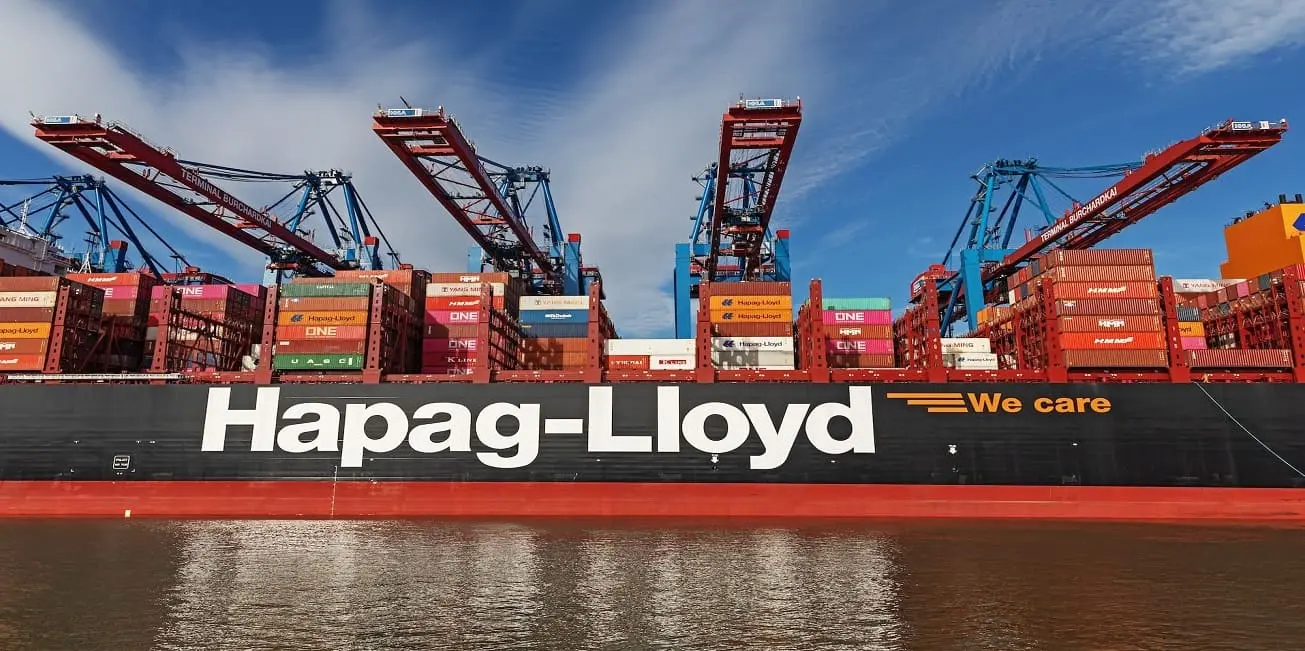
Hapag-Lloyd has signed a contract with Chinese shipyard CIMC Raffles to build eight 4,500 TEU dual-fuel methanol container ships, reported London’s Logistics Manager.
The US$500 million investment marks the carrier’s first methanol-powered newbuild order. with deliveries due between 2028 and 2029.
The vessels are designed to be 30 percent more efficient than current ships of similar size.
Operating on green methanol, they are expected to cut annual emissions by 350,000 tonnes of CO2, advancing
Hapag-Lloyd’s Strategy 2030 climate goals.
The order strengthens the company’s multi-fuel fleet strategy, which already includes 37 dual-fuel LNG vessels.
Supporting measures include a retrofit programme with Seaspan to convert five 10,100 TEU ships by 2027, and a supply deal with Goldwind securing 250,000 tonnes of green methanol annually.
Hapag-Lloyd will also charter 14 feeder vessels ranging from 1,800 to 4.500 TEU to modernise regional networks.
chief executive Rolf Habben Jansen said the investment in sub-5,000-TEU ships will replace ageing tonnage and help achieve a one-third cut in greenhouse gas emissions by 2030.
The new ships will be integrated into the Gemini Cooperation hub-and-spoke network, offering customers more sustainable “Ship Green” options.
The company aims to reach net-zero fleet operations by 2045, five years ahead of the wider industry target.
Meat export to China jumps 177% in 2025
Pakistan’s exports of boiled meat to China surged 177 percent year on year in export value in 2025, according to data released by China’s General Administration of Customs (GACC), highlighting a sharp expansion in bilateral agrifood trade and China’s growing appetite for diversified, halal-certified protein products.
Pakistan travel guide Chinese customs data shows that Pakistan shipped 2.38 million kilograms of boiled beef under HS code 16025090, with exports valued at $14.52 million.
Exporters said the sharp rise reflects improved market access for Pakistani meat processors, stronger compliance with Chinese sanitary and halal standards, and rising demand across China’s major consumption centres, Gwadar Pro reported on Saturday.
Within China, the top destinations were primarily economically advanced, high-consumption regions.
Jiangsu Province emerged as the largest market for Pakistani meat products, importing nearly 1.0 million kilograms worth $5.08 million.
It was followed by Zhejiang Province, which imported 458,595 kilograms valued at $3.66 million, and Tianjin, with 510,520 kilograms worth $3.50 million.
Significant volumes also entered Guangdong Province, China’s largest consumer market, along with smaller but growing shipments to Xinjiang, Shandong, Hainan and Hunan.
On average, Pakistan’s meat exports to China were priced at approximately $6.1 per kilogram, positioning the country competitively while supplying value-added products rather than low-margin raw meat.
Industry analysts said this price- quality balance has made Pakistani products attractive to Chinese importers serving food processing, catering and retail segments.
Experts attribute the rapid increase to multiple factors.
Chinese consumers are increasingly shifting toward ready-to- cook and processed meat products, while Pakistan has expanded the number of export approved slaughterhouses and processing facilities that meet Chinese regulatory requirements.
Improvements in cold- chain logistics, smoother customs procedures and the use of bonded trade channels-particularly through Hainan-have also reduced delivery time and costs.
Compared with other suppliers. Mongolia remained China’s largest import source of prepared bovine meat in this category, shipping 4.37 million kilograms valued at $18.53 million, largely benefiting from geographic proximity and border trade with Inner Mongolia. Groceries
By contrast, the United States exported only 18,099 kilograms worth $68,033, reflecting a different market focus and product mix.
Industry observers noted that Pakistan has substantial room to further expand its foot- print in the Chinese market.
Moving up the value chain through seasoned and portioned products, investing in cold-chain infrastructure, strengthening branding partnerships with Chinese distributors, and accelerating certification of additional processing plants could significantly boost exports in the coming years.
Abdullah, a Pakistani meat exporter to China, said demand is rising across China’s coastal and inland provinces alike.
Pakistan’s 2025 performance, he added, signals a structural shift toward more stable, large-scale meat exports to China, reinforcing the growing depth of economic cooperation between the two countries.
China foreign trade hits record US$6.5 trillion
China’s foreign trade reached a record RMB45.5 trillion (US$6.5 trillion) in 2025, reported Caixin.
Growth was driven by mechanical and electrical exports, which for the first time accounted for more than 60 percent of outbound shipments.
Customs figures showed combined imports and exports rose 3.8 percent last year, marking nine straight years of expansion.
Exports of mechanical and electrical goods increased 9 percent, highlighting China’s move toward higher-value manufacturing despite external pressures.
In dollar terms, mechanical and electrical exports totaled US$2.3 trillion in 2025, while any imports stood at $1.03 trillion.
That produced a $1.27 trillion surplus, exceeding China’s overall trade surplus of $1.19 trillion.
Products included automobiles, integrated circuits, ships and other advanced goods.
Panama port traffic rises 3.6pc in '25
Panama’s container traffic grew 3.6 percent in 2025 to 9.9 million TEU, the Maritime Authority said.
The country’s ports feed into the Panama Canal, a vital link between the Pacific and Atlantic oceans, reports Melbourne’s Baird Maritime.
The SSA Marine Manzanillo International Terminal on the Atlantic coast handled 2.9 million TEU, up five percent from 2024.
Panama Ports Company’s Balboa terminal moved 2.7 million TEU, a two percent rise, while its Cristobal terminal saw traffic climb nine percent to 1.2 million TEU.
Colon Container Terminal posted the largest increase, handling 1.7 million TEU, a 10 percent jump compared to 2024.
Panama International Terminal was the only facility to record a decline, moving 1.4 million TEU, down two percent.
“We also saw an increase in the repositioning of empty containers, which reaffirms the importance of the Panamanian hub as a strategic point for redistribution of equipment in the region,” said
Max Florez, general director of ports and auxiliary maritime industries.
DP World Callao tops 2 million TEU
Peru’s Port of Callao has become the first terminal on South America’s west coast to handle more than two million TEU in a single year, reports London’s Port Technology International.
The milestone marks a 22 percent rise from 2023, underscoring the impact of the Bicentennial Pier expansion by DP World.
Apoyo Consultoria estimated the South Pier terminal contributed more than US$316 million to Peru’s GDP and generated $23.6 billion in economic activity in 2024.
The achievement was celebrated at an event attended by senior officials and industry leaders, who stressed the importance of private investment in logistics.
The Bicentennial Pier, a $400 million project, boosted capacity by 80 percent, enabling the port to serve larger vessels and reduce congestion.
The upgrade has positioned Callao to meet rising trade demand while improving service reliability for shippers.
Carlos Merino, CEO of DP World in Colombia, Ecuador and Peru, noted that a decade ago two million TEU equaled the combined throughput of all Peruvian ports.
He said the single-terminal achievement reflects how strategic investment in modern port infrastructure can transform national trade capacity and strengthen global supply chain links.
Maersk resumes Red Sea shipping
Global air cargo demand climbed 5.5 percent in November 2025, driven by emerging market strength and peak season activity despite uneven regional performance, reports London’s Air Cargo News
IATA said Africa led growth with a 15.6 percent increase, while Asia Pacific rose 10.3 percent on ecommerce and intra-regional trade.
Middle Eastern carriers expanded volumes by 7.4 percent, and European airlines grew 5.8 percent.
The Americas remained weak.
Capacity rose 4.7 percent year on year, lifting cargo load factor to 49.1 percent.
IATA said the expansion reflected strategic fleet deployments across major markets.
Jet fuel prices gained 5.9 percent, marking a third monthly rise.
Cargo yields fell 2.9 percent year on year but jumped 8.2 percent month on month, the strongest increase since December 2021.
Global goods trade grew 3.2 percent in October, while manufacturing sentiment strengthened in November with PMI at 51.17. New export orders edged up to 49.87 but stayed below the expansion threshold.
IATA director general Willie Walsh said strong emerging market demand and selective Middle Eastern growth offset softness in the Americas.
He added the resilient fourth quarter bodes well for the industry entering 2026.
Yang Ming targets 30pc fleet growth by 2030
AP Moller-Maersk has resumed transits through the Suez Canal and Red Sea following improved stability after the Gaza ceasefire, reports London’s Financial Times.
The company said it would implement its first structural return to the trans-Suez route for its MECL service linking the Middle East and India to the US east coast.
Container shipping groups have been weighing a return since Yemen’s Houthi forces signalled in November they would halt attacks on vessels.
CMA CGM earlier this month resumed transits on its India America Express service.
A wider reopening of the corridor would end more than two years of disruption, cutting Asia-Europe transit times by up to two weeks and reducing the number of vessels needed, lowering freight rates.
Xeneta analyst Peter Sand a full-scale return could leave 6-8 percent of the global container fleet surplus, shifting market balance against carriers.
Maersk’s share price fell four percent after the announcement.
The company said it would only return fully if conditions were safe, noting one of its ships had successfully transited the Bab elMandeb Strait.
Jon Gahagan of Sedna Global said the ceasefire made it natural for Maersk to resume Red Sea operations, though the Houthi threat remains.
Analysts cautioned the Middle East situation is volatile, with concerns heightened after US President Donald Trump raised fears of possible military action in Iran.