
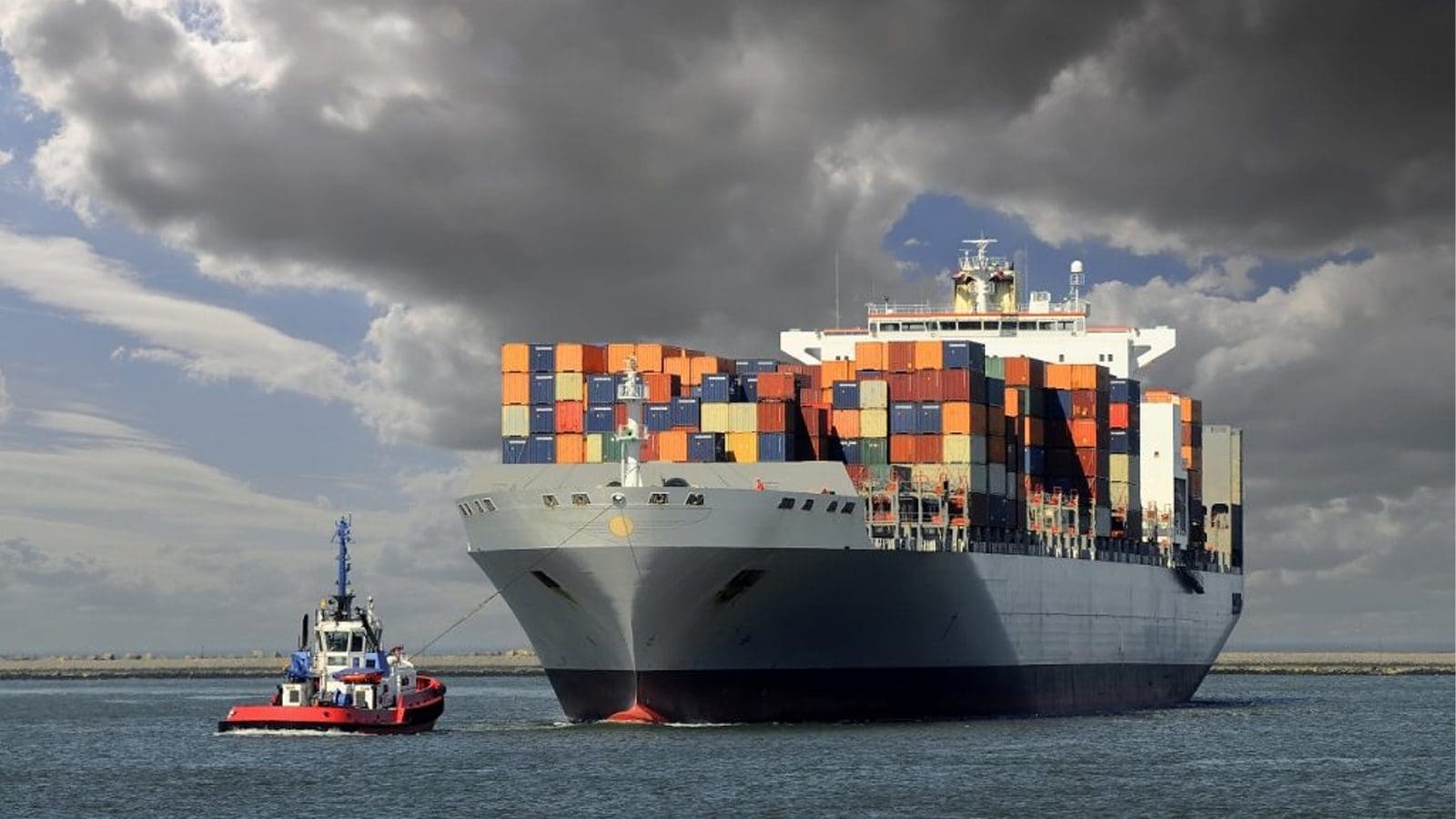
Box shipping overcapacity crisis Saved by Red Sea diversions
Sea-Intelligence’s latest Global Liner Performance (GLP) report has revealed that schedule reliability remained consistent year-over- year (YoY) in January 2025 at 51.5 per cent.
Schedule reliability in the global shipping industry remained steady throughout 2024, consistently within the 50-55 per cent range.
However, on a monthly-over- month (MoM) basis, schedule re- liability dropped by 2.1 percent- age points, while the average delay for late vessel arrivals decreased by 0.001 days to 5.32 days.
The January 2025 figure YoY was 0.85 days lower.
Maersk was the most reliable top-13 carrier in January 2025 with schedule reliability of 55 per cent, followed by another 6 carriers with schedule reliability over 50 percent.
The remaining 6 top-13 carriers were within 46-50 per cent, with Yang Ming and OOCL at the bottom with 46.6 per cent.
In January 2025, the difference between the most and least reliable carriers dropped to under 8.5 percentage points – the smallest difference since March 2017 ac- cording to Sea-Intelligence.
Only four of the top 13 carriers recorded MoM improvements, with Wan Hai recording the largest increase of 3.7 percentage points.
Seven carriers recorded an improvement on a YoY level, with Maersk recording the biggest improvement of 10.9 percentage points.
Late last year, Sea-Intelligence revealed that vessel bunching in- creased considerably at ports and terminals following the pandemic, partially due to the Red Sea crisis.
ONE enhances WA1 and SW2 services
Ocean Network Express (ONE) has announced the expansion of its WAI and SW2 services to include extra frequency for Onne and Lekki port calls
According to ONE, the new rotation will take effect as follows:
WA1Cotonou call to be shifted to SW2 and add call Onne: Current: Shanghai -> Ningbo -> Nansha Singapore -> Port Kelang -> Apapa-> Tincan ->. Cotonou -> Tema -> Lome -> Port Kelang -> Singapore -> Shanghai New: Shanghai -> Ningbo -> Nansha. Singapore > Port Kelang -> Apapa-> Tincan -> Onne > Tema -> Lome > Port Kelang->Singapore -> Shanghai With effective from: SEASMILE (SSMT) v.0509W (Proforma ETA Shanghai 03 March 2025)
SW2 -Lekki & Cotonou (Weekly call); Onne call to be shifted to WAI:
Current: Qingdao -> Shanghai ->Ningbo -> Xiamen -> Nansha -> Singapore -> Abidjan -> Tema -> Apapa-> Lekki/Onne-> Abidjan – > Singapore -> Qingdao New (weekly Lekki and Cotonou call): Qingdao-> Shanghai -> Ningbo -> Xiamen -> Nansha-> Singapore -> Abidjan – Tema -> Apapa -> Lekki> Cotonou -> Abidjan -> Singapore > -> Qingdao
With effective from: SPAR- ROW (SPWT) v.0509W (Proforma ETA Qingdao 01 March 2025)
Global Shipping Business Network (GSBN) is working closely with ONE to adopt the Digital Container Shipping Association’s (DCSA) eBL standard.
DP World Posorja joins Portchain Connect Network
The Deep-Water Port in Posorja, operated by DP World, has implemented Port chain Connect to simplify the berth alignment process with shipping lines.
The Deep-Water Port in Posorja will use Portchain Connect to increase the quality and speed
of its berth alignment with customers through digital handshakes and secure data sharing.
Port chain aims to simplify DP World Posorja’s communication channels and improve overall berth alignment.
Portchain Connect reportedly enables the Port of Posorja to receive real-time schedule and move count updates directly from carrier systems. It allows them to respond and counter-propose quickly, to align the vessel schedule with the terminal berth plan.
Carlos Merino, CEO of DP World Ecuador, Peru & Colombia, said: “Portchain’s commitment to data collaboration aligns perfectly with our goal to improve overall supply chain visibility, ensuring everyone involved can make in- formed decisions.”
Earlier this month, DP World invested £60 million ($75.6 million) in the UK’s trade capacity by ordering four new quay cranes for its Southampton container terminal.
Europe up Exports to 10pc to 5.3bn
ISLAMABAD: Exports to European countries grew 9.86 per cent in the first seven months of the current fiscal year from a year ago mainly due to higher shipments to western states.
In absolute terms, Pakistan’s exports to the European Union (EU) reached $5.345 billion in July- January FY25 from $4.865bn last year, according to data compiled by the State Bank of Pakistan.
The export resurgence was due to a slight increase in demand for Pakistani goods in western, east- ern and northern Europe. In FY24, Pakistan’s exports to the EU dipped 3.12pc to $8.240bn despite in its GSP+ status, which allows duty-free entry into most European markets.
In October 2023, the European Parliament unanimously voted to extend the GSP+ status for another four years until 2027 for develop- ing countries, including Pakistan, to enjoy duty-free or minimum duty on European exports.
Western Europe, which includes countries such as Germany Netherlands, France, Italy, and Belgium, accounts for the largest portion of Pakistan’s exports to the EU. The exprts to this region increased by 12.72pc to $2.702bn in 7MFY25, up from $2.397bn 7MFY24
There is also a slight increase in exports to eastern and northern Europe. The exports to the north of Europe saw a rise of 17.10pc to $428.64m in 7MFY25, up from $366.03m in the corresponding months last year.
Exports to southern Europe saw a paltry growth of 2.58pc to $1.788bn in 7MFY25 from $1.743bn, in the corresponding period last the year. In this region, exports to Spain record a paltry growth of 0.5pc to $857.02m in 7MFY25 from – $856.52m in the preceding year.
PIL takes delivery of third 14,000 TEU dual-fuel box ship
SINGAPORE-HEADQUARTERED Pacific International Lines. (PIL) has taken delivery of its third of four 14,000 TEU containerships in its fleet designed to run on LNG and constructed by Jiangnan Shipyard in China.
“We are thrilled to welcome Kota Ebony, our third 14K vessel to our fleet. These efficient dual- fuel vessels enable us to further bolster our services and support the growing trade between China and Latin America,” said Lars Kastrup, CEO of PIL.
“The first two sister ships, Kota Eagle and Kota Emerald, were delivered in October and December last year, and are already operating successfully on our Latin America service network. We are now proud to add Kota Ebony to reinforce the East Coast Latin America service.”
The fourth 14,000 TEU vessel is expected in the coming months and will be joined by another 14 dual-fuel, biomethane-capable vessels which will be delivered progressively over 2025 and the subsequent years.
“This significant investment represents PIL’s ongoing efforts at fleet renewal as well as our unwavering commitment to making ship- ping more environmentally sustainable as we chart our way to achieve net zero emissions by 2050,” Mr Kastrup said.
The 14,000 TEU LNG dual-fuel ships are equipped with GTT’s Mark III LNG containment system and feature a high container intake as well as various energy-saving technologies such as hull coatings, an optimized hull form, and variable frequency drive motors.
Salalah port expansion sees capacity increase from 4.5m to 6.5m TEU
THE APM Terminals-operated Port of Salalah has completed a US$300 million expansion project, doubling its container handling capacity.
The investment has increased the port’s capacity from 4.5 million to 6.5 million TEU, according to APM Terminals’ release. The project included upgrades to all six existing berths, an expansion of the container yard, and the acqui- sition of new equipment.
The expansion is designed to support the port’s role as a key hub in the Gemini network, a collaboration between AP Moller-Maersk and Hapag-Lloyd, reports St Petersburg Port News.
The first Gemini vessel arrived at Salalah on February 18
New equipment includes 10 Ship-to-Shore (STS) cranes capable of handling ultra-large container vessels, 12 hybrid rubber- tyred gantry (RTG) cranes, reach stackers, empty container handlers, and terminal trucks. The project also included a new access road, a new electrical power substation, electrical network upgrades, and a reefer expansion of 2,000 plugs
Port of Colombo witnesses a shaky start in 2025
THE Port of Colombo reported a shaky start to the new year as transshipment container volumes declined amidst persistent congestion, marking a contrast to the co- bust growth experienced in the first and latter parts of 2024.
The port, a critical transshipment hub in South Asia, faced operational bottlenecks, primarily driven by heightened Sri Lanka Customs inspections, according to Sri Lanka’s Daily Mirror.
Transshipment volumes,
which typically account for 90 per cent of the port’s total container throughput, declined by 6.5 per cent year on year to 525,768 TEU in January 2025.
This decline is particularly no- table given the strong performance in early and late 2024, when the port benefited significantly from diversions caused by disruptions in the Red Sea.
The initial congestion was driven by increased traffic from the Red Sea crisis. This was exacerbated by an increase in Sri Lanka Customs inspections later last year, ultimately slowing operations and impacting the port’s efficiency.
The Port of Colombo handled a total of 657,728 TEU in January 2025, marking a4.8 per cent year- on-year decline compared to the same period last year.
The Colombo International Container Terminal (CICT), the port’s only fully operational deep container terminal, saw a 10.9 percent y-o-y decline in containerized handling, processing 272,217 TEU in January 2025..
Similarly, the SLPA-run Jaya Container Terminal (JCT) and the partially operational East Con- tainer Terminal (ECT) handled 204,095 TEU, recording a 13.7 percent y-o-y decline.
In contrast, the South Asia Gateway Terminal (SAGT) bucked the trend with a 21.6 per cent y-o- y increase in containerized cargo handling, reaching 181,416 TEU.