
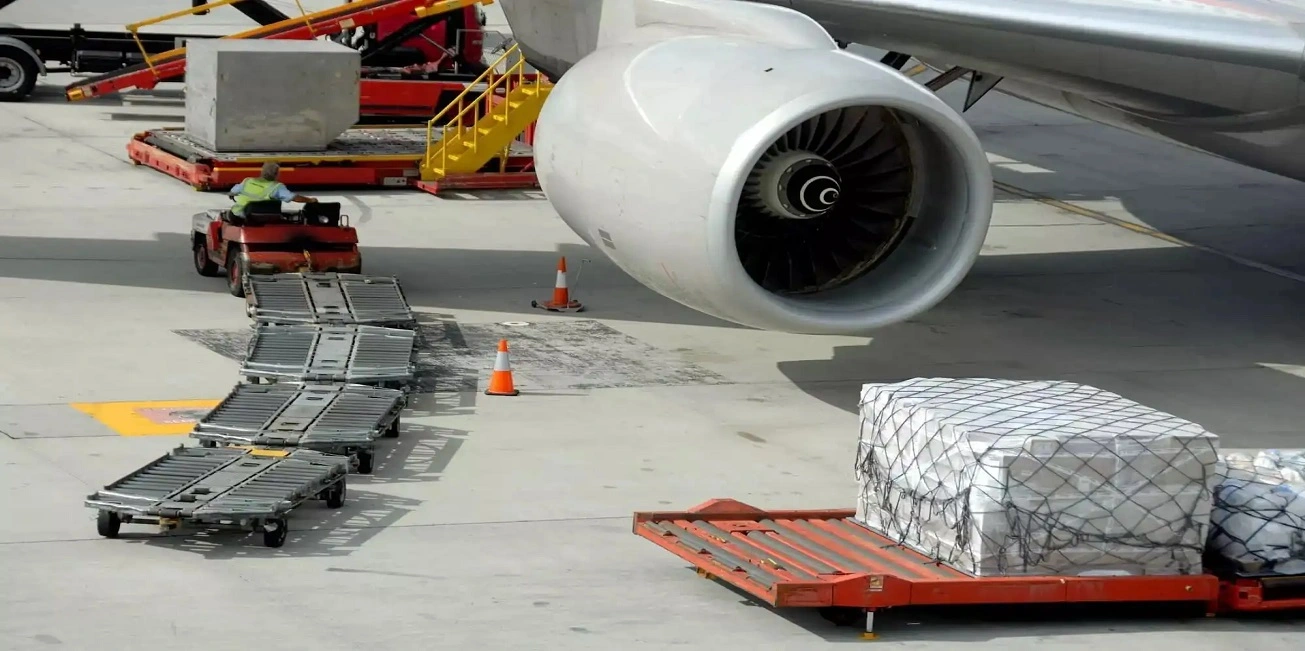
Global air cargo spot rates have surged as conflict in the Middle East tightens capacity and drives up fuel costs, reports London’s Air Cargo Week.
WorldACD data showed average global rates rose 10 percent week-on-week to US$2.67 per kilo in mid-March, following an eight percent rise the previous week.
Volumes increased four percent, driven by Asia Pacific recovery and partial rebound from Middle East and South Asia origins.
Spot rates from Middle East and South Asia origins jumped 22 percent to $4.37 per kilo, 58 percent higher than last year.
Gulf tonnages rebounded 74 percent week- on-week after collapsing the previous week, though still 50 percent below pre-war levels.
Rates from Dubai to Europe rose 9 percent to $3.93 per kilo, more than double last year’s level.
To the US, Dubai rates surged 56 percent to $8.46 per kilo, 2.5 times higher than a year earlier.
Jet fuel prices rose 11 percent week-on-week, nearly doubling from pre-war levels, prompting carriers to impose fuel and war risk surcharges.
Capacity remains constrained, with UAE limiting flights to domestic carriers after a drone strike on a fuel terminal.
Asia Pacific volumes continued to recover post-Lunar New Year, up 5 percent week-on-week.
though still 12 percent below preholiday levels.
Spot rates to Europe rose 13 percent, reflecting the impact of the Middle East crisis on global markets.
CMA CGM strengthens PANAMA DIRECT with new Cork port call
CMA CGM has announced the addition of a new port call in Cork, Ireland, as part of its ongoing strategy to expand its global network.
The new call is designed to enhance connectivity for the Irish market and strengthen CMA CGM’s transatlantic service offering.
From 28 April 2026, Cork will be directly connected to New York and Savannah.
This direct link will allow importers and exporters in Ireland to benefit from faster transit times, greater schedule reliability, and more frequent sailings.
It is intended to improve supply chain efficiency for both importers and exporters, providing a seamless solution between Ireland and key North American ports.
The PANAMA DIRECT service, which is well known for its consistency and operational reliability, will see further enhancements with the deployment of an additional vessel.
This measure is intended to support higher frequency and improved schedule adherence, ensuring that customers can plan their logistics with confidence.
The first vessel to call at Cork under this new service will be MV CMA CGM WHITE (voyage ORPLUSIMA), with an estimated arrival date of 28 April 2026.
CMA CGM expects that this new service will not only increase the efficiency of cargo flows but also support the continued growth of the Irish market within its transatlantic trade network.
Recently, CMA CGM announced an update to its Peak Season Surcharge, applying to cargo moving from Türkiye to multiple destinations across Latin America and the Caribbean.
ONE invests in Busan's first automated terminal
Ocean Network Express (ONE) has finalised a long-term partnership with Dongwon Group, acquiring an indirect stake in its subsidiary Dongwon Global Terminal Busan (DGT).
DGT is South Korea’s first fully automated container terminal, using automated guided vehicles in Busan.
Once complete, it will have a capacity exceeding 4.5 million TEUS, with five berths (1,750 metres) and one feeder berth (385 metres).
The investment strengthens ONE’s position in the region and secures access to terminal capacity at a key transhipment hub.
Busan’s role as both a gateway and transhipment centre is expected to support more efficient cargo flows and improved network reliability.
Hiroki Tsujii, Global Chief Officer of ONE’s Product and Network division, said: “This strategic partnership supports our long-term growth ambitions and ensures consistent, high-quality service for our customers.
By securing direct access to capacity in this key port region, customers can benefit from more reliable and stable connections within Asia and the broader global network.”
The move follows ONE’s agreement to acquire an additional stake in Poseidon Corp.
from existing shareholders.
Reefer shippers stuck as Gulf war halts flows
Cold chain shippers with containers bound for the Middle East face mounting delays as reefer boxes were offloaded at ports out- side the Persian Gulf with no timeline for resumption of voyages through the war zone, reports
New York’s Journal of Commerce.
Ocean carriers have suspended acceptance of reefer, dangerous goods and special cargo in and out of the UAE, Oman, Iraq, Kuwait, Qatar, Bahrain and Saudi Arabia until further notice.
Containers already en route when fighting began on February 28 were dropped at ports in India, Singapore and elsewhere, incurring storage charges.
Tyson Foods is among those affected, with halal chicken shipments from Brazil offloaded before reaching Gulf markets.
Juliana Violato, Tyson’s senior procurement manager in Europe, said production in Brazil has slowed as containers remain stranded, with possible rerouting through Oman or Saudi Arabia still uncertain.
Industry consultant Thomas Eskesen said frozen food and perishables are the top concern, with diversions via Jeddah offering limited relief.
Land-based options through UAE and Oman ports are under strain, with trucking bottle-necks including a reported 20-mile queue at Dubai’s Jebel Ali.
Port of Nagoya handles 2.64m TEUs in 2025
The Port of Nagoya handled 2.64 million TEUS of foreign trade containers in 2025, up 1.9 percent year-on-year (YoY), according to preliminary figures from the Nagoya Port Authority.
Exports reached 1.37 million TEUs, up 1.7 percent, while imports rose 2.2 percent to 1.27 million TEUS.
Domestic container volumes fell 11.5 percent to 147,914 TEUS, bringing total throughput to 2.79 million TEUS, a 1.1 percent increase.
Oceangoing cargo totalled 112.55 million tonnes, up 1.4 percent, comprising 44.53 million tonnes of exports (+2.3 percent) and 68.02 million tonnes of imports es (+0.8 percent).
Domestic cargo rose 2.4 percent to 46.8 million tonnes, taking total cargo volume to 159 million tonnes, up 1.7 percent.
Overall throughput at the Port of Tomakomai reached 228,758 TEUS in 2025, including feeder traffic, marking a 2 percent decline on 2024, according to preliminary figures from the Tomakomai Port Authority.
TS Lines orders fuel-saving ships
TS Lines has ordered four new 5,300-TEU vessels from Huangpu Wenchong Shipbuilding in China, aiming to modernise its fleet despite a looming industry downturn, reports Cayman Islands Bitget App.
The global container shipping sector faces overcapacity from 2026 as carriers retain older ships while adding new ones, keeping freight rates under pressure.
TS Lines is positioning for long-term competitiveness in Asia-Pacific by investing in efficient assets.
The four ships, part of Huangpu Wenchong’s Swan Series, will be delivered between June and December 2028.
The order is valued at US$245 million, or about $61 million per vessel, reflecting a focus on cost efficiency and retrofit-ready designs.
These vessels are engineered for fuel savings and compliance with evolving emissions rules.
TS Lines’ collaboration with Huangpu Wenchong, part of China State Shipbuilding Corp, now covers 14 ships ranging from 1,900 to 5,300 TEU
The company has reported average annual revenue growth of 30.3 percent but earnings have fallen 35.9 percent per year amid margin pressure.
Despite this, TS Lines maintains a 25 percent return on equity and a 34.4 percent net margin.
The first new vessel is due in Q2 2028, marking the start of the fleet’s transformation.
Analysts warn that prolonged oversupply could limit returns, but management sees the investment as a strategic bet on future resilience.
China Europe rail freight up 25pc in 2026
Freight volumes on the China- Europe rail corridor rose sharply in January and February, with container traffic up 25 percent year- on-year and train trips increasing 32 percent, reports Rotterdam’s Rail Freight.
China Railway said 352,100 TEU were moved on the route in the first two months of 2026, compared with 281,000 TEU a year earlier.
The 3,501 train trips represented a 31.7 percent rise, marking a strong rebound after volumes fell 11 percent in early 2025.
From January to February, the network carried 352, 100 TEU, according to China State Railway Group, reported Caixin.
The surge contrasts with full-year 2025, when total trips increased just 3.2 percent to about 20,000 and overall cargo volume fell 1.3 percent to roughly 2.1 million TEU.
Outbound trips dropped 6.1 percent to 9,898 last year, while inbound journeys rose 14.4 percent to about 10,100.
The early-2026 increase was concentrated largely in outbound traffic.
Departures from China jumped 47.5 percent to 1,736 trips in the two-month period, carrying 181,200 TEU, a 41 percent increase.
Inbound journeys rose 19.2 percent to 1,765 trips, carrying 170,900 TEU.
The state operator said it has strengthened coordination and optimised scheduling to meet market demand, while also improving digital port systems to speed customs clearance.
The growth contrasts with 2025, when total trips rose just 3.2 percent and volumes declined 1.3 percent to 2.1 million TEU.
The figures precede the out- break of war in Iran, which has duction driven up fuel prices and disrupted maritime and air freight.
Analysts said the conflict could further boost demand for rail services, which bypass high-risk areas and are less exposed to energy costs.
The early-year surge places the Eurasian land bridge on a stronger footing, with prospects for continued growth as global shippers seek reliable alternatives amid geopolitical and energy market pressures.