
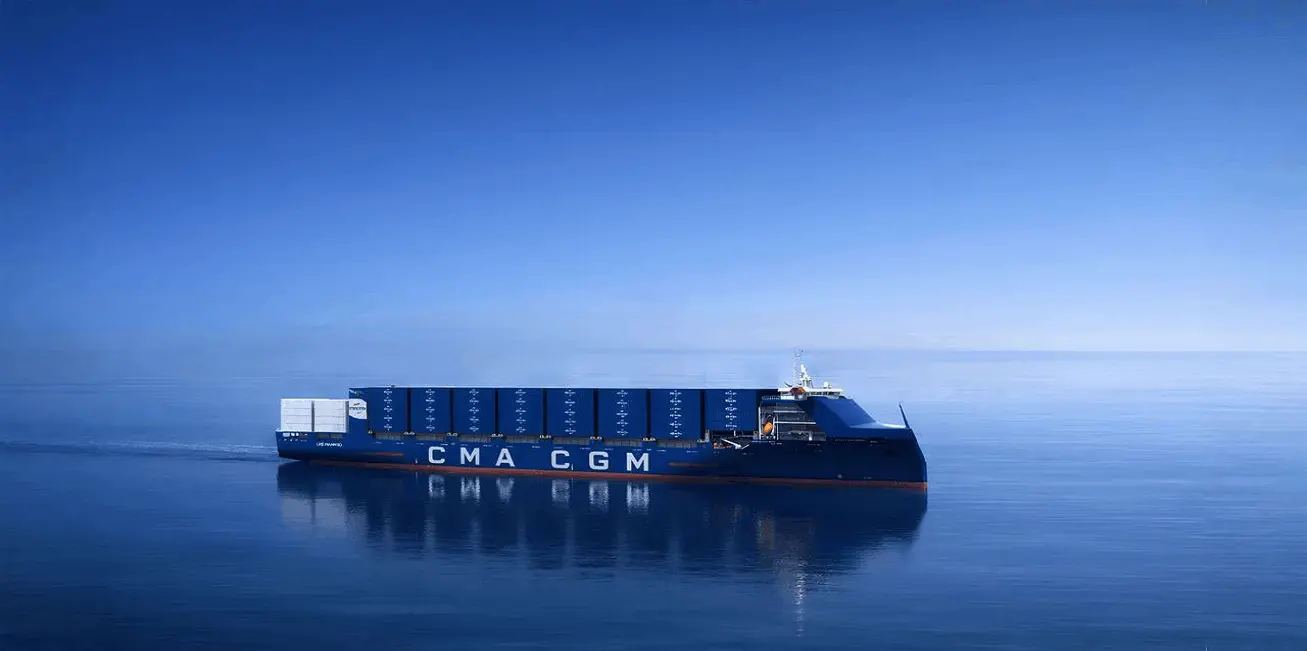
CMA CGM will impose a US$900 per TEU peak season surcharge on cargo from Asian main ports to the Mediterranean and North Africa from 15 June, reports Saint Petersburg’s Port News.
The surcharge is $1,800 for FEUS.
CMA CGM also announced new Freight All Kind rates on the same trades effective June 15.
West Mediterranean rates are $4,800 per TEU and $6,500 per FEU.
Adriatic rates are $4,900 and $6,600 respectively.
East Mediterranean, Black Sea, Syria, Egypt and Turkey rates are $5,300 per 20-foot and $6,700 per 40-foot container.
North Africa rates are higher, with Algeria at $6,500 per 20-foot and $9,200 per 40-foot container.
Tunisia, Libya and Morocco are listed at $5,900 per TEU and $7,400 per FEU.
CMA CGM said the FAK rates include basic freight, bunker surcharges, ETS and LLS, but terminal handling, safety, security and local charges may also apply.
The company identified the levy as a Peak Season Surcharge.
CMA CGM, headquartered in Marseille, operates container liner shipping, port terminals and logistics businesses, including CEVA Logistics.
Liner reliability hits 2026 high at 62.4pc
Global liner schedule reliability rose to 62.4 percent in April, the highest level so far in 2026, according to Copenhagen-based Sea-Intelligence, reports Saint Petersburg’s Port News.
The figure was up 0.4 percentage points month on month and 4.0 percentage points year on year based on issue 177 of the company’s Global Liner Performance report covering 34 trade lanes and more than 60 carriers.
The average delay for late vessel arrivals fell by 0.27 days month on month to 5.34 days, though it remained 0.31 days higher than in April 2025.
Maersk was the most reliable carrier among the top 13 in April at 76.1 percent, followed by Hapag-Lloyd at 75.1 percent.
Five carriers were in the 60 to 70 percent range, another five in the 50 to 60 percent range, while Wan Hai was the least reliable at 39.6 percent.
Five of the 13 carriers improved month on month, while 11 recorded year-on-year gains.
Gemini Cooperation posted the strongest alliance performance in March and April, with reliability of 85.0 percent across all arrivals and 85.6 percent across trade arrivals.
MSC followed with 73.4 percent and 72.3 percent respectively.
Premier Alliance recorded 54.2 percent under both measures.
Under the old alliance structure, Ocean Alliance scored 67.6 percent.
Sea-Intelligence said alliance performance has traditionally been measured by arrivals in destination regions, but a second measure covering all arrivals was introduced in February 2025 to reflect the new alliances.
Canada could double exports to China
China’s Foreign Minister Wang Yi said Canada could double its exports to China by 2030, during talks with Canadian Foreign Minister Anita Anand in Ottawa.
The rare visit marked the first by a Chinese foreign minister to Canada in a decade, reports Reuters.
Mr Wang told Ms Anand that Canadian exports could rise by 100 percent, surpassing the country’s target of a 50 percent increase by 2030.
Anand said Canada was focused on diversifying trade and strengthening economic ties with China.
Mr Wang’s three-day visit included a meeting with Prime Minister Mark Carney.
Ms Anand’s office said discussions covered trade, human rights and foreign interference in what it described as a frank and constructive exchange.
Both sides agreed on the need for stable communication channels.
Canada and China signed a trade deal in January to cut tariffs on electric vehicles and canola.
Carney, who visited China earlier this year, has sought to reduce reliance on the United States amid trade tensions with Washington.
He has signed more than 20 economic and security agreements in the past year.
The visit came days after Canadian warship HMCS Charlottetown transited the Taiwan Strait.
China said it opposed any attempt to undermine its sovereignty under the pretext of freedom of navigation.
Beijing continues to expand its military capabilities while asserting sovereignty over Taiwan and the strait.
Earlier in May, Canadian Conservative opposition MP Michael Chong visited Taiwan and met President Lai Chingte.
AD Ports acquires Brazilian agri-bulk terminal operator
AD Ports Group has acquired Corredor Logística e Infraestrutura (CLI), a Brazilian agri-bulk port terminal operator.
Based in São Paulo, CLI operates two key export terminals under long-term concessions: CLI
Sul at the Port of Santos, focused on sugar exports alongside corn and soybeans, and CLI Norte at the Port of Itaqui, part of Brazil’s northern “Arc of the North” logistics corridor serving emerging agricultural export flows.
The region recorded the fastest terminal growth in Brazil in 2025, underlining its increasing role in the country’s export network.
CLI is owned by Macquarie Asset Management and IG4 Capital.
The acquisition gives AD Ports Group full ownership of CLI Norte and an 80 percent stake in CLI Sul.
The transaction has an enterprise value of AED 3.1 billion ($835 million) and is expected to close in the second half of the year, subject to regulatory approvals.
CLI’s senior management will remain in place.
AD Ports Group, Managing Director & Group CEO, Captain Mohamed Juma Al Shamisl, said: “The purchase of CLI is a game changer for AD Ports Group.
The transaction extends our Group’s international reach for the first time into Latin America, and deepens our growing agrifoods activities, one of our core verticals.
“Under the wise guidance of our leadership in the United Arab Emirates, AD Ports Group is committed to enabling trade in one of the world’s most-important, fastest-growing agricultural commodities markets.”
The group said the deal strengthens its broader strategy to build an East-West trade corridor linking South America with the Indian Subcontinent, East Africa and Southeast Asia, alongside expanding UAE-Mercosur trade ties.
Brazil is already a key market for Emirati investment, with bilateral projects supported by a growing trade and investment framework.
The acquisition is AD Ports Group’s largest to date, exceeding its 2023 purchase of Noatum and its 2024 investment in Global Feeder Shipping.
The group has also expanded its agri-bulk footprint across Pakistan, Kazakhstan, Jordan and Spain through recent terminal investments.
CLI handled 17 million tonnes of agri-bulk cargo 2025, generating AED 654 million ($178 million) in revenue and AED 360 million ($98 million) in EBITDA.
The terminals sit on structurally constrained export corridors. particularly Santos, where limited capacity and congestion are expected to support long-term utilisation.
Macquarie Asset Management and IG4 Capital said the platform is well-positioned for continued growth under its new owner, while AD Ports Group sees the asset as a foundation for wider regional expansion in Latin America.
Hapag-Lloyd completes first methanol vessel retrofit
Hapag-Lloyd and Seaspan have completed the first vessel conversion under their joint methanol retrofit programme.
The 10,100 TEU vessel Seaspan Yangtze has been upgraded from a conventional MAN S90 engine to a dual-fuel engine capable of operating on methanol.
The vessel is the first of five chartered ships scheduled for conversion as part of a wider programme involving Hapag-Lloyd, Seaspan Corporation and Everllence.
The remaining vessels earmarked for retrofit are Seaspan Amazon, Seaspan Ganges, Seaspan Thames and Seaspan Zambezi.
The total investment across the five conversions is estimated at approximately $120 million.
Silke Lehmköster, Managing Director Fleet at Hapag-Lloyd, said: “Retrofitting existing vessels is an important lever on our way to decarbonise our fleet operations by 2045.
The successful conversion of the Seaspan Yangtze shows that technical innovation and close cooperation with strong partners can make proven vessels ready for the use of low-carbon fuels.
For our customers, this is another concrete step towards more sustainable supply chains.”
According to the companies, each retrofit could reduce CO2e emissions by between 30,000 and 50,000 metric tonnes per vessel annually when operating on low-carbon methanol.
Beyond emissions reductions, the conversions are expected to extend vessel service life while providing greater fuel flexibility as the container shipping sector transitions towards alternative fuels.
The project highlights the growing role of retrofit solutions in fleet decarbonisation, complementing investments in newbuild vessels, operational efficiency measures and alternative fuel sourcing.
Air cargo market to hit US$642 billion
The global air freight market is projected to grow from US$389.55 billion in 2026 to $642 20 billion by 2035. expanding at a compound annual growth rate of 5.8 percent, reported Ottawa’s Precedence Research
Growth is driven by rising cross-border ecommerce and investment in high-speed cargo infrastructure.
Asia-Pacific led the market with 39 percent share in 2025, while North America held 28 percent and is expected to grow at 4.8 percent CAGR through 2035.
By service type, express freight accounted for 38 percent of the market in 2025, followed by standard air freight at 34 percent.
General cargo held 36 percent of cargo type share, while pharmaceuticals and healthcare products are forecast to expand at 8.5 percent CAGR
Retail and e-commerce contributed 26 percent of demand in 2025, with healthcare and pharmaceuticals at 18 percent.
Dedicated freighters carried 58 percent of cargo, while belly cargo accounted for 42 percent.
Next-day delivery dominated with 46 percent share.
The International Air Transport Association said air cargo demand rose 11.3 percent in 2024 to record levels, fuelled by e-commerce and maritime disruptions.
Artificial intelligence is increasingly used to improve cargo visibility and logistics coordination.
Industry trends include wider adoption of sustainable aviation fuel and more efficient freighter aircraft.
ONE updates Asia-South Africa shipping services
Ocean Network Express (ONE) has announced enhancements to its Asia-South Africa service network, revising the rotations of its South Africa Connection (SAC) and South Africa Service (SAS) offerings.
The changes form part of the carrier’s ongoing efforts to optimise network efficiency and improve schedule reliability across key trade corridors linking Asia with Southern Africa.
The updated South Africa Connection (SAC) service will operate on a weekly basis, calling at Shanghai, Ningbo, Xiamen, Nansha, Singapore and Durban before returning to Singapore and Shanghai.
The revised rotation will be introduced with the vessel COSCO Wellington, which is scheduled to arrive in Shanghai on 14 June 2026.
Meanwhile, the South Africa Service (SAS) will also maintain a weekly frequency.
Under the new rotation, vessels will call at Qingdao, Shanghai, Ningbo, Shekou, Hong Kong, Singapore, Durban and Cape Town before returning via Singapore to Qingdao.
The first sailing under the revised structure will be undertaken by Dolphin II, with an estimated arrival in Qingdao on 9 June 2026.
The network adjustments are designed to strengthen connectivity between major Asian manufacturing hubs and South African gateway ports, while supporting more reliable transit times for cargo moving along the trade lane.