
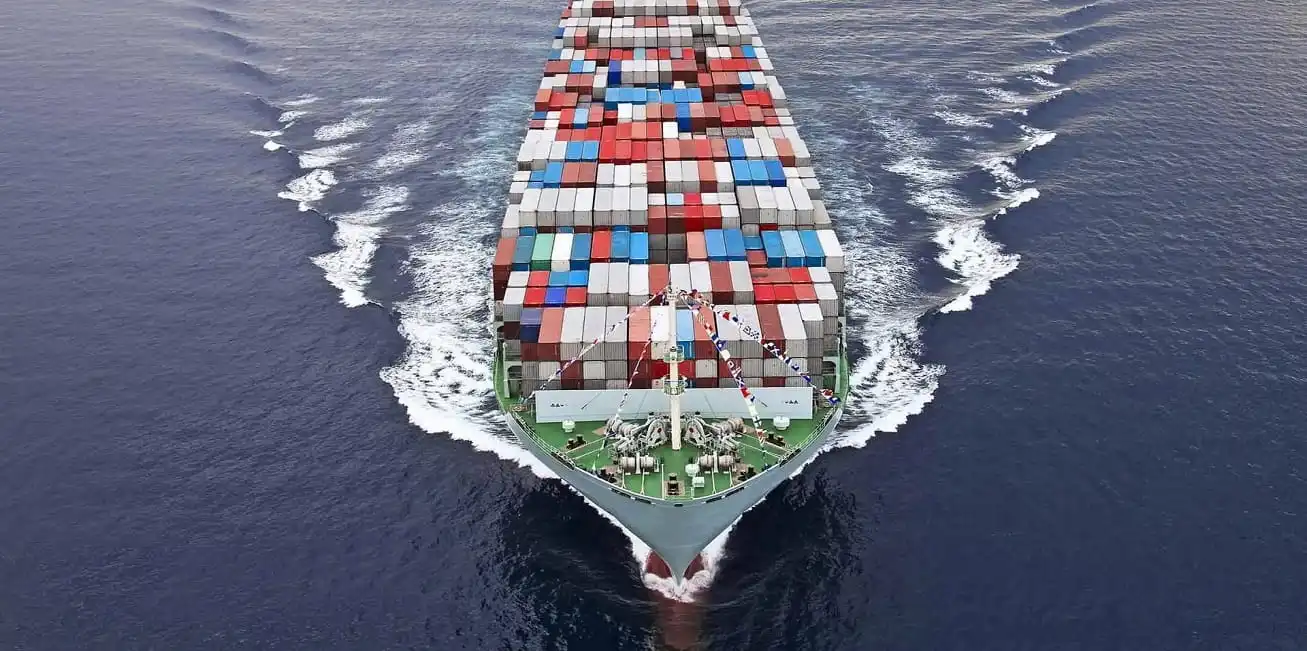
Container ship order volumes have reached their highest level since 2009, with Maersk and CMA CGM both committing to large- vessel acquisitions that reflect the industry’s sustained appetite for fleet expansion.
In mid-September, Maersk confirmed an order for 26 container ships of 18,600 TEU capacity, representing a combined capacity of approximately 483,600 TEU, with delivery scheduled between 2029 and 2030.
The vessels form part of Maersk’s ongoing fleet renewal programme and are all equipped with dual-fuel engines capable of operating on liquefied gas.
According to The Loadstar, 20 of the ships will be constructed by China’s Hengli Heavy Industry, with the remaining six built by New Times Shipbuilding.
This is not Maersk’s first large-vessel order of the year.
In February- the company signed a contract with New Times Shipbuilding for eight 18,600 TEU container ships, also scheduled for delivery in 2029 and 2030-an order Maersk described at the time as part of its fleet renewal strategy.
According to The Loadstar, citing Linerlytica data, CMA CGM is planning to order 12 ultra-large container ships of 24,000 TEU capacity, fitted with dual-fuel propulsion systems and earmarked for delivery in 2029 and 2030.
The prospective order would push CMA CGM’s orderbook-to-fleet ratio to approximately 45%. Unlike Maersk’s confirmed 26-vessel order, however, the CMA CGM order has yet to receive an official announcement and currently rests on industry media reporting alone.
The new orders placed by both carriers have further inflated an already sizeable global orderbook.
Linerlytica data indicates that 1,925 container ships are currently on order worldwide, representing a combined capacity of approximately 15.6 million TEU.
The orderbook-to-fleet ratio has now exceeded 45% a level not seen since 2009- and total ordered capacity has surpassed more than double the post-pandemic peak of 7.6 million TEU recorded in August 2023.
Expanded orderbooks are not confined to the industry’s two largest operators.
Sea-Intelligence data shows Maersk’s orderbook equivalent to approximately 35% of its existing fleet capacity, Mediterranean Shipping Company and CMA CGM at around 39%, and COSCO Shipping reaching 52%. Certain mid-sized and smaller ship owners have committed to orders that already exceed the size of their current fleets.
Lars Jensen, drawing on Alpha liner data, notes that five shipowners currently hold orderbooks larger than their existing fleets, with Vietnam’s Hai An Transport carrying an orderbook equivalent to 368% of its present capacity.
Beyond new deliveries, a further variable is emerging.
Splash247, citing industry analysis, notes that a portion of global container shipping capacity remains absorbed by extended voyages rerouted around the Cape of Good Hope.
Should Asia-to-Europe services progressively resume transit through the Suez Canal, the shorter routing would release vessels previously committed to the longer diversion – adding a layer of existing capacity back into the market on top of new deliveries.
As a substantial wave of new tonnage converges on the 2029- 2030 delivery window, carriers face evolving decisions around capacity deployment, route realignment, and competitive positioning for market share. Orderbook size, however, represents only one variable in a more complex equation.
The factors that will ultimately determine freight rates and space availability include the pace of vessel deliveries, route deployment strategies, scrapping activity, the trajectory of Suez Canal resumption, and shifts in global cargo volumes.
What is clear is that global container ship orders have reached their highest point since 2009, and the volume of new capacity set to enter the market over the coming years will stand as one of the defining commercial questions of the decade ahead.
NYK orders new offshore wind SOV from Pax Ocean
NYK has ordered an offshore wind service operation vessel from Pax Ocean Group for deployment in Taiwan and other Asia-Pacific markets from around 2029.
The 89.6 m vessel will provide the accommodation, logistics and off-shore access for personnel working on the construction and maintenance of wind farms.
It will have capacity for up to 120 people, a 19.2 m beam and a design draught of 5 m
The Japanese shipowner said the vessel is intended to support the growing regional need for off- shore accommodation and maintenance capability as wind farms move into construction and operational phases.
NYK said the newbuilding will operate in partnership with Taiwan-based offshore wind specialist IOVTEC and shipowner and manager Hsin Chien Marine.
NYK took an equity stake in IOVTEC in 2025 as part of its expansion in Taiwan’s offshore wind market.
The SOV will be fitted with dynamic positioning, a motion compensated gangway and a motion-compensated crane to transfer technicians and equipment safely in offshore conditions.
It will also use Ulstein’s Twin X-Stern hull concept, which places propulsion units at both ends of the ship to improve manoeuvrability and station-keeping performance during walk-to-work operations.
The order extends NYK’s off- shore wind service business beyond Europe, where its Northern Offshore Group subsidiary operates crew-transfer vessels and acquired the 81 m Northern Ocean SOV in 2025.
That vessel can accommodate 60 people, half the capacity planned for the Asia-Pacific newbuild.
COSCO SHIPPING Ports Lifts Nine-Month Profit 19.6% as Overseas Terminals Drive Growth
COSCO SHIPPING Ports Limited (HKEX: 1199), a global terminal operator with a network spanning the Bohai Rim, the Yangtze River Delta, the Pearl River Delta, the Mediterranean and the Middle East, reported a 19.6% year-on- year rise in net profit attributable to shareholders to $264.3 million for the first nine months of 2025, as strong gains at overseas terminals offset softer conditions in parts of its home market.
Revenue for the nine-month period climbed 11.4% year-on-year to $1,234.7 million, the company said.
Total throughput handled across its terminal portfolio reached 113.3 million TEU, up 5.6% from a year earlier, while third-quarter throughput advanced 4.2% to 38.98 million TEU.
Basic earnings per share rose 13.2% to 6.94 US cents.
The headline figure for the period was the performance of the company’s overseas terminals, where profit surged 65.3% year- on-year, driven by the Mediterranean and Middle East regions.
Profit from Chinese terminals grew a comparatively modest 2.6%, underscoring the widening contribution of the company’s international footprint.
Gross profit for the nine months increased 5.7% to $326.5 million.
EBITDA, however, edged down 3.6% to $674.6 million.
Profit contribution from joint ventures and associates rose 12.3% to $268.8 million, reinforcing the company’s reliance on its network of partnered assets.
Net finance costs fell 19.6% to $95.0 million, easing pressure on the bottom line and supporting the double-digit net profit gain.
The lower financing expense strengthens the balance sheet as the company continues to expand overseas capacity.
Revenue from overseas subsidiaries grew 20.7% year-on-year, with the gross profit margin at those operations improving by 0.9 percentage points.
Third-quarter throughput at the company’s Chinese terminals rose 3.1% year-on- year, with results varying markedly by region.
The Bohai Rim posted a 3.1% third-quarter gain, the Yangtze River Delta rose 1.9%, and the Southwest Coast advanced 10.7%.
The Pearl River Delta was broadly flat, while the Southeast Coast declined 4.9%.
Overseas terminals collectively grew 7.6% in the quarter.
Individual assets showed standout results.
Throughput at Beibu Gulf Port rose 10.7%, CSP Zeebrugge climbed 24.1%, and Suez Canal Container Terminal surged 58.3%.
Piraeus Container Terminal, the company’s flagship Mediterranean gateway, saw throughput fall 14.8% year-on- year, which the company attributed to a slowdown in the Mediterranean market.
For cargo owners and logistics partners tracking capacity and reliability across major trade lanes, the divergence signals shifting volumes: firm momentum through the Middle East corridor and northern Europe, set against softness in parts of the Mediterranean and China’s southeastern coast.
The company’s broadening overseas base points to continued investment in the gateways that underpin global container flows.
Panama slips to third in global flag rankings
Panama’s long retreat from the top of the global ship registry rankings has reached another milestone, with the once dominant flag now overtaken by the Marshall Islands to fall into third place.
The latest Clarksons Research data, dated September 1, shows the Marshall Islands fleet at 212.7m gt, comfortably ahead of Panama on 196m gt.
Liberia has extended its lead at the top to 317.4m gt.
Panama remains comfortably ahead by vessel numbers, with 7,516 ships against 4,808 for the Marshall Islands and 6,167 for Liberia, but its tonnage has contracted sharply.
The Clarksons data shows Panama down 15% this year, from 230.5m gt at the end of 2025, while both Liberia and the Marshall Islands grown 8.7%.
Pakistan emerges as transit hub: minister
ISLAMABAD: Pakistan is seeking to strengthen regional connectivity and position itself as a key transit hub for trade between Central Asia, China and the South Caucasus, Communications Minister Abdul Aleem Khan said the other day.
Speaking at a high-level panel at the Azerbaijan International Investment Forum in Baku, the minister said Pakistan was pursuing fiscal discipline and austerity to withstand global economic uncertainty, including higher fuel and maritime freight costs and disruptions to traditional trade routes.
He said Pakistan was also seeking to act as a neutral diplomatic venue and constructive mediator in regional conflicts to help ease tensions and maintain trade flows.
Mr Khan said Pakistan’s deep-sea ports Karachi, Port Qasim and Gwadar remained operational and could serve as alternative gateways for regional commerce.
“Karachi Port Trust handled more than 54.68 million tonnes of cargo in the previous fiscal year,” he said.
Improved regional connectivity is transforming Pakistan into an important trade hub, as the country emerges as a key maritime gateway for Central Asian states,
he said.
He highlighted motorway projects including the M-6, M-10 and MNJC as key trade routes linking Pakistan with western China and Central Asia.
The minister also pointed to transport arrangements with Azerbaijan, including 1,500 annual reciprocal permits, which he said would strengthen links between Pakistani ports, the South Caucasus and the Trans Caspian Middle Corridor.
OOCL Launches Canadian Gateway Express 3, Linking Canada and the West Mediterranean
OOCL has announced the launch of its new Canadian Gateway Express 3 (GEX3), a weekly service establishing a direct connection between Canada and the West Mediterranean.
The addition strengthens the carrier’s transatlantic network and delivers a dedicated corridor for businesses moving cargo between two of the world’s most active trading regions.
For shippers, freight forwarders, and importers managing goods across these markets, GEX3 introduces a reliable new option built around schedule integrity, predict able transit times, and expanded market reach.
At the center of GEX3 is a direct link between Montreal and key gateways in the Western Mediterranean.
Rather than relying on indirect routings and multiple transshipment points, cargo owners gain a straightforward path that reduces handling and supports tighter control over delivery commitments.
Direct connectivity matters most when reliability is on the line.
Fewer touchpoints mean fewer opportunities for delay, giving businesses greater confidence in inventory planning and their ability to meet customer deadlines.
GEX3 is backed by a dedicated feeder network that extends coverage well beyond the ports of call.
Through these connections, the service reaches a wide range of Mediterranean destinations, giving customers access to markets across Southern Europe, North Africa, and the surrounding trade lanes.
This combination of a direct mainline and a broad feeder structure supports several practical outcomes:
Wider market access for businesses expanding their footprint across the region
*Consolidated routing options that help manage total landed cost
*Greater flexibility for adjusting to seasonal demand and shifting order volumes
For importers focused on cost efficiency and quick market entry, the expanded reach opens new sourcing and distribution possibilities without requiring separate carrier arrangements.
GEX3 operates on a fixed weekly schedule, giving customers a dependable cadence to build their supply chains around.
Consistent weekly departures support accurate forecasting, steadier inventory turnover, and smoother cash flow management.
Schedule integrity remains a defining feature of the service.
Reliable transit times and a stable rotation reduce the uncertainty that often complicates cross-region planning, allowing forwarders and cargo owners alike to coordinate downstream operations with greater precision.
The new service will begin according to the following schedule:
* Westbound: First sailing from Salerno on 13 October 2026
*Eastbound: First sailing from Montreal on 9 November 2026
The full rotation covers major gateways across the West Mediterranean and Canada, connecting industrial and commercial center in both directions.
Westbound:
Tangier – Salemo – Livomo- Genoa-Fos Sur Mer – Sagunto- Algeciras-Montreal
Eastbound:
Montreal-Tangier – Salerno- Livorno – Genoa-Fos Sur Mer – Sagunto – Algeciras
This structured rotation links Canada’s largest eastern gateway with Italy’s manufacturing hubs, the ports of Southern France, and Iberian trade centers, while the Tangier and Algeciras calls anchor connectivity to North Africa and onward feeder services.