
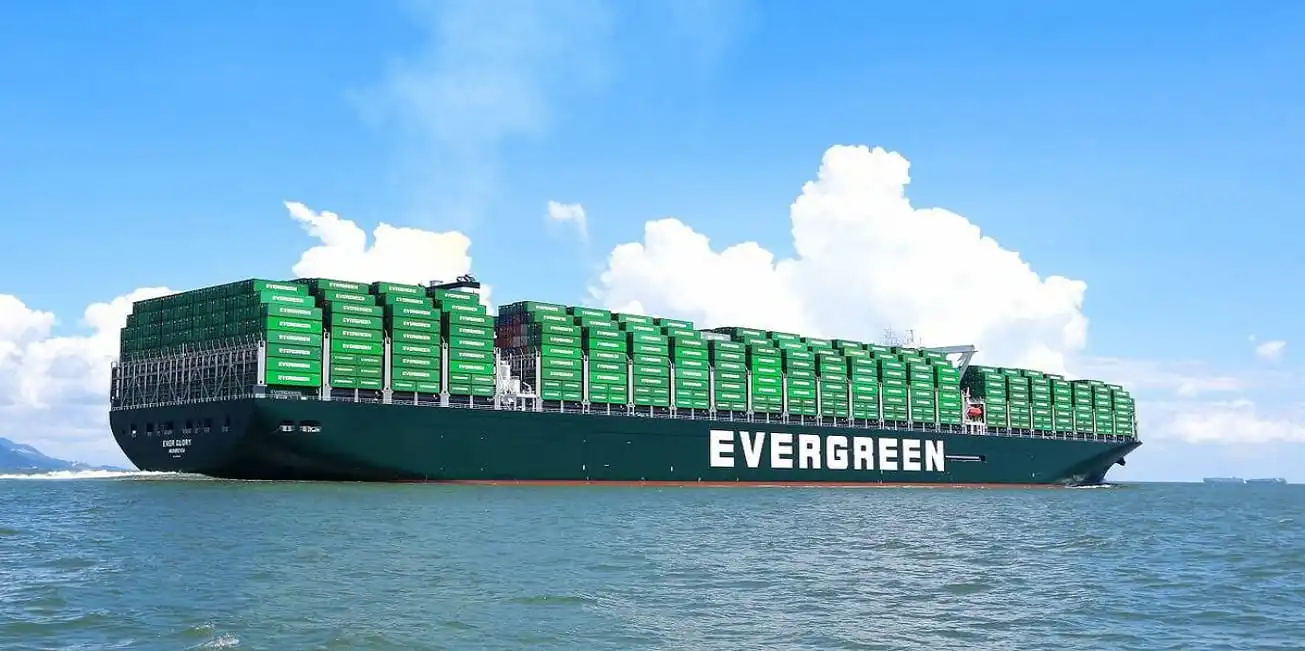
Evergreen Marine Corp. (Taiwan) Ltd through its subsidiary EMA is buying seven units of 5,900 teu class container vessels and 16 units of 3,100 teu class container vessels.
The company reported the acquisitions on January 27 but didn’t specify in its announcement the delivery date of the 23 units in total.
The new orders for the seven units are placed at Jiangsu New Yangzi Shipbuilding Co., Ltd. and for the 16 units at CSSC Huangpu Wenchong Shipbuilding Company Limited.
Jiangsu New Yangzi Shipbuilding has won an order of 7 units of 5,900 teu class container vessels.
The unit price is between $67m and $82m per vessel, or the total transaction price is between $469m and $574m.
Evergreen Marine Corp.
has also placed an order at CSSC Huangpu Wenchong Shipbuilding Company Limited for 16 units of 3,100 teu class container vessels.
The unit price is between $46m and $56m per vessel, or the total transaction price is between $736m and $896m.
Both orders were announced on January 27.
Evergreen Group started its business operation with Evergreen Marine Corporation (EMC), which was established on 1 September 1968.
Nowadays, Evergreen operates a fleet of more than 200 full- containerships and has developed a service network across five continents.
CMA CGM and Stone peak launch $2.4B terminal joint venture
Marseille-based container shipping line CMA CGM and infrastructure investment firm Stone peak have launched the U.S. joint venture United Ports LLC to acquire ten major CMA CGM-operated port terminals worldwide, including in the U.S., Brazil and Spain, as well as across Asia.
Under the deal, Stone peak will invest $2.4bn to acquire a 25% minority stake in the newly formed joint venture.
The transaction will include 10 key assets: Los Angeles Fenix Marine Services (United States), Port Liberty terminals in New York and Bayonne (United States), Santos terminals (Brazil), CSP Valencia and CSP Bilbao (Spain), Terminal Maritima del Guadalquivir (Spain), TTI Algeciras (Spain), Nhava Sheva Freeport Terminal (India), CMA CGM Kaohsiung Terminal (Taiwan), and Gemalink in Cai Mep (Vietnam).
CMA CGM and Stone peak will respectively hold 75% and 25% ownership stakes in United Ports LLC, while CMA CGM will retain full operational control.
CMA CGM plans to reinvest the $2.4bn in proceeds from the transaction in the continued growth of its core businesses, while expanding supply chain capacity to meet the ever-growing demand for shipping and logistics solutions across sea, land, air and logistics.
The announcement also marks the beginning of a long- term relationship between CMA CGM and Stone peak, including the potential to develop and support future investment capacity and new terminal projects in the U.S. and globally.
As part of the transaction, Stone peak will have the opportunity to contribute an additional $3.6bn in funding for future joint terminal projects.
The transaction is expected to close in the second half of 2026, subject to customary regulatory approvals, including relevant antitrust and foreign direct investment approvals.
“The creation of United Ports LLC, our joint venture with Stone peak, marks an important step in the development of our terminal activities in the United States and globally,” said Rodolphe Saadé, chairman and CEO of CMA CGM Group.
“Through this strategic partnership, we bring together ten CMA CGM-operated terminals across six countries, including major facilities such as FMS in Los Angeles, Port Liberty in New York, Santos in Brazil and Nhava Sheva in India.”
Klaipeda Port hits 1.3 million TEU
Lithuania’s Port of Klaipeda reported strong growth in 2025, setting records across container, roro, LNG and other cargo segments, reports London’s Port Technology International.
Director General Algis Latakas said the port handled 39 million tonnes last year, supported by investment, security, technology and environmental measures.
He noted seven new records despite geopolitical pressures and sanctions.
Container handling rose 29 percent to nearly 13 million tonnes.
The port passed the one million TEU milestone in October and closed the year at 1.30 million TEU, up 22 percent on 2024 and surpassing the previous peak of 10.5 million tonnes set in 2022.
Ro-ro traffic grew six percent to 6.5 million tonnes, with 353,759 vehicles processed.
New services from TT-Line and DFDS supported the increase.
LNG throughput climbed 19 percent to 2.4 million tonnes following the restart of FSRU Independence.
Construction materials and minerals reached 2.1 million tonnes, aiding national infrastructure projects.
However, timber fell to 606,000 tonnes, scrap metal dropped to 1.2 million tonnes and grain declined seven percent to 3.9 million tonnes.
Vessel calls fell three percent to 5,313, reflecting the port’s ability to handle larger, more efficient ships while maintaining productivity and reducing environmental impact.
K Line, MOL and MISC line up for next wave of Northern Lights CO2 carrier orders
Northern Lights has handed out a fresh round of CO2 shipping business to three of Japan and Malaysia’s biggest blue-chip owners.
The Oslo-based CCS JV – owned by Equinor, Total Energies and Shell – has awarded a long- term time charter for one 12,000 cu m liquid CO2 carrier to a consortium of Kawasaki Kisen Kaisha (K Line) and MISC, with a second sister vessel set to go to the same pair in April 2026.
In parallel, Mitsui OSK Lines (MOL) has secured two long-term charters for another two newbuild CO2 carriers.
The first three vessels will each have 12,000 cu m cargo capacity, significantly lifting Northern Lights’ seaborne capacity beyond its initial 7,500 cum trio and aligning with signed customer contracts and the project to lift transport and storage capability above 5m tonnes of CO2 per year.
All four new ships will be owned by the respective shipowners.
China’s Dalian Shipbuilding Offshore (DSOC) and South Korea’s HD Hyundai Heavy Industries (HHI) have been tapped to build the vessels, with deliveries scheduled between the second half of 2028 and the first half of 2029.
“We are pleased to significantly grow our transport capacity by adding vessels to our existing Northern Lights fleet,” said managing director Tim Heijn.
“With an expanded fleet, we will be able to deliver on our commitments to our customers.
It will also enable us to optimise operations and increase flexibility.”
The move follows the delivery of the 7,500-cu m Northern Pioneer, Northern Pathfinder and Northern Phoenix from DSIC/ DSOC since late 2024, all managed by K Line under phase one of Norway’s Long ship CCS project.
A fourth identical vessel, owned and operated by Bernhard Schulte, will join in 2026.
Northern Lights began injecting liquefied CO2 for permanent subsea storage in August 2025 and already has commercial agreements with emitters including Yara, Ørsted and Stockholm Exergi.
DP World lifts record 2m TEU in Callao
Dubai-based DP World has set a record at its South Pier Terminal in Callao, Peru, handling 2m TEU in 2025 – the first time any terminal on the West Coast of South America has reached this volume, reports London’s Lloyd’s List.
The milestone represents a five percent increase from 2024 and a 22 percent rise compared with 2023.
The launch of the US$400 million Bicentennial Pier in 2024 expanded capacity by 80 percent to 2.7 million TEU.
DP World said the achievement reflects sustained investment, expanded capacity and operational efficiencies that strengthen Callao’s role as a regional logistics hub.
Vessel-handling capacity grew 89 percent and productivity, measured in TEU per hour, rose 70 percent in 2024.
Peruvian consultancy Apoyo estimated the terminal contributed more than $316 million to Peru’s GDP in 2024.
Cargo value through Callao reached US$23.6 billion, including $3.66 billion in agricultural exports, 40 percent of the national total.
In 2025, DP World moved $438.3 million of avocado exports, around 60 percent of Peru’s shipments.
By November, Callao handled 55.8 percent of Peru’s agricultural exports, with 35.2 percent through DP World’s terminal.
Just a decade ago, two million TEU was the total volume handled by all ports in Peru.
Today, a single terminal achieves this,” said DP World Colombia, Ecuador and Peru chief executive Mr Carlos Merino.
DP World has invested about $8 billion in Latin America since 2010 and plans another $1.5 billion by 2028.
PIL signs for 8 LNG neo panamaxes
Pacific International Lines has signed letters of intent for eight LNG dual-fuel neo panamax container ships, with construction split between Chinese and South Korean yards, reports Singapore’s Splash 247.
The Singapore carrier has chosen Hudong-Zhonghua Shipbuilding in China and HD Hyundai Heavy Industries in South Korea to each build four 13,000 TEU vessels.
Deliveries are scheduled for 2028 and 2029.
Ranked 12th globally by capacity, the company has been in talks with the yards since last year as it weighed its next round of fleet investments.
The eight ships are part of a wider newbuilding programme worth about US$1.5 billion, aimed at modernising the fleet and cutting emissions.
The LNG dual-fuel vessels are intended for major east-west and regional routes, giving the carrier flexibility as environmental rules tighten.
The latest agreements add to an already busy orderbook.
The company currently has 23 ships on order, including 12 LNG-powered units – five of 13,000 TEU and seven of 9,000 TEU – all contracted at Hudong-Zhonghua’s Jiangnan Changxing facilities, according to Alpha liner.
Market sources said the neo-panamax series shows the carrier leaning into LNG as a transition fuel, pairing larger hulls with cleaner propulsion as it reshapes its fleet for the next decade.
PSA, MOL unveil joint venture RoRo Terminal in Singapore
PSA Singapore (PSA) and Mitsui O.S.K. Lines Ltd (MOL) have announced a joint venture RoRo terminal in Singapore.
The terminal is pending regulatory approval and is expected to begin operations in the first half of 2026.
As Southeast Asia’s largest automotive transhipment hub, Singapore connects Asia to global markets, offering multiple regional links and value-added services.
The JV will enhance MOL’s RoRo service reliability and operational efficiency while securing long- term terminal capacity to meet rising automotive transport demand.
MOL will leverage its global network, and PSA will bring its terminal expertise, jointly managing operations and strengthening their long-term partnership.
Beyond the terminal, the collaboration will focus on operational optimisation, digital innovation, and sustainability, aligning with PSA’s vision of a synchronised network and MOL’S “BLUE ACTION 2035” plan.
Nelson Quek, Regional CEO Southeast Asia, PSA International, said, “PSA has long served as a cornerstone of global trade, trusted as a key hub and vital node within the world’s supply chains.
“This partnership with MOL strengthens that role by integrating our automobile terminal more deeply into our global network, enabling seamless connectivity across the automotive logistics value chain.
Together, we are committed to delivering sustainable, long-term value for our automotive customers.”
Jotaro Tamura, Senior Managing Executive Officer of MOL, said, “This investment is an important part of MOL regional strategy to expand beyond shipping business alongside our marine transportation services, and to expand our automotive business.
By combining the strengths of MOL and PSA in this joint venture, we will enhance scale and efficiency while driving sustainability and digital innovation.
This investment reflects MOL’s commitment to stronger industry partnerships and a more sustainable global supply chain.
Together, we aim to deliver even higher quality automotive transportation services to our customers.”
Recently, ITG Meerhout (BCTN) and PSA Antwerp (PSAA) signed a cooperation agreement to launch a new, fast, and reliable barge service connecting PSAA’s North Sea Terminal (Quay 913) and ITG Meerhout.