
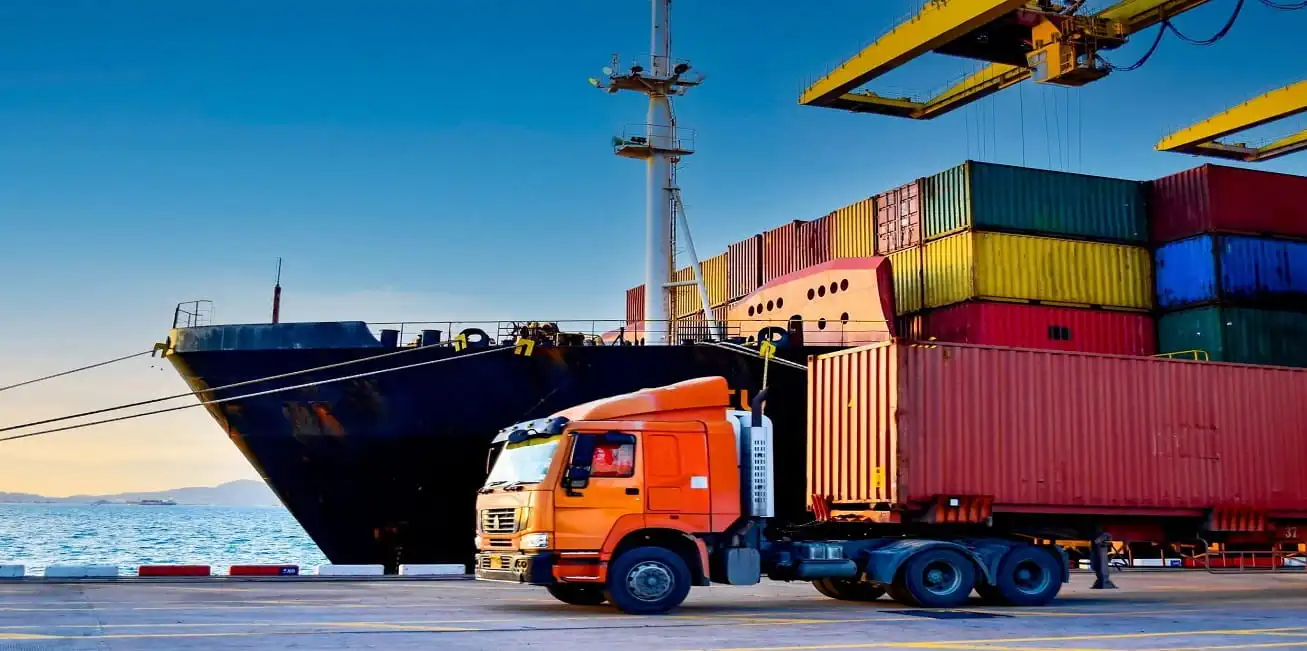
Global container shipping is seeing an earlier-than-usual surge in demand as importers move ahead of expected disruptions, Bloomberg reports.
Trade activity typically rises before the third quarter and Christmas holidays, but orders have shifted forward this year.
Analysts said concerns over fuel shortages, tariff expiry and higher costs are driving importers to book earlier.
The US Trade Representative’s temporary tariffs on all imports expire on July 24, adding urgency to shipments.
Bloomberg noted European importers are leading the trend, with Transpacific demand expected to follow.
Brendan Murray of Bloomberg said importers are concerned about how Middle East turmoil will affect the second half of the year.
Forwarders warn customers to book at least three weeks in advance as vessel space becomes scarce.
US and China-Southeast Asia bookings rose 10 percent in week 19, with premium services fully allocated through June.
JPMorgan’s Global Manufacturing PMI showed Asia output expanding at its fastest pace in years, supported by clients advancing purchases.
Carriers plan to lift Transpacific capacity to 2.3 million TEU in July, compared with 2.1 million TEU in June and 1.9 million TEU in May.
Logistics firm Kuehne + Nagel advised shippers to plan proactively, maintain flexibility and provide accurate forward visibility to avoid disruption during the peak season.
Tanjung Pelepas port targets 16 million TEUS a year
Port of Tanjung Pelepas aims to raise annual throughput to 16 million containers by 2029, up from are a record 14 million last year, reports Free Malaysia Today.
Chief executive Mark Hardiman said the port handled nearly 1.3 million TEU in May, its highest monthly throughput.
He attributed growth to global shipping realignment following the Gemini Cooperation between Maersk and Hapag-Lloyd in 2025, which made PTP the main hub for the alliance.
To reach the 2029 target, Mr Hardiman said PTP will complete Berth Zero, adding 360 metres of berth space and four cranes.
The port’s free zone is about 95 percent occupied, with expansion expected to align with the Johor- Singapore Special Economic Zone.
Mr Hardiman said PTP is advancing decarbonisation, aiming to cut emissions by 45 percent by 2030 and achieve net zero by 2050.
The port has fully electrified 67 quay cranes and 234 rubber-tyred gantry cranes, and is electrifying its fleet of more than 600 prime movers.
PTP has joined Tenaga Nasional Bhd’s Green Energy Tariff programme, secured renewable electricity allocations, and expanded rooftop solar installations.
It is also working with the Port of Melbourne under a memorandum of understanding on decarbonisation and alternative fuels.
Mr Hardiman said PTP is improving gender diversity, with five women marine pilots among 45, women making up 10 percent of prime mover operators, and Malaysia’s first woman operating a rubber-tyred gantry crane.
Diversity targets have been introduced across operations and management.
West African countries face high container shipping costs
Shippers importing goods from Southeast Asia into Nigeria and other West African countries will face higher freight costs as carriers impose new surcharges, according to the Lagos Guardian.
CMA CGM announced a peak season surcharge of US$500 per TEU on cargo from Southeast Asia to West Africa, effective this week.
The surcharge applies to both dry and reefer cargo under short-term contracts and will remain until further notice.
The company said the surcharge is separate from basic freight rates and other charges such as bunker surcharges, Terminal Handling Charges at origin and destination, and safety and security fees.
Contingency and local charges may also be levied.
CMA CGM stated the measure is aimed at maintaining reliable services amid seasonal demand pressures and market fluctuations.
The announcement comes as carriers globally adjust freight rates in response to rising operational costs and disruptions linked to the Middle East crisis.
Drewry noted that container freight rates surged in early June as an earlier-than-usual peak season, carrier surcharges and limited vessel availability pushed FEU prices sharply higher.
Cosco Shipping to build third big containership
Hudong-Zhonghua Shipbuilding has started building the third in a series of six 13,600 TEU vessels ordered by Cosco Shipping container Lines, reports Melbourne’s Baird Maritime.
The steel-cutting ceremony took place on June 5.
The ship, designed in-house, will measure 336 metres in length, 51 metres in beam and 30.2 metres in depth.
It will carry up to 2,000 reefer containers.
The vessel will be powered by a conventional-fuel main engine, with environmental features including anti-fouling paint, shore power charging and desulphurisation systems.
All six ships will be classed by the China Classification Society, with deliveries scheduled by 2027.
U.S. Container Imports Climb
US containerised imports rose 6.6 percent in May to 2.43 million TEU, up 11.5 percent year on year, reflecting seasonal growth despite lingering geopolitical and trade risks, reported the American Journal of Transportation.
China-origin imports rebounded sharply to 816,197 TEU, a 19.9 percent monthly rise and 28.1 percent higher year on year.
China’s share of US imports increased to 33.6 percent, though volumes remain 20.2 percent below the July 2024 peak.
Eight of the top 10 US ports posted higher volumes in May.
Savannah rose 17 percent, New York/Newark 10.8 percent and Houston 18.2 percent.
Los Angeles and Tacoma were the only gateways to decline.
East and Gulf Coast ports captured 44.8 percent of total imports, while West Coast ports accounted for 45.1 percent.
Port delays remained stable, with Long Beach congestion easing from 7.3 days in April to 2.2 days in May.
Other ports saw only modest changes, suggesting overall stable operations.
Gulf Coast imports climbed 14.8 percent to 257,564 TEU, the second-highest monthly volume on record.
Fitch raises global shipping outlook
Fitch Ratings has revised its 2026 outlook for the global shipping sector to neutral from deteriorating, citing war-driven demand for alternative suppliers and routes that have lifted tanker rates.
Tanker shipping has benefited most from the Iran conflict and closure of the Strait of Hormuz, which previously carried over 20 percent of global seaborne oil.
Importers are sourcing crude and products from the US, Brazil and West Africa, raising tonne-mile demand and charter rates, particularly for very large crude carriers.
Container shipping has seen spot freight rates more than double from pre-war levels.
Higher surcharges for fuel, war-risk and congestion will limit earnings growth, but revenues are expected to rise.
Fitch forecasts container demand growth of about two percent in 2026, with supply expanding nearly five percent due to new deliveries.
Dry bulk shipping is less affected, though Capesize vessels are benefiting from increased iron ore transport.
Fertiliser exports from the Middle East have been disrupted, but any shift toward higher coal imports could support bulk demand.
Fitch projects global GDP growth of 2.4 percent in 2026 and 2.5 percent in 2027, with oil prices expected to fall from US$87 per barrel in 2026 to $65 in 2027.
Over- supply risks remain for container shipping, with the order book at more than 35 percent of existing fleet capacity.
Gemini's 18,000 TEUers on Asia-Med run
Gemini Cooperation, the Maersk-Hapag Lloyd alliance, has cut capacity on Asia-North Europe and shifted larger vessels into the Asia-Mediterranean trade, where its market share is projected to rise to 29.7 percent by July 2026, reported Saint Petersburg’s Port News citing Sea-Intelligence.
The move marked a reallocation of East-West vessel deployment rather than a uniform expansion.
In Asia-North Europe, Gemini’s share fell from 25.7 percent in mid-May to 22.5 percent by June 2026 after a downgrade of the AE3/NE3 service.
Following a two-week blanking in early June, the service resumed with 14,000 to 15,000 TEU ships replacing 18,000-plus TEU vessels.
The change cut weekly deployed capacity on the lane by about 5,500 TEU.
In contrast, Gemini boosted Asia-Mediterranean capacity.
Its share is projected to rise from 23.4 percent to 29.7 percent by July 2026 after second-quarter changes.
These included launching a fourth loop, AE19/SE4 with 14,000 TEU ships and upgrading AE15/SE3 from 13,100 TEU to 18,400 TEU.
Sea-Intelligence data showed the 18,000 TEU ships removed from Asia-North Europe were redeployed into the Mediterranean upgrade.
The switch added a net 22,402 TEU of weekly capacity and lifted Gemini’s share on the lane by to 28.1 percent.
The strategy highlights Gemini’s focus on a denser Asia-Mediterranean network, while Ocean Alliance continues to expand across major trades.
ONE restructures Adriatic Service 1 port rotation
Ocean Network Express (ONE) has announced a restructuring of its Adriatic Service 1 (AD1), aimed at improving schedule integrity and reducing transit times across its East Mediterranean-Adriatic network.
The service provides a regular connection between the East Mediterranean and the Adriatic region, with ONE stating that the changes are intended to streamline port calls and support more reliable weekly coverage.
Under the revised rotation, the service will be simplified from Koper-Venice-Ancona-Aliaga – Piraeus – Damietta – Koper to a shortened loop of Koper – Venice – Ancona – Damietta – Koper.
The carrier said the adjustment is designed to optimise schedule performance and improve operational consistency across the service.
The updated rotation will be deployed with the Mito 065E vessel, effective from its estimated time of arrival in Koper on 2 July 2026.