
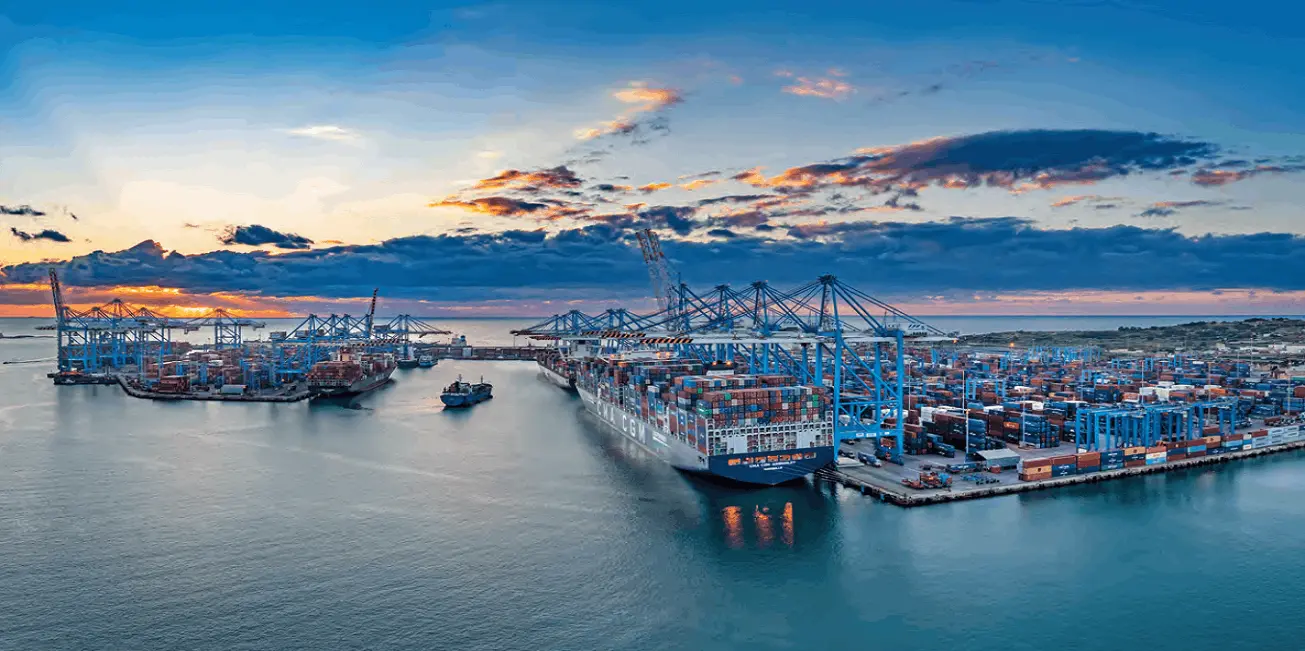
International Container Terminal Services, Inc. (ICTSI) has reported strong financial results for 2025, underpinned by higher volumes, improved margins and continued expansion across its global terminal portfolio.
The group posted revenues from port operations of $3.23 billion, up 18 percent from $2.74 billion in 2024.
EBITDA rose 21 percent to $2.14 billion, while net income attributable to equity holders increased 23 percent to $1.05 billion, compared with $849.8 million a year earlier.
Diluted earnings per share climbed 25 percent to $0.510.
Consolidated throughput reached 14.5 million TEU in 2025, an 11 percent increase from 13.1 million TEU in 2024, supported by stronger trade activity across all regions and a recovery in Guayaquil, Ecuador.
Excluding the impact of new and discontinued operations, volumes would still have risen by 10 percent.
ICTSI Chairman and President, Enrique K. Razon Jr., said: “Digit growth across volume, revenues, EBITDA, and net income.
These results reflect the quality of our diversified global portfolio, resilience of demand across our markets, and the disciplined execution of our long-term strategy.
The 11 percent increase in consolidated volume underscores the strength of our customer relationships and the essential role our terminals play in the supply chains of their respective economies.
“Our focus on operational efficiency, targeted capital allocation, and prudent financial management supported continued margin expansion and strong cash generation.”
Gross revenues were driven primarily by higher volumes, improved container mix, tariff adjustments and stronger ancillary service revenues, partially offset by unfavorable foreign exchange impacts linked to the depreciation of the Mexican peso, Brazilian real and Australian dollar.
Cash operating expenses rose 11 percent to $807.1 million, reflecting higher volumes, expanded ancillary services and salary adjustments, though partially mitigated by ongoing Cost optimisation and favourable currency effects.
Capital expenditure totalled $650.4 million in 2025, supporting major expansion works at terminals in Mexico, the Philippines, Brazil and the Democratic Republic of Congo (DRC), as well as equipinent upgrades and the new Batu Ampar Container Terminal project in Batam, Indonesia.
Excluding the upfront Batam payment, organic capex reached $572.5 million.
For 2026, ICTSI expects capital expenditure of approximately $740 million, focused on expansion projects in Mexico, the Philippines, Brazil and the DRC, alongside new developments in Honduras, Australia and Ecuador.
ICTSI operates container terminals across six continents and continues to pursue new opportunities in the global ports sector.
In February, ICTSI, through its wholly owned subsidiary Victoria International Container Terminal Ltd., secured a 26-year extension to operate and manage the Webb Dock East terminal at the Port of Melbourne, extending the contract for 20266.
Air freight costs set to surge 30pc, says HAFFA
Air freight costs are expected to rise at least 30 percent as Middle East airspace closures disrupt trade routes, according to the Hong Kong Association of Freight Forwarding and Logistics (HAFFA), report the Standard.
HAFFA chairman Gary Lau Ho-yin said the conflict is crippling routes and forcing airlines to reroute flights to Europe.
He warned the shortage of available pace will drive up logistics costs.
Mr Lau said the Strait of Hormuz has also been closed, with Iran’s Revolutionary Guard Corps warning vessels attempting passage would be set ablaze.
He cautioned the maritime sector may face similar disruption, with shipping firms possibly seeking alternative routes or rail transport.
Ocean Network Express reported about 750 ships are including 100 containerships rep resenting 10 percent of the global fleet.
Mr Lau said the cascading impact will affect exports from Hong Kong, with higher costs and delays likely if the situation persists.
MSC introduces war-risk surcharge on Africa trade
Mediterranean Shipping Company (MSC) has announced the introduction of war-risk surcharges on cargo shipments bound for African markets and Indian Ocean island destinations.
The new charges apply to cargo moving from both the Indian subcontinent and the Gulf region, according to MSC customer advisories.
The measure comes as shipping activity across key Middle Eastern maritime corridors faces disruption and heightened security concerns.
Under the updated surcharge structure, shipments originating in India, Pakistan, Sri Lanka and Bangladesh and destined for East Africa, Somalia, Mozambique and Indian Ocean island ports will incur additional fees.
Cargo transported from Gulf countries to destinations in West, East and Southern Africa, as well as Mozambique and Indian Ocean island markets, is also subject to the surcharge.
The cost increase varies depending on the origin of the shipment and container type.
For cargo departing from the Indian subcontinent, $500 per 20-foot dry container and $1,000 for refrigerated units.
Shipments originating in the Gulf face higher charges. According to the carrier, the surcharge amounts to $2,000 for 20-foot containers, $3,000 for 40-foot containers, and $4,000 for refrigerated containers travelling to the affected regions.
The surcharges took effect on 5 March 2026 and apply to cargo moving along the affected trade routes until further notice.
Shipping companies have increasingly adopted such measures as security risks and operational disruptions affect traffic through critical maritime chokepoints, including routes – linking the Middle East with Africa and the Indian Ocean.
Additional surcharges are typically introduced to offset higher operational costs associated with navigating areas exposed to geopolitical tensions or maritime security threats.
Hapag-Lloyd adds Gulf war risk surcharge
German shipping group Hapag-Lloyd has introduced a war risk surcharge for cargo to and from the Upper Gulf, Arabian Gulf and Persian Gulf from March 2 until further notice, reports London’s Middle East Online.
The surcharge is set at US$1,500 per TEU for standard containers and $3,500 per container for reefers and special equipment.
The charge will be borne by the booking party, typically the shipper or forwarder, reflecting higher costs and risks in volatile Gulf waters.
Hapag-Lloyd cited the dynamic situation around the Strait of Hormuz and the need for enhanced security measures as reasons for the decision.
The move comes as carriers adjust operations amid escalating conflict in the Middle East.
Maersk and CMA CGM have o paused or rerouted sailings through the Bab el-Mandeb Strait, diverting vessels around the Cape of Good Hope.
CMA CGM also introduced an emergency conflict surcharge covering destinations across the Gulf, Red Sea and Horn of Africa.
Ports such as Jebel Ali in Dubai temporarily suspended operations after reports of missile activity.
Insurers have cancelled or sharply raised war risk premiums for vessels transiting the Gulf and Strait of Hormuz, with rates rising by up to 50 percent from previous levels of about 0.25 percent of a ship’s replacement value.
The measures underscore the severe impact of the conflict on maritime trade routes, particularly the Strait of Hormuz, a chokepoint for 20-30 percent, of global seaborne oil and significant liquefied natural gas volumes.
Longer voyages, higher insurance and surcharges are expected to drive up freight costs and strain supply chains.
Mid-sized Korean shipyards post record profits
Mid-sized shipbuilders in South Korea are reporting record profits as ecofriendly technologies and niche markets drive growth during the current industry boom, reports Seoul’s Chosun Daily.
HJ Shipbuilding & Construction secured a KRW353.2 billion (US$265 million) order last month for two 11,000-TEU ships from a European client.
It is the first time in about 90 years the Yeongdo Shipyard has received an order for vessels above 10,000 TEU.
The company overcame dock limitations by widening hulls and maximising cargo space efficiency.
Daehan Shipbuilding’s operating profit rose 86 percent to KRW294.1 billion last year, while HJ Shipbuilding & Construction posted KRW67 billion, an 825 percent increase.
K Shipbuilding recorded KRW84.7 billion in the first three quarters, seven times higher than the previous year.
Daehan Shipbuilding expanded into Suezmax-class crude oil carriers, requiring investment in heavier ship block assembly.
It secured eight such orders worth KRWI.2 trillion in January and February.
Shuttle tankers, introduced in 2024, also boosted profitability.
K Shipbuilding restructured around petrochemical tankers after past diversification troubles.
Rising demand linked to the Russia-Ukraine war and Red Sea crisis helped it secure 15 orders last year and five more in early 2026.
Mid-sized shipyards are now targeting eco-friendly vessels, traditionally dominated by larger rivals.
K Shipbding gained design approval from DNV for its LNG bunkering vessel, dubbed the “floating gas station,” and plans to pursue further orders in the ecofriendly gas carrier segment.
CMA CGM names new methanol powered 13,000-TEUer
French shipping giant CMA CGM has christened its latest dual-fuel vessel, the 13,000-TEU CMA CGM Osmium, during a ceremony in South Korea.
reports Rotterdam’s Offshore Energy.
The ship was welcomed by Ma XunMin and Dorothee Regazzoni, Head of Territory BNP Paribas South Korea, who acted as godmother in line with maritime tradition.
CMA CGM said the Osmium will soon operate on the M2X service linking Asia with Mexico.
The company described the vessel as part of its fleet expansion supporting its net zero carbon 2050 target.
The naming follows the arrival of the first in a series of six 15,000- TEU methanol-powered ships, marking the French group’s 400th owned vessel.
CMA CGM recently signed a final shipbuilding contract with India’s Cochin Shipyard Limited for six LNG-powered containerships, further diversifying its alternative-fuel fleet.