
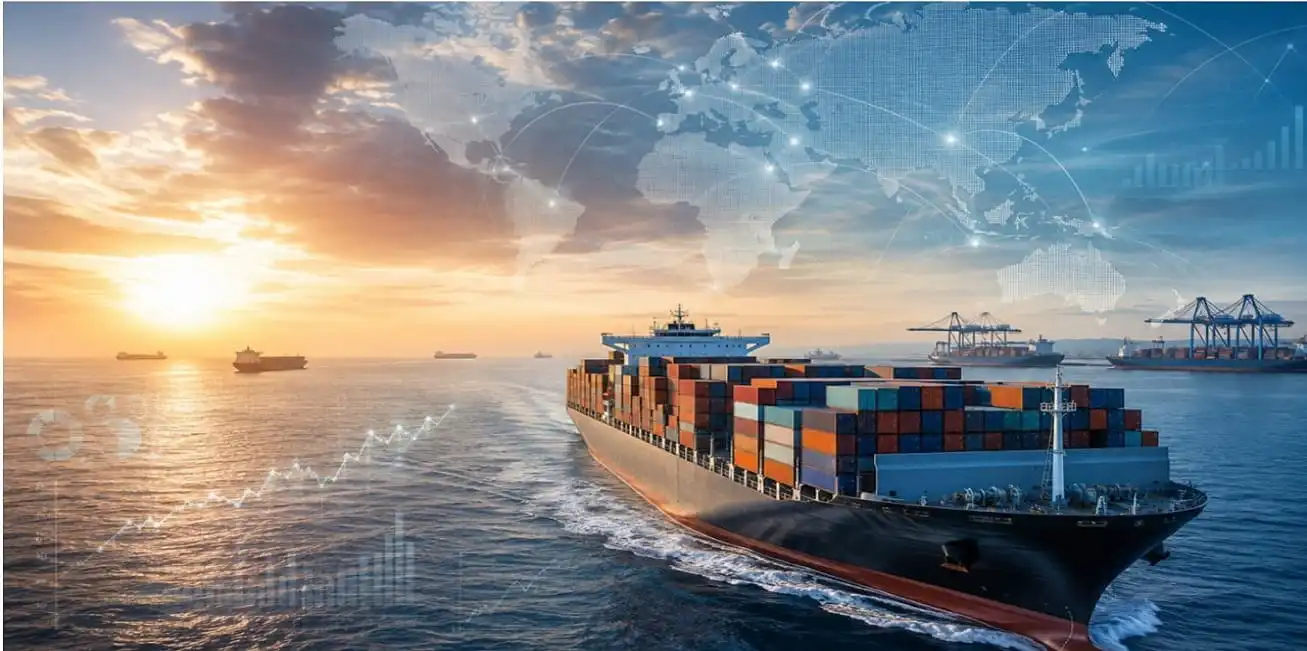
Maersk and Hapag-Lloyd have jointly announced the structural realignment of four routes – AES, AEII, AE12, and ME2-operating under the Gemini Cooperation framework.
The affected services will resume transit via the Suez Canal, discontinuing the extended Cape of Good Hope diversions.
Maersk noted that, together with the previously realigned AE15 and AE19 services, the Gemini Cooperation network now counts six routes restored to Red Sea passage.
The structural adjustments deliver the following updated port sequences:
AES connects Asia and Northern Europe, with the revised rotation calling at: Qingdao – Ningbo- Tanjung Pelepas – Suez Canal – London – Bremerhaven – Hamburg -Rotterdam-Algeciras – Suez Canal-Tanjung Pelepas.
AE11 connects Asia and the Mediterranean, with the revised rotation calling at: Shanghai Yantian – Tanjung Pelepas – Suez Canal Tangier – Valencia – Barcelona – La Spezia – Genoa – Vado Ligure – Suez Canal – Singapore.
AE12 connects Asia and the Mediterranean, with the revised rotation calling at: Ningbo – Shanghai – Tanjung Pelepas – Suez Canal-Algeciras – Koper – Rijeka- Algeciras Suez Canal Singapore.
ME2 connects India and Europe, with the revised rotation calling at: Ennore – Colombo – Suez Canal – Algeciras – Rotterdam – London – Hamburg – Tangier – Suez Canal – Colombo.
Maersk has affirmed that the Suez Canal represents a critical maritime corridor linking East and West, and a key enabler of efficient global supply chains.
Transit via the Suez Canal and Red Sea constitutes the fastest, most sustainable, and most operationally effective means of delivering services between Asia and Europe.
By restoring these four routes to Suez Canal passage – rather than maintaining Cape of Good Hope diversions Maersk and Hapag- Lloyd position themselves to deliver materially enhanced transit performance for their customers.
Maersk has stated that both carriers will continue to monitor the security situation in the Middle East with close and sustained attention.
Any further realignment of the Gemini Cooperation network will be contingent upon the continued stabilisation of the Red Sea region and the absence of renewed conflict escalation.
The safety of crew, vessels, and customer cargo remains the paramount priority governing all operational decisions.
The broader Middle East security environment continues to evolve, with both the Strait of Hormuz and the Bab-el-Mandeb Strait subject to ongoing pressure.
Nevertheless, the conflict between Saudi Arabia and Houthi forces does not appear to have impeded the liner industry’s determination to advance Red Sea reinstatement.
The pace of return is accelerating outpacing earlier projections – and has emerged as one of the defining variables shaping competitive dynamics across the container shipping market.
Wan Hai Lines Finalizes Order for Six 11,000-TEU Ships at Waigaoqiao Shipbuilding
Shanghai Waigaoqiao Shipbuilding, a subsidiary of China State Shipbuilding Corporation (CSSC) with a product range spanning 7,000 to 20,000 TEU, has confirmed a new construction agreement with Taiwan-based carrier Wan Hai Lines, reinforcing a partnership that began in 2024.
On September 10, Waigaoqiao Shipbuilding, together with China Shipbuilding Trading Co., Ltd.
(CSTC), signed a contract with Wan Hai Lines for six 11,000-TEU container ships, advancing a collaboration built on prior deliveries and repeat business.
The order is priced between $118 million and $124 million per vessel, bringing the total value to between $708 million and $744 million.
Wan Hai Lines had first announced its intention to place the order on August 12, specifying vessels engineered as methanol and liquefied natural gas (LNG) dual-fuel-ready ships.
The September signing formalizes that commitment.
The six-ship contract forms part of a broader ordering campaign at the yard.
To date this year, Wan Hai Lines has ordered eight container ships across two designs at Waigaoqiao Shipbuilding- one 9,200-TEU vessel and seven 11.000-TEU vessels – with a combined value ranging from $928 million to $980 million.
The two 2026 orders represent the second and third collaborations between the two companies.
The relationship dates to 2024, when Wan Hai Lines purchased two 7,000-TEU container ships from Waigaoqiao Shipbuilding.
The shipbuilder said the vessels were delivered in the first half of 2026 and have received positive operational feedback.
Established in 1965, Wan Hai Lines is a longstanding Asian carrier with an intra-Asia and global service network.
Waigaoqiao Shipbuilding describes the 11,000-TEU container ship as a new-generation, environmentally focused, medium-sized vessel that it independently developed and designed.
The design meets Energy Efficiency Design Index (EEDI) Phase III standards- the strictest current tier of the International Maritime Organization’s efficiency requirements for new ships – and accommodates both methanol and LNG dual-fuel systems.
That dual-fuel-ready configuration gives owners a clear pathway to transition to cleaner fuels over the vessel’s operating life, helping reduce future carbon- emission costs as regulations tighten.
Each hull is equipped with a desulfurization tower and a range of energy-saving and drag reduction devices intended to optimize speed and fuel efficiency.
For cargo owners weighing regulatory exposure and long-term freight costs, this tonnage points to more predictable, compliance ready capacity entering the trades.
Port of Kobe posts 7.8 percent container growth in July
The Port of Kobe handled 186,910 TEUs of container exports and imports in July, up 7.8 percent year-on-year, according to preliminary figures released by the Kobe City Government’s Port and Harbor Bureau.
Exports totalled 97,326 TEUs, up 4.6 percent, while imports reached 89,584 TEUs, up 11.5 percent.
For the first seven months of the year (January to July), the port handled 1.23 million TEUS of exports and imports combined, up 1.6 percent.
Exports over the period stood at 655,580 TEUS, down slightly by 0.1 percent, while imports rose 3.6 percent to 575,500 TEUS.
The volume growth comes as Mitsui O.S.K. Lines. Ltd. moves to expand its footprint at the port, having signed a lease agreement for four berths, PC14-17, at the recently expanded South Pier in the Port Island Phase 2 area.
The deal secures dedicated berthing capacity for MOL at one of Kobe’s newer terminal developments, positioning the carrier to support continued cargo growth through the port.
The pairing of rising throughput with fresh berth investment underscores Kobe’s position as a growing hub for container traffic in the region, with infrastructure expansion at Port Island Phase 2 aimed at accommodating higher volumes as trade recovers.
Port Congestion Is Now Shipping's Biggest Bottleneck
For decades, the container shipping industry measured its shipping is no strength in ships.
Fleet size, vessel orders, and nominal TEU capacity defined a carrier’s standing.
That measures no longer tells the whole story.
A rare consensus is forming among the world’s largest liner operators: the next major conliner operators: the next major constraint on global shipping is no longer vessel availability, but port capacity and the infrastructure inland markets.
The shift matters directly to anyone moving cargo.
When ship wait outside terminals for days, transit times stretch, schedules slip and costs climb.
Understanding where the bottleneck ” now sits is the first step toward planning around it.
MSC Chief Executive Soren toft has described port congestion as a central issue facing the container transport system.
More vessels can be added, he has argued, but if ports cannot handle them efficiently, the result is simply longer queues outside terminals.
Hapag-Lloyd Chief Executive Rolf Habben Jansen reached a similar conclusion.
He recently aid that a considerable part of the congestion affecting major ports appeared to be “fairly structural”and could remain a feature of the market for several years.
Maersk Chief Executive Vincent Clerc has called for greater investment in ports,
large terminal project can railways, trucking capacity and other landside infrastructure as supply-chain bottlenecks increasingly move ashore.
CMA CGM Chairman and Chief Executive Rodolphe Saade added one of the clearest statements yet.
Announcing the group’s latest terminal investment at Jeddah Islamic Port in August 2026, he said that “terminals are becoming increasingly strategic assets” as global trade patterns evolve and infrastructure requires expansion and modernization.
In his assessment, terminals help secure operations, reinforce major trade corridors, and provide customers with greater reliability.
These executives run companies with different strategies and different fleets.
Their conclusion is the same: fleet size determines a carrier’s nominal capacity, but port access and terminal performance increasingly determine how much of that capacity can actually be deployed.
The scale of the coming capacity is substantial.
According to Alpha liner data, the global containership orderbook in stood approximately 12.98 million TEU across 1, 592 vessels in June 2026 -equivalents 38. 3% of the existing cellular feet.
A further 329 ships totaling about 1.89 million TEU were ordered during the first half of 2026 alone.
A large volume of new capacity will continue entering the market over the next several years.
Port infrastructure cannot expand at the same pace and the reason is structural.
A containership can typically be ordered and delivered within two to three years.
A major deep-water container terminal takes much longer.
It requires scarce waterfront land, dredging. environmental approvals, concession agreements, quay construction, yard development, cranes, rail connections, road access and supporting utilities.
From planning and financing to full operation, a large terminal project can take five to ten years.
Expansion is even harder at mature gateways near densely populated cities, where terminals face land shortages, channel restrictions, environmental limits and community opposition.
This mismatch is changing the industry’s understanding of effective capacity.
More ships at sea do not automatically create an equivalent increase in transport capacity.
A vessel waiting outside a port for several days, followed by slow berth operations or congested landside connections, can lose much of the capacity benefit that additional tonnage was meant to deliver.
The congestion is measurable, and the figures are striking.
Sea-Intelligence estimated in late August 2026 that worsening port congestion had made approximately 6.6% of the global container fleet unavailable for normal be operations.
In practical terms, a significant share of the world’s shipping capacity was tied up in queues rather than moving cargo
Operational updates illustrated the point.
Hapag-Lloyd reported waiting times of eight to ten days for some services at Shanghar’s Yangshan terminals, white certain non-Gemini services faced delays seven to eleven days.
A series of typhoons immediately triggered the latest disruption in Shanghai and Ningbo.
The scale and duration of the resulting back- log also revealed how little spare capacity ports already operating under sustained pressure have.
The deeper cause is a gap between planning assumptions and actual demand,
Habben Jansen noted that infrastructure had generally been planned around expected cargo-flow growth of 3% to 4% per year.
Chinese export container volumes, however, increased by roughly 10%, 6% and 7% across three successive years.
When demand grows consistently faster than terminal capacity, congestion stops being a temporary event and begins to develop structural characteristics.
For shippers and freight forwarders, the practical implications are immediate.
Transit reliability is now a port question.
A carrier’s headline capacity says little about whether a specific service will run on schedule.
Berth availability, transshipment speed. and inland connectivity increasingly determine whether cargo arrives on time.
Route reliability, not just rate, deserves close attention when selecting services.
Buffers are worth building in.
With congestion showing structural characteristics rather than seasonal spikes, longer and more variable transit times may persist.
Adjusting inventory planning, order timing, and safety stock to account for that variability helps protect against stockouts and missed customer commitments.
Visibility is a defense.
Real-time tracking and early warning of berth delays allow faster rerouting decisions and more accurate delivery promises.
The ability to see disruption forming rather than discovering it on arrival- is becoming central to controlling total landed cost and preserving cash flow.
Diversification reduces exposure.
Concentrating volume through a single congested gateway raises risk.
Understanding which hubs are gaining berth capacity, and which are chronically strained, supports smarter routing and stronger contingency planning.
The competitive picture in container shipping is being redrawn.
Carriers can order, charter, or redeploy ships within a couple of years.
A high-quality terminal at a mature gateway or a strategically positioned transshipment hub cannot be replicated quickly.
Ships define the scale of a carrier’s network.
Ports determine how efficiently that network actually operates.
For every business that depends on reliable, cost-effective global freight, the message is clear: the next phase of competition – and the next source of delay or advantage – is already moving from sea to shore.
Textile exports jump 5.55pc
ISLAMABAD Pakistan’s textile and clothing exports rose 3,35 percent to 53.379 billion in July August 2026-27 from $3.202b in the corresponding period last year.
The marginal growth in export proceeds was due to elevated input costs, which eroded exporters competitiveness, and external shocks that disrupted shipments, according to Pakistan Bureau of Statistics data released on Friday.
Two major setbacks mainly contributed to slower export growth the suspension of trade with Afghanistan since October 2025 and falling exports to the Middle East due to the war in the region, especially in the United Arab Emirates.
The PBS data showed exports of readymade garments surged 13.59pc in value and 10.92pc in quantity during July-August FY27, while knitwear increased 4.79pc in value and 9.24pc in quantity.
However, bedwear dipped 0.31pc in value and 1.31pc in quantity.
Oil import bill rises 8.35pc in July- August towel exports rose slightly by 6.74pc in value and 6.21pc in quantity in 2MFY27, while cotton cloth standing Asia fell by 7.66pc in value and 10.38pc in quantity.
Yarn exports surged 34.80pc 2MFY27 on YoY basis.
Exports of made-up articles, excluding towels, rose 6.95pc, while tents, canvas and tarpaulin fell 7.17pc in 2MFY27.
Synthetic fibre imports fell 20.40pc in 2MFY27, while arrivals of synthetic and artificial silk yarn rose 8.02pc.
Raw cotton imports increased by 38.92pc during the months under review, compared with the same period a year earlier.
However, imports of second-hand clothes surged by 40.36pc during the month under review.
OOCL Strengthens Connectivity Between Southern China and Thailand
OOCL announced the launch of its new South China Laem Chabang Service (CHL7), a direct link designed to strengthen connectivity between Southern China and Thailand.
Commencing on September 29, 2026, the CHL7 service will connect Nansha, Yangpu, and Laem Chabang, improving flexibility, connectivity, and schedule reliability for cargo moving between Southern China and Thailand.
The new service positions OOCL to meet rising demand along one of Asia’s most active intra-regional trade corridors.
The CHL7 service rotation is as follows: Nansha – Laem Chabang – Yangpu – Nansha.
By connecting the manufacturing and export hub of Nansha, the strategic port of Yangpu on Hainan Island, and Thailand’s principal deep-sea gateway at Laem Chabang, the CHL7 offers cargo owners a dependable transit option built around consistent scheduling.
For businesses managing tight delivery commitments and cost-sensitive supply chains. the direct routing reduces reliance on transshipment, supporting more predictable lead times and tighter inventory planning.
The launch reinforces OOCL’s broader commitment to expanding its intra-Asia network, where reliable connections and efficient port coverage remain central to customers’ competitiveness
Shippers, freight forwarders, and importers operating between the two markets gain a streamlined option that supports faster market entry, greater route flexibility, and improved visibility across the trade lane.
The CHL7 complements OOCL’s existing intra-Asia service portfolio and integrates with the company’s digital tools, giving customers access to real-time shipment tracking, online booking, and documentation support.
These capabilities enable more informed decision-making and stronger control over cargo to throughout its journey.
With the introduction of the and CHL7, OOCL continues to reinforce its role as a trusted partner for trade between Southern China and Thailand, connecting key markets with the reliability and reach that customers depend on.