
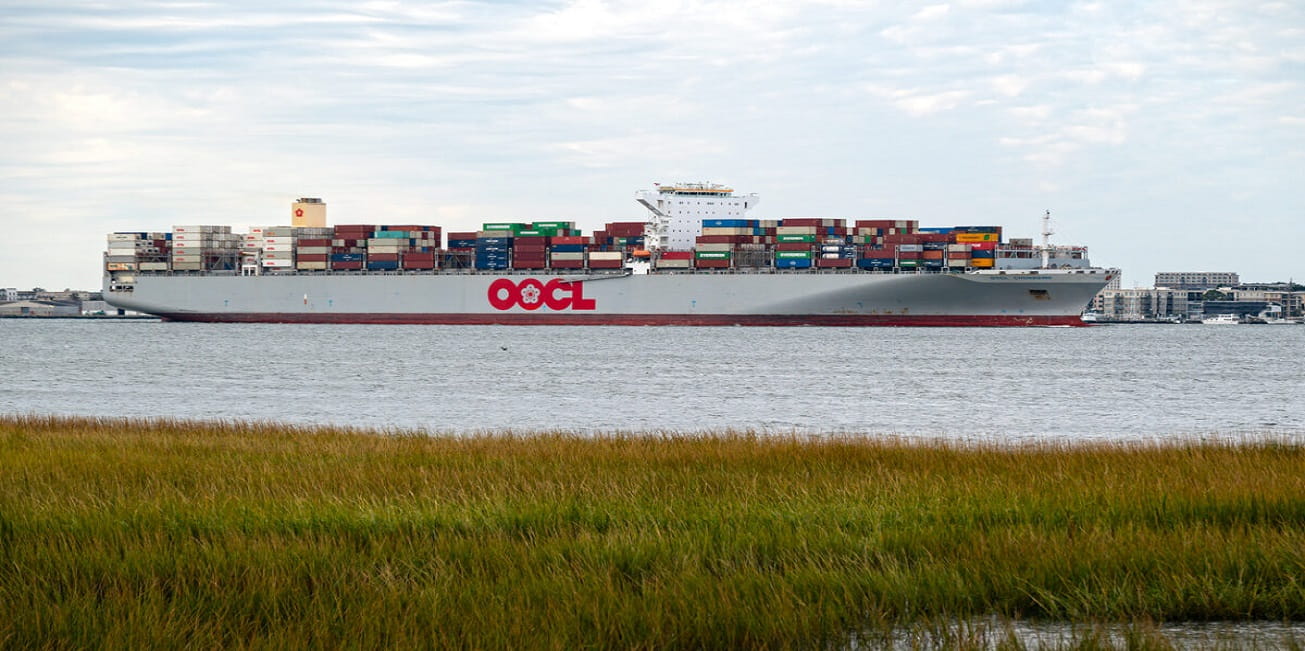
Orient Overseas Container Line (OOCL) has unveiled a new Southeast Asia – Indian Subcontinent Service (SIS), marking its first dedicated route linking Southeast Asia with India’s west coast and Pakistan.
The service, set to commence on 24 April 2026, is designed to provide a direct and reliable connection between key Southeast Asian hubs and the Indian Subcontinent.
The move strengthens regional supply chain links and offers improved access to both Indian and Pakistani markets.
SIS will call at major ports across the corridor, supporting cargo flows between manufacturing centres in Southeast Asia and consumption markets in South Asia.
The rotation is as follows: Laem Chabang-Singapore – Port Klang – Nhava Sheva – Mundra – Karachi Port Klang Singapore-Laem Chabang.
By establishing a direct connection, the carrier aims to reduce transit times and improve schedule reliability for shippers operating between these regions,
The inclusion of key gateway ports such as Nhava Sheva and Mundra in India, alongside Karachi in Pakistan, underlines the strategic importance of west coast South Asia in global containerised trade.
Meanwhile, transhipment hubs including Singapore and Port Klang provide additional connectivity to wider global networks.
With intra-Asia trade continuing to grow, services such as SIS are expected to play a critical role in supporting regional logistics demand, particularly as supply chains diversify and shift closer to end markets.
In March, OOCL announced that will introduce a temporary Emergency Bunker Surcharge (EBS) as disruption to fuel flows through the Strait of Hormuz tightens global bunker availability and raises procurement costs.
Container shipping profits reach $15.4bn in 2025
Global container carriers recorded a combined EBIT of $15.4 billion in 2025, indicating a moderation in eamings but stopping short of a sharp downturn.
Analysis from Seg-Intelligence shows that although profits fell notably from $35.4 billion in 2024 and remain well below the highs seen in 2021 and 2022, overall performance continues to exceed prepandemic benchmarks.
All major carriers that reported results remained profitable at the operating level.
COSCO achieved the highest EBIT at $4.93 billion, followed by Evergreen with $2.36 billion.
OOCL posted $1.54 billion, while Maersk reported $1.39 billion.
At the lower end of the table, ONE and Yang Ming recorded EBIT of $459 million and $472 million, respectively.
On a per-container basis, earnings declined across the board compared with 2024.
ONE saw the – steepest drop, with EBIT per TEU falling to $36.
Despite this reduction, EBIT per TEU figures remain strong when viewed against historical performance.
ZIM reported $277 per TEU, followed by HMM at $257 and OOCL at $195. COSCO reached $180 per TEU, while Yang Ming posted $107, with all exceeding levels recorded between 2010 and 2019.
Meanwhile, Hapag-Lloyd and Maersk returned to more typical historical ranges, reporting $83 and $54 per TEU, respectively, aligning more closely with their early-2010s averages.
Overall, the data points to a sector that has moved past the exceptional profitability of recent years but is still operating above the weaker conditions seen prior to the pandemic.
News comes as major carriers reroute and take operational measures amid escalating conflict in the Middle East, following disruptions in the Strait of Hormuz.
Jubail Port container terminal begins operations
The Saudi Ports Authority (Mawani) has announced the start of operations at the container terminal in Jubail Commercial Port, following a concession agreement with Saudi Global Ports Company (SGP).
The project represents a private sector investment of more than SAR 2 billion ($533 million) and forms part of Saudi Arabia’s National Transport and Logistics Strategy under Vision 2030.
Under the agreement, the terminal has undergone a series of infrastructure and equipment upgrades.
Quay length has been extended from 1,000 metres to 1,400 metres, while berth depth has increased from 14 metres to 18 metres.
Equipment has also been expanded, with ship-to-shore crane numbers rising from six to 10, and rubber-tyred gantry cranes increasing from 13 to 29, including automated and environmentally friendly units.
As a result, the terminal’s annual capacity has grown from 1.5 million TEUS to 2.4 million. TEUS across a total area of 460,000 square metres.
The upgrades are expected to enable the handling of next-generation container vessels and improve operational efficiency.
Engineer Saleh bin Nasser Al- Jasser, Minister of Transport and Logistics and Chairman of Mawani, said the launch reflects continued cooperation with the private sector and confidence in the Kingdom’s investment environment.
He added that the project contributes to the objectives of the National Transport and Logistics Strategy and supports Saudi Arabia’s position as a global logistics hub connecting three continents.
Jubail Commercial Port, located in the Eastern Province, serves nearby industrial cities and plays a key role in handling imports and exports.
Its position supports national industries and links them to regional and global markets.
MSC launches Eagle loop connecting Oceania-Americas
Mediterranean Shipping Company (MSC) has introduced its standalone Eagle service, strengthening direct port connectivity between Oceania and the Americas, including the Caribbean.
The weekly loop is structured to support both import and export flows, with a focus on schedule reliability and transit consistency, factors critical for ports handling time-sensitive cargo such as perishables
The service depfoys optimised el speeds to maintain competitive, transit times while ensuring predictable delivery windows.
From a port and terminal perspective, Eagle establishes direct calls Philadelphia and Savannah key enhancing cargo flows into US East Coast gateways.
These calls are complemented by transhipment operations at Rodman, Freeport and Cristobal, enabling efficient cargo distribution across Latin America and Central America.
The rotation is as follows: Philadelphia – Savannah – freeport – Rodman – Papeete- Auckland – Sydney – Melbourne – Brisbane – Wellington – Tauranga – Rodman – Cristobal- Philadelphia.
MSC reports competitive transit benchmarks across the loop, including 25 days from Tauranga Philadelphia and 31 days from Brisbane to Philadelphia.
On the return leg, Savannah to Auckland is 27 days, while Philadelphia to Sydney reaches 34 days.
The service also integrates with broader intercontinental networks, offering connections to Europe, the Mediterranean, South America and the Caribbean via established hub ports.
This positions Eagle as part of a wider strategy to streamline cargo flows through major transhipment nodes while maintaining direct port pairings where demand supports it.
For terminal operators and port authorities, the service introduces additional weekly volumes and strengthens Oceania-US East Coast trade lanes, with potential knock-on effects for hinterland logistics and cold chain handling capacity.
Recently, MSC moved into the tanker segment through a stake in South Korea’s Sinokor Merchant Marine, according to regulatory filings and multiple industry reports.
Rotterdam advances Europe's largest hydrogen plant
Air Products is advancing construction of its new liquid hydrogen facility at the Port of Rotterdam, with the project now over 65 percent complete and on track for a 2027 start-up.
Once finished, the plant will be the largest liquid hydrogen facility of its kind in Europe, reinforcing Rotterdam’s position as a key hydrogen hub within the region.
The development is set to significantly expand Europe’s liquid hydrogen supply, supporting demand across multiple sectors, including electronics manufacturing, space applications, industrial processing, road mobility, maritime, aviation and emerging energy markets.
Integrated into Air Products’ existing hydrogen network within the Rotterdam industrial cluster, the facility will supply customers across the Benelux, France, Germany and the UK, strengthening cross-border energy distribution.
For ports and terminals, the project signals continued momentum in hydrogen infrastructure deployment, with implications for future bunkering, landside energy integration and industrial decarbonisation strategies.
Boudewijn Siemons, CEO of the Port of Rotterdam Authority, said: “As Europe’s largest port and a key energy hub, Rotterdam is committed to enabling the development of Europe’s hydrogen economy.
Air Products’ investment strengthens the infrastructure needed for industrial decarbonisation and ensures a reliable, locally available hydrogen supply for businesses across the region.”
Recently, six rail operators active on the Port Railway Line in Rotterdam agreed to a new framework aimed at improving operational coordination and reducing disruption across the network.
Air cargo demand rises 11.2pc in February
Global air cargo demand rose 11.2 percent year on year in February 2026, outpacing capacity growth of 8.5 percent, reported Mumbai’s STAT Trade Times.
International operations recorded a slightly higher increase of 11.6 percent.
Capacity, measured in available cargo tonne-kilometres, grew 8.5 percent compared with February 2025, including a 9.8 percent rise in international capacity.
Willie Walsh, director general of the International Air Transport Association, said demand was partly boosted by shipments ahead of the Lunar New Year but warned that war in the Middle East had created uncertainty for the rest of the year.
Mr Walsh noted rising fuel costs, shortages in some regions and disruption to Gulf cargo hubs as key challenges.
He said an early resolution of the conflict, along with stable fuel supply and pricing, would benefit the sector.
Global goods trade rose 5.2 percent in January, while jet fuel prices increased 1.2 percent in February.
Manufacturing activity strengthened, with the global Purchasing Managers’ Index rising to 53.1 and new export orders reaching 51.4, their highest since July 2021.
African airlines posted the strongest growth, with demand up 21 percent and capacity 17.3 percent.
Middle Eastern carriers followed with demand rising 16.5 percent and capacity 13.5 percent.
Asia-Pacific airlines saw demand grow 13.6 percent and capacity 10.1 percent.
North American carriers reported demand up 9.4 percent and capacity 5.3 percent, while European carriers recorded demand growth of 6.9 percent and capacity 6.1 percent.
Latin American and Caribbean airlines posted the weakest performance, with demand up 0.7 percent and capacity 4.5 percent.
Air freight volumes increased across all major trade lanes.
The Africa??sia corridor recorded the fastest growth at 61.9 percent, marking its eighth consecutive month of expansion.
Middle East-Asia traffic rose 24 percent, while Europe-Asia grew 13.1 percent, extending a 36- month growth streak.
Other routes including Asia-North America, Europe??iddle East and intra-Asia also recorded steady gains.
Pak economy expands 3.89pc in Oct-Dec
ISLAMABAD: Pakistan’s economy grew by 3.89 percent in the October-December quarter of 2025-26, showing an increase from 2.18pc recorded in the same period last year.
The economy also recorded a slight improvement compared to the revised 3.63pc expansion in the first quarter (July-September), despite a slight slowdown in the growth of the agriculture and industrial sectors, according to data released by the National Accounts Committee (NAC) the other day.
The services sector posted a slight improvement over the first quarter, partly offsetting the deceleration observed in the other two sectors.
The year-on-year quarterly growth was mainly driven by a 740pc increase in the industrial sector followed by 1.76pc growth in the agriculture sector and 3.63pc of in the services sector.
The combined performance of these three key sectors contributed expansion during the quarter.
Industrial, services sectors drive growth despite agriculture slowdown
The NAC slightly revised the GDP growth to 3.63pc in QIFY26, down from the earlier 3.71pc.
It finalised GDP growth at 2.62pc in (FY24, slightly lower than the previous estimate of 2.63pc, and the revised growth for FY25 is 3.06pc, down slightly from the earlier estimate of 3.09pc.
The State Bank of Pakistan (SBP) expects GDP to grow at 4pc la for FY26.
The World Bank projection is slightly below the SBP at 3pc by the end of June 2026.
However, the government has projected a 4.2pc expansion in FY26, a target that seems ambitious.
The 115th meeting of the NAC, chaired by the Planning Commission secretary, took place on Thursday at the Pakistan Bureau of Statistics headquarters.
The meeting approved the updated annual growth rates for FY25.
The analysis of the second quarter showed that the agriculture sector grew by 1.76pc in Q2 compared to the same period last year.
Important crops have shrunk by 1.87pc in Q2, mainly due to a decline in cotton production 0.9pc) and increases in inputs such as seeds (6pc) and fertiliser (7.2pc).
Other crops contracted by 5.69pc compared to 19.14pc last year, driven by falling green fodder production (-12.8pc) and higher input use.
Livestock increased by 5.59pc versus 5.56pc last year because of a decrease in input costs.
The forestry and fishing industries are growing by 3.76pc and 0.77pc, respectively, maintaining their usual growth trends.
The industry sector has witnessed growth of 7.40pc, com- 7.40pc, compared with 0.78pc last year.
The analysis shows that the mining and quarrying industry is experiencing negative growth of-2.46pc due to declines in production of gas (-3.98pc), marble (-10.68pc), limestone (-8.35pc), and other minerals (-5.91pc).
Large-Scale Manufacturing (LSM) growth is driven by QIM, which grew 5.71pc in Q2 of 2025- 26.
Major contributors have been Automobiles (52.95pc), transport equipment (40.81pc), and petroleum products (24.65pc).
A growth of 15.11pc has been reported in electricity, gas, and water supply, driven by an increase in the quarterly subsidies (from Rs217 billion to Rs323 billion) and a decline in the CPI electricity deflator (from 283.60 to 256.41).
The construction industry, estimated to have grown by 10.53pc, is based on output indicators.
Production of cement increased by 8.44pc during Q2FY26 compared to the same quarter last year.
The services industry grew by 3.69pc in Q2 of 2025-26 compared to 2.80pc in Q2 of the previous year.
Wholesale and retail trade increased by 4.46pc, driven by growth in agriculture (2pc), manufacturing (6.1pc), and imports (1.3pc).
The transport and storage sector expanded by 2.79pc, up from 2.68pc during the same period last year, mainly supported by higher output in road transportation, including trucks, buses and wagons.