
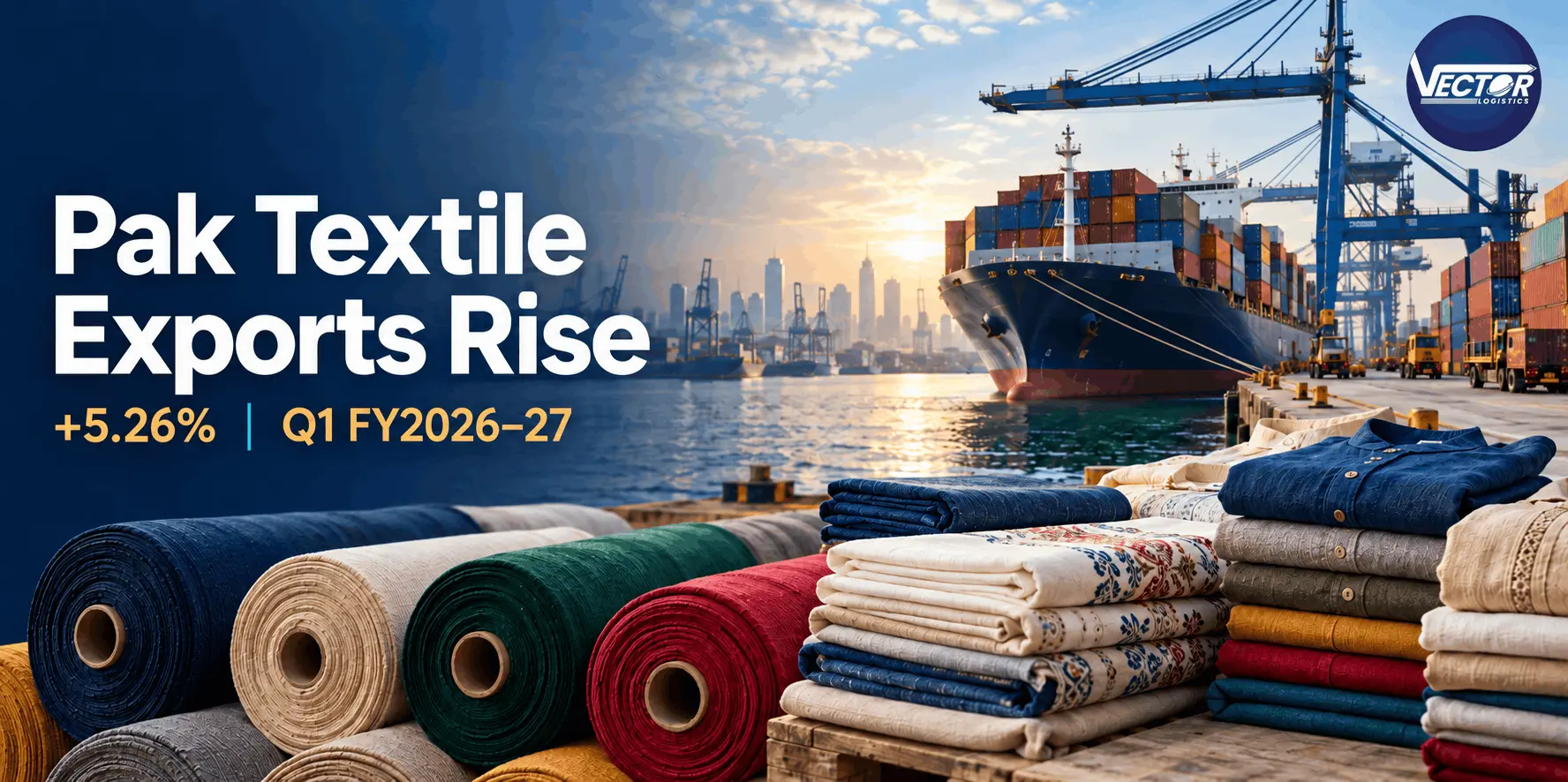
ISLAMABAD: Pakistan’s textile and clothing exports rose 5.26 percent to $5.026 billion in the first quarter of 2026-27 from $4.775bn in the same period last year.
The marginal rise in export proceeds was attributed to elevated input costs, which eroded exporters’ competitiveness, and external shocks that disrupted shipments, according to data from the Pakistan Bureau of Statistics released reached on Thursday.
PBS data showed readymade garment exports surged 15.69pc in value and 17.38pc in quantity during July-September FY27, while knitwear rose 14pc in value but fell 0.46pc in quantity.
By contrast, bedwear dipped 0.07pc in value and 0.71pc in quantity.
Pakistan’s oil import bill rose hat 6.50pc in 1QFY27 to $4.02bn from a $3.77bn a year ago.
Data showed import of crude oil jumped 23. 10pc in value, with a decline of 6.87pc in quantity, indicating that the higher value of crude oil is due to rising international oil prices.
Global Container Trade Sets New Record as August Shipments Reach 17.46 Million TEU
The latest data from Container Trade Statistics (CTS) confirms that global container shipments reached a historic high of 17.46 million TEU in August, with freight rates climbing to their highest level in more than two years.
For the first eight months of 2026, cumulative global container throughput reached 133 million TEU, representing year-on-year growth of 4.7%.
CTS reports that August global container shipments surpassed the record se just one-month prior in July, advancing 3.7% compared to August 2025.
Global container trade sustained its growth trajectory despite a range of persistent adverse conditions, including rising fuel costs, restricted transit through the Strait of Hormuz, Panama Canal limitations, and shifting tariff conditions.
August volumes registered 7.2% above the same period in 2024 and 12.9% above August Ports 2023 levels.
According to CTS data, the global price index reached 117 points in August – its highest reading since July 2024 – standing approximately 50% above January 2026 levels and 44% above August 2025 levels.
CTS attributes the rise in the freight rate index to pricing pressure that has accumulated steadily since late February.
Vessel diversions on major trade lanes have disrupted operational continuity, constraining available capacity and elevating operating costs, with both factors exerting upward pressure on rates.
North American container import volumes registered 2% growth year-on-year through August, extending the gradual recovery trajectory that has been in place since May 2026.
Increased exports from Asia have supported this recovery, with trans-Pacific trade volumes recording cumulative growth of 5% for the year to date.
Sub-Saharan Africa posted the highest import growth rate of any region, advancing 13% through August.
The Indian Subcontinent and Middle East region stands as the sole market to record both import and export declines: imports have fallen 5% year to date, while exports have contracted 10%, representing a reduction of nearly one million TEU against the first eight months of 2025.
Asian exports have expanded 8% year to date, adding approximately 6.3 million TEU relative to the same period in 2025.
European exports, which declined in the opening months of the year, have since recovered to broadly flat levels.
CTS attributes this improvement to stabilising or increasing cargo flows across the majority of destination markets.
Despite August’s record- breaking shipment volumes, CTS cautions that a deceleration in month-on-month growth may signal softening demand, identifying volume performance and freight rate trajectory as the defining questions for the final quarter of 2026.
Long Beach breaks cargo record S as volumes near 1m TEUS
The Port of Long Beach handled 997,177 TEUS in September, its busiest month in 115 years, with container volumes rising 25 percent year on year.
The total surpassed the previous monthly record of 987,191 TEUS set in October 2024.
CEO Dr Noel Hacegaba announced the figures during his Supply Chain Insight media briefing on 15 October.
The port attributed the increase to shippers’ cost-saving strategies amid high diesel costs, Panama Canal access restrictions and a possible new US-China trade deal.
It reported that terminal operators and dockworkers handled the higher volumes without congestion.
Imports increased 31.3 percent to 509,390 TEUS compared with September 2025, while exports rose 7.8 percent to 91,747 TEUS.
Empty container movements grew 22.1 percent to 396,040 TEUS.
Across the first nine months of 2026, Long Beach handled 7,675,255 TEUS, an increase of 3.9 percent compared with the same period last year.
“Shippers continue to lean on the Port of Long Beach as a reliable partner in their business strategies, leading to our historic month for cargo,” Hacegaba said.
“Every milestone brings us closer to achieving our long-term goal of doubling cargo volumes to 20 million TEUS annually by 2050 as we build the Port of the FutureTM. “
Total Terminals International also set a monthly rail record for the port in September, handling 59,410 moves.
Rail accounted for nearly half of the terminal’s total container volume.
During the briefing, Hacegaba discussed agricultural exports the potential impact of diesel prices in the coming months with Peter Friedmann, Executive Director of the Agriculture Transportation Coalition.
The programme will provide additional evening and Saturday gates, giving customers more flexibility to access terminals.
It is scheduled to begin in late October, two weeks before the bridge closure, and run for six weeks, excluding Thanksgiving week.
“We are proud to do this in partnership with our marine terminal operators, the International Longshore & Warehouse Union and the Harbor Trucking Association to minimize impacts to traffic and cargo flow,” Hacegaba said.
The Port of Long Beach will remain fully open and moving cargo with efficiency during the bridge closure next door.”
Food exports surge 25pc in July-Sept
ISLAMABAD: Pakistan’s raw food exports surged 25.31 percent in the first quarter of the current fiscal year, compared with the same period last year, driven largely by higher rice shipments.
According to data compiled by the Pakistan Bureau of Statistics, imports of raw food items rose by just 3.44pc in July-September 2026-27, indicating a slowdown.
In absolute terms, food exports reached $1.388 billion in 1QFY27, up from $1.108bn in the corresponding period last year.
This increase is mainly driven by higher rice export value.
In FY26, exports of raw food products fell 29.49pc to $5.017bn from $7.116bn in the preceding fiscal year.
Rice shipments drive growth to $1.39bn; imports grow just 3.44pc Food imports reached $2.330bn in 1QFY27, up from $2.252bn over the last year.
The government has already approved a plan to import wheat to plug shortfalls in local production.
In FY26, the food import bill surged 11.66 to $9.150bn, up from $8.195bn in the preceding fiscal year.
Other products that contribute to the rise in exports include fish products, tobacco, oilseeds and meat products.
The government has also allowed the export of 200,000 tonnes of sugar in the current fiscal year.
Product-wise data show that rice exports surged 55.89pc in 1QFY27.
Exports of basmati rice, however, jumped 86.28pc and non-basmati by 39.20pc in value.
The increase was also noted in quantity for both basmati (80.21pc) and non-basmati (43.55pc), respectively.
The Ministry of Commerce extended the rice export subsidy scheme by another three months, until Sept 30, and raised the Duty Drawback of Local Taxes and Levies (DLTL) rate for non-basmati rice to support exporters facing weaker international demand.
Similarly, meat exports grew by 21.09pc in IQFY27 on a YoY basis.
Fish product exports grew by 14.61pc.
Most other food products recorded negative growth.
Vegetables registered the steepest fall, plunging by 20.48pc, and fruits by 30.62pc.
Tobacco exports grew by 44.21pc, and spices by 18.94pc during 1QFY27.1
On the import side, palm oil accounted for the largest share of imported food items, followed by pulses, tea, and soyabean oil.
Palm oil imports dipped 2.30pc in 1QFY27.
In terms of quantity, palm oil dipped 13.75pc.
Pulse imports shrank by 12.07pc in July-September.
Soyabean oil imports remained negligible.
The import bill for all other food items rose 24.19pc, tea 25.54pc and milk products 2.80pc in 1QFY27.
Taicang Port Launches Direct Container Express Service to the Middle East
A vessel carrying nearly one thousand containers of export cargo has departed from the Zhonghe Xing Terminal at Taicang Port, bound for Jeddah Port in Saudi Arabia-marking the official launch of Taicang Port’s direct container express service to the Middle East.
Jeddah Port stands as the largest deep-water hub port along Saudi Arabia’s Red Sea coastline and serves as a core conduit for China’s Belt and Road Initiative and Saudi Arabia’s Vision 2030.
With reach extending across Saudi Arabia and close to 30 countries and regions throughout the Middle East, the port occupies a position of considerable strategic possible importance.
The inauguration of time for this direct express service establishes an efficient and reliable new maritime logistics corridor linking the Yangtze River Delta region with Saudi Arabia and its Middle Eastern neighbours.
To support the successful launch of the new route, the Taicang Maritime Safety Administration leveraged its professional expertise to safeguard the route’s safe and stable operation.
Recognising the time-sensitive nature of express sailings, the Administration established a dedicated green channel for administrative approvals, implementing flexible processing procedures to compress vessel clearance timelines to the greatest extent possible – ensuring zero waiting time for import and export approvals and delivering measurable savings in both time and cost for shipping enterprises.
During the vessel’s departure, the Administration coordinated traffic management with precision, monitored meteorological and hydrological conditions closely, and deployed its smart maritime platform alongside multiple digital tools to track vessel movements in real time, ensuring the ship’s safe transit in and out of port.
Port of Savannah Sets September Record With 504,015 TEUS
The Port of Savannah moved 504,015 twenty-foot equivalent units (TEUs), the standard measure of container cargo, in September.
The total marks a record for the month and a 3.7 percent increase over September 2025.
The result extends a period of steady growth for Georgia Ports Authority (GPA) as cargo owners prepare for the final stretch of the year.
September’s performance brings Georgia Ports’ fiscal year first quarter to more than 1.5 million TEUS, an increase of 40,560 TEUS, or 2.7 percent, over the same period last year.
The quarter is the second-best in GPA’s history, trailing only the first quarter of fiscal year 2023.
Inland, the Appalachian Regional Port recorded a 13 percent increase in volumes for the quarter compared with the same period a year earlier.
Strong consumer spending and an extended peak season drove September’s trade growth.
Typhoon-related delays at Asian ports pushed peak shipping volumes later into the calendar, shifting demand into September.
Ocean carriers responded by leaning on Savannah’s fluid terminal operations and its proximity to major retail distribution centers.
Imports led the gains, with loaded import containers rising 5.5 percent over September 2025.
For retailers and manufacturers moving goods ahead of the holiday season, that capacity provided a dependable outlet as Asian schedules shifted.
“Thanks to our Georgia Ports employees, Gateway Terminals and the ILA, we are providing world-class service to our customers while handling record volumes,” said Griff Lynch, CEO of Georgia Ports Authority.
Infrastructure Investments Strengthen Capacity and Fluidity GPA continues to expand the infrastructure behind its growth.
The $1.6 billion renovation of Ocean Terminal is now more than 60 percent complete.
Once finished, the project will raise the terminal’s capacity from 200,000 TEUS to 1.75 million TEUS, adding significant room for future cargo growth.
“We know our customers have a choice and we’re thankful for their choosing Georgia Ports,” said Kevin Price, President of Georgia Ports Authority.
“The capital investments we’ve made are now paying off in service levels for our customers and fluidity for our trucking partners.”
Landside access has improved as well.
The Brampton Road Connector, a Georgia Department of Transportation project that opened in July 2026, created a third high-volume truck corridor to Gate 3 at Garden City Terminal.
The route lets trucks avoid local neighborhood roads and at-grade rail crossings, where tracks meet the road at street level.
For shippers and the trucking partners serving them, that means a more direct path between the terminal and the wider highway network.
“This September performance speaks volumes about our team and shows Georgia Ports is the key gateway to Georgia and the Southeast,” said Georgia Ports Authority Chairman Alec Poitevint.
“I want to thank Gov.
Kemp, the General Assembly and Georgia Dept.
of Transportation Commissioner Russell McMurry and his team for supporting a statewide logistics network that has helped make Georgia the best state to do business for 13 years in a row.”
Conditions in the Panama Canal are also improving, a welcome sign for cargo owners routing goods to the U.S. East Coast.
With the start of the rainy season, the Panama Canal Authority has reported better conditions at Lake Gatun, the reservoir that supplies water for canal operations.
The Port of Brunswick handled 43,415 units of roll-on/ roll-off (RoRo) cargo in September.
RoRo cargo, such as vehicles and equipment, is drive on and off ships rather than lifted by crane.
The total represents a 22 percent decrease compared with September 2025, as global market conditions for vehicle manufacturers remain competitive.
Heavy machinery told a different story.
Brunswick moved 3,754 heavy machinery units in September, up from 3,359 a year earlier, an increase of nearly 12 percent.