
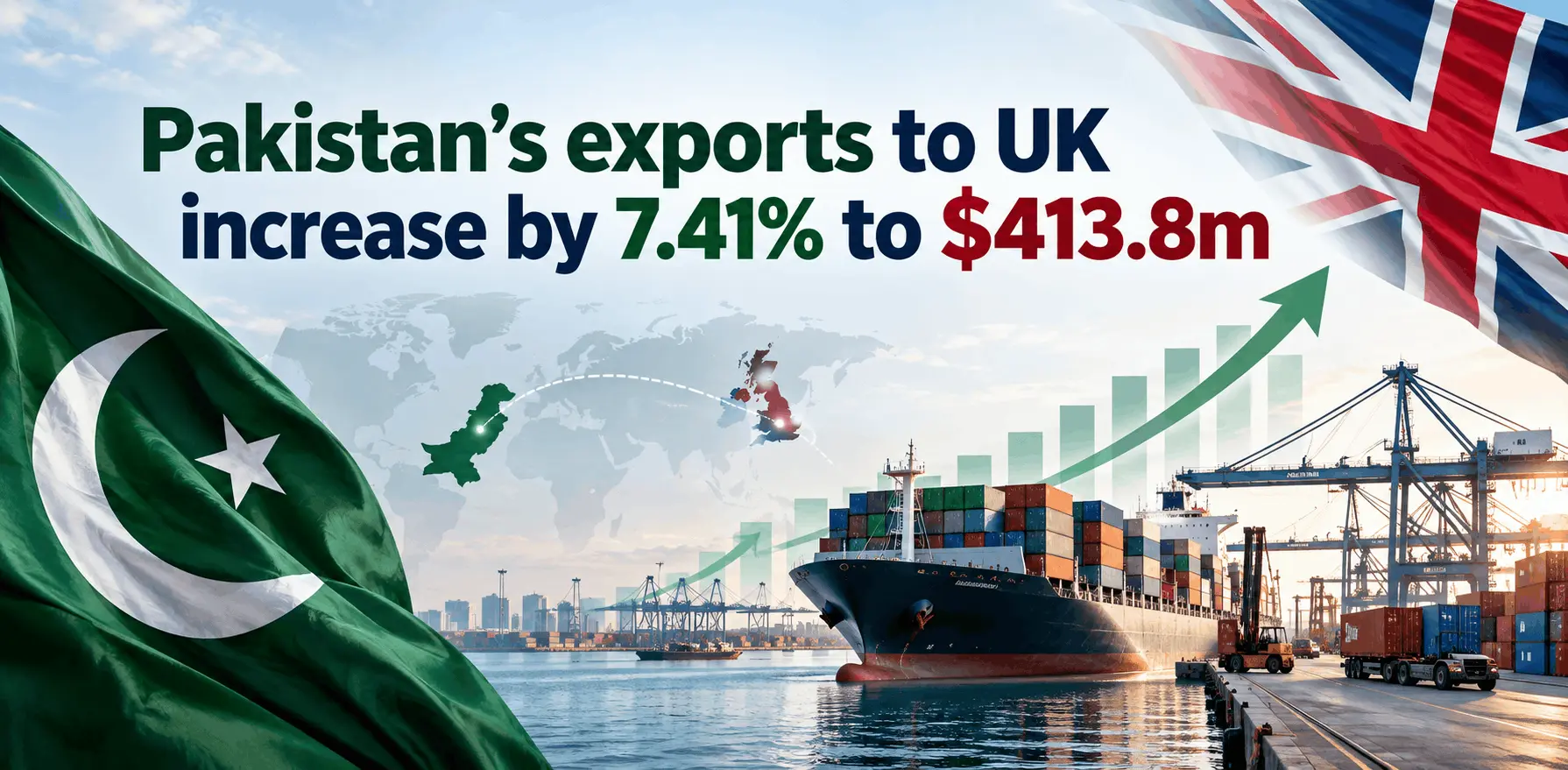
Pakistan’s export of goods and services to the United Kingdom (UK) witnessed an increase of 7.41 percent during the first two months of the current fiscal year (2026-27) as compared to the exports of the corresponding months of last year, the State Bank of Pakistan (SBP) reported.
The overall exports to UK were recorded at $413.801 million during July-August (2026-27) against exports of $385.224 million during July-August (2025-26), SBP revealed.
On a year-to-year basis, exports to UK increased by 6.29 percent from $182.075 million in August 2025, against the exports of $193.545 million in August 2026.
Meanwhile, on a month-on-month basis, expons to UK decreased by 12.12 percent during August 2026 as compared to the exports of $220.257 million in July 2026, the SBP data revealed.
Overall Pakistan’s exports to other countries witnessed an increase of 3.97 percent in the first-two months, from US $5.237 billion to US $5.445 billion, the SBP data revealed.
On the other hand, the imports from UK into the country during the months under review were recorded at US$213.534 million against US $127.847 million last year, showing an increase of 67.02 percent in July -August (2026-27).
On a year-on-year basis, imports from UK increased by 112.86 percent to US $133.486 million in August 2026, against the imports of US $62.709 million in August 2025.
On a month-on-month basis, the imports from UK into the country also increased by 66.75 percent during August 2026, as compared to the imports of US $80.048 million during July 2026, according to the data.
The overall imports into the country increased by 11.34 percent, from $10.449 billion to US $11.634 billion, according to the data.
HD Hyundai Delivers World's First "Lashing- Free" Containership to CMA CGM
South Korean shipbuilding group HD Hyundai is reporting the delivery of its first container vessel using the company’s newly developed “Lashing-Free” system that eliminates the need for workers to manually secure containers on board.
It highlights benefits of increased capacity and ease of handling while also reporting that the system will be able to handle heavy weather and provide other benefits to the ships.
The system was installed on a new containership built for CMA CGM, which underwent sea trials in September.
The ship has a capacity of 13,000 TEU while using HD Hyundai’s hybrid-type Lashing-Free Technology.
The ship is methanol-fueled and otherwise appears to use a conventional layout for the placement of containers above deck.
HD Hyundai Heavy Industries reports it independently developed and validated all key components of the Lashing-Free technology.
HD Hyundai Samho was responsible for the detailed design and construction of the vessel incorporating the system.
The vessel extends the cell guides, which support containers stacked vertically in alignment inside the cargo hold, above deck.
HD Hyundai says that it also incorporates technologies designed to prevent cargo loss and maximize logistics efficiency.
The technology the shipbuilder says is expected to play a key role in accelerating automation and unmanned operations across the broader logistics network connecting land and sea, including container terminals.
The Lashing-Free containership removes the need for manual container lashing, which traditionally is carried out by workers using lashing equipment on large container vessels.
Improperly attached containers and failures of the locking system have often been cited as a concern and one of the potential contributors to stack collapse or overboard containers.
The conventional large hatch covers used on container vessels currently would obstruct the extended cell guides, preventing them from reaching above deck.
To overcome this structural limitation, HD Hyundai Heavy Industries developed a standardized “portable bench” that can be installed between the cell guides.
The portable bench is built to the same dimensions as a 40-foot container, allowing it to be handled using the same port cranes used to load and unload containers.
HD Hyundai Heavy Industries has also developed a “Twist lock Rooting System,” which it says securely fastens containers stowed outside the cell guide area to the vessel’s structure.
Sea trials conducted by HD Hyundai in September for this first vessel, it says, also showed that the Lashing-Free system significantly reduces vibration during operation compared with conventional designs using hatch covers and lashing bridges.
HD Hyundai reports another benefit of the system is that the Lashing-Free containership can carry over 10 percent additional cargo weight on deck compared with conventional vessels of the same type.
Global Ship Lease (Youroukos) takes orderbook to 17 ships
Greece’s containership owner and lessor Global Ship Lease exercised options to build two additional mid-size, ultra-high-reefer, wide-beam, latest-generation containerships for an aggregate contract price of approximately $163m.
The company said the exercise of newbuild options is subject to certain conditions precedent being met.
The additional newbuilds are scheduled to be delivered in the fourth quarter of 2029.
The New York-listed Global Ship Lease said it is in discussions with ‘prospective charterers’ regarding their employment upon delivery.
The latest move takes the George Youroukos-led company’s newbuilding orderbook to 17 ships.
George Youroukos, executive chairman of Global Ship Lease, commented: “We are strong believers in the value proposition of high specification, highly flexible, mid-sized containerships and expect them to play a crucial role for our industry for many years to come.
“By exercising these additional newbuild options, we are very pleased to be growing our exposure to this increasingly valuable vessel class on attractive terms agreed earlier this year and at prices no longer available in the market for comparably specified ships with 2029 deliveries.”
New York-listed Global Ship Lease is an owner containership with a diversified fleet of mid-sized and smaller containerships.
The company’s operating fleet of 71 containerships as of June 30, 2026, had an average age weighted by TEU capacity of 18.4 years.
41 ships are wide-beam postpanamax.
As of June 30, 2026, Global Ship Lease’ fleet also included 15 newbuilding containerships under construction with scheduled deliveries between the fourth quarter of 2028 and the first quarter of 2030.
Pakistan's seafood exports reach $125m in 1QFY27
Federal Minister for Maritime Affairs Muhammad Junaid Anwar Chaudhry said on Monday that Pakistan’s fish and seafood exports clocked at $125.4 million during the first quarter of the current fiscal year, against $93.28 million during the first quarter of 2025-26.
The increase in export earnings underscores the growing economic potential of the marine fisheries sector as Pakistan seeks to expand its blue economy Chaudhry said in a statement.
The minister said in terms of volume, exports increased from 35,294MT in Q1 2024-25 to 43,995MT in Q1 2025-26 and reached 61,679MT in Q1 2026-27.
The minister noted that both the value and volume of fish exports had grown substantially over the past three years, with the rise in export earnings broadly keeping pace with the increase in volume.
He said the fisheries sector was an important component of Pakistan’s coastal economy, providing livelihoods to fishing communities while generating foreign exchange through exports of fish and other marine products.
Chaudhry appreciated the performance of the Marine Fisheries Department, particularly its record export earnings of $568 million during FY2025-26. Order Seafood
He said the opening of new international markets, particularly Russia, for Pakistani fisheries products was another significant achievement.
He said recent initiatives to resume shrimp exports to the United States, along with the revival of the fishing licensing regime in Pakistan’s Exclusive Economic Zone (EEZ), would help promote the sustainable utilisation of the country’s marine fisheries resources.
The minister stressed the need to address institutional, technical and capacity-related bottlenecks to enhance fish and seafood exports to lucrative international seafood markets, particularly the European Union.
He also called for the revival and restoration of the Fisheries Training Centre (FTC) of the Marine Fisheries Department to strengthen human-resource capacity, improve technical and professional standards, and enhance compliance with international fisheries and seafood safety requirements.
Chaudhry reiterated his commitment to modernising the fisheries sector, promoting the sustainable utilisation of marine resources, expanding increasing the sector’s contribution to the national economy. Track Freight
Wallenius Wilhelmsen eyes up to 12 more car carriers
Wallenius Wilhelmsen has raised about NOK2 88m (5300m) fresh equity as it prepares to add four large LNG dual-fuel car carriers with options for another eight.
The Oslo-listed group completed a private placement late on Tuesday, issuing 17.145m shares at NOK 168 each.
The company said the proceeds, together with debt financing, would be used to fund an expanded newbuilding programme.
Wallenius Wilhelmsen is in advanced discussions with shipyards for four large LNG dual-fuel vessels scheduled for delivery in 2030.
The negotiations also cover options for another eight ships on similar terms, with quarterly deliveries from 2031 onwards.
No yard, vessel capacity or contract price has yet been disclosed, and shipbuilding contracts have not been signed.
If all eight options are exercised, the company said its newbuilding programme would reach 26 vessels including options, with deliveries stretching from the third quarter of 2026 through 2032.
The fresh tranche adds a different fuel configuration to the car carrier giant’s fleet renewal push.
Splash has tracked Wallenius Wilhelmsen’s existing Shaper class programme at China Merchants Jinling Shipyard, where the company built up a 14-ship orderbook, including eight units upsized to 11,700 ceu.
Those vessels were designed around methanol dual-fuel propulsion and ammonia readiness.
Wallenius Wilhelmsen currently operates nearly 130 vessels across 15 trade routes.
Golar picks NYK carrier for fourth FLNG conversion
Golar LNG has acquired a 2013- built LNG carrier from Japan’s NYK Line for conversion into its fourth floating LNG unit, filling in a key missing piece of its $2.45bn expansion programme.
The Nasdaq-listed FLNG specialist has agreed to buy the 177.427 cum Grace Dahlia, which will become the donor vessel for the 3.5m tonnes per annum MKII FLNG ordered at China’s CIMC Raffles in August.
No purchase price was disclosed.
The acquisition gives the new unit around 20% more LNG storage than FLNG Esperanza, Golar’s first MKII design, which is already under conversion at the same Yantai yard.
The Grace Dahlia will be converted alongside Esperanza, with the fourth FLNG scheduled for yard delivery by the end of 2029.
Golar has pitched the unit as the earliest available new FLNG capacity globally and is in advanced discussions over long-term employment.
Built by Kawasaki Heavy Industries at Sakaide in 2013, the 300- m Grace Dahlia is a Moss-type LNG carrier with four spherical tanks and 177,427 cu m of capacity.
Kawasaki developed the ship with its reheat steam turbine propulsion system.
Splash reported in August that Golar had taken final investment decision on the fourth FLNG, signing an EPC contract with CIMC Raffles worth about $2.45bn on a fully delivered basis.
At the time, the company said a donor vessel had been secured but did not identify it.
The repeat MKII design follows FLNG Esperanza, which is being created from the former 148,500 cum LNG carrier Fuji LNG Conversion is scheduled for completion in late 2027 before the unit heads to Argentina for a 20- year charter with Southern Energy starting in the second half of 2028.
Golar already has two FLNGS operating or committed to long- term work.
Gimi is on a 20-year contract with BP at the Greater Tortue Ahmeyim development off Mauritania and Senegal, while Hilli has left Cameroon for upgrade work in Singapore ahead of a 20-year deployment off Argentina starting next year.
The company has increasingly concentrated around floating liquefaction, selling its last conventional LNG carrier in 2025 after five decades in LNG shipping.