
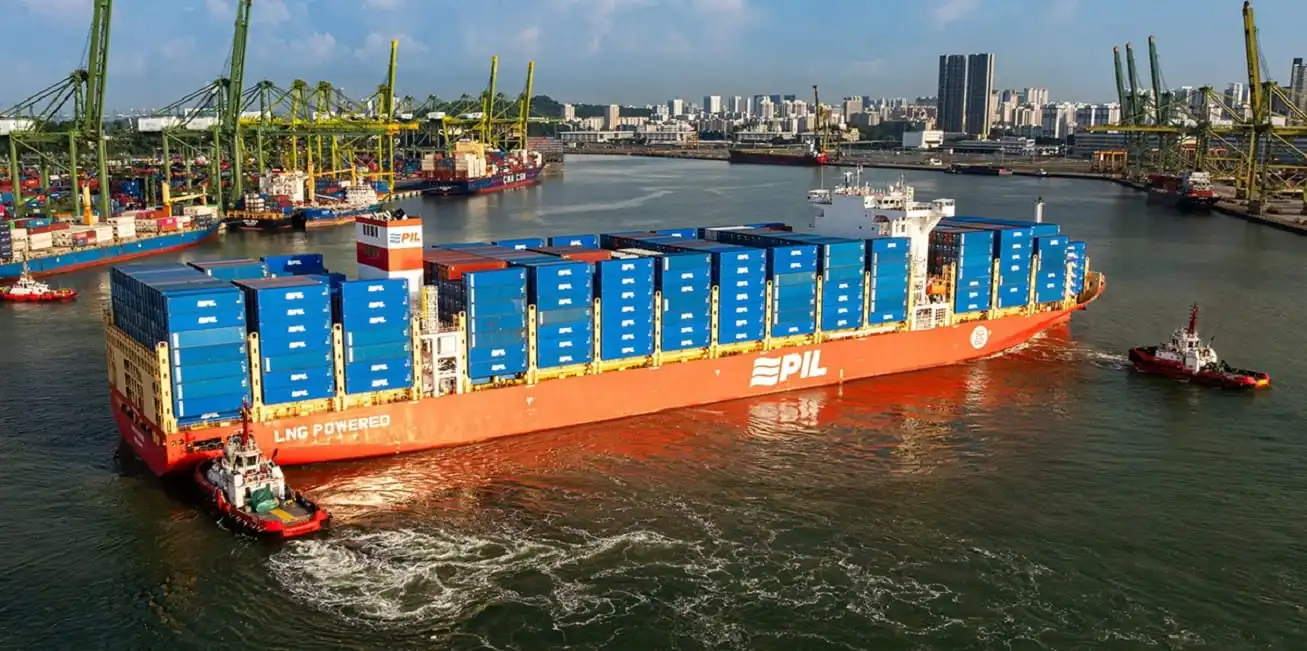
Pacific International Lines (PIL) and PSA International (PSA), with verification support from DNV, have launched Singapore’s first joint land-sea green value-added service for transhipped cargo at the Port of Singapore, aimed at enabling verifiable Scope 3 emissions reductions across supply chains.
The service reportedly allows shippers and cargo owners to allocate carbon reductions generated through the use of lower-carbon fuels across shipping, port, and landside operations.
Pilot trials are scheduled to begin later in May.
The initiative stems from a March 2025 Memorandum of Understanding between PIL, PSA and DNV focused on advancing carbon emissions measurement, reporting and reduction across maritime logistics chains.
PIL will contribute vessel operations and fuel optimisation to generate emissions savings within its shipping network, while PSA will apply port and supply chain capabilities to reduce emissions across terminal and landside movements.
DNV will provide digital systems for standardised emissions data and independent verification.
Lionel Patrice Chatelet, Chief Commercial Officer at PIL, said: “PIL is advancing maritime decarbonisation by leveraging carbon in setting as a practical and impactful lever within our own value chain.
By investing in initiatives that directly reduce or remove emissions across our operations, PIL ensures that emissions reductions are real, measurable, and closely tied to our business activities.
This approach not only accelerates progress toward our climate targets but also enables customers to access lower-carbon shipping solutions.”
Eddy Ng, Group Head of Operations, Technology Sustainability at PSA International, said: “PSA facilitates global trade through responsible stewardship, working with partners to enable efficient, resilient and sustainable trade flows.
Our collaboration with PIL and DNV marks an important step in advancing low-carbon initiatives to support the decarbonisation of maritime supply chains and strengthen Singapore’s position as a hub for sustainable maritime and low-carbon energy solutions.”
The service positions Singapore further within emerging low-carbon logistics frameworks, linking port operations with carrier-level emissions management and independent verification systems.
This expansion follows the recent development that the Saudi Ports Authority issued a unified licence to PIL as an approved foreign investor to carry out maritime agency activities at ports across the Kingdom.
Hambantota Port hits 13,260 TEUS in single-vessel record
Hambantota International Port (HIP) has recorded its highest single-vessel container through put to date after handling MSC Marie Leslie, operated by Mediterranean Shipping Company (MSC), between 11 and 15 April 2026.
During the call, HIP processed 7,968 container moves, equating to 13,260 TEUS, surpassing its previous benchmarks and reinforcing a continued upward trend in high volume vessel handling.
The latest figure exceeds March 2026 records set by MSC Ilenia (12,957 TEUS) and MSC Ruby (11,369 TEUS), indicating strengthening operational capacity and increasing container concentration on individual vessel calls.
Tommy Yang, Chief Operating Officer of Hambantota International Port Group (HIPG), said: “This achievement reflects the coordination, discipline and capability of our teams across all functions.
As volumes continue to increase, our focus remains on delivering safe, efficient and reliable services to our customers.”
The vessel operation was supported by integrated port functions, including operations, engineering, safety and navigation teams, alongside external partners, with an emphasis on maintaining productivity under high density cargo handling conditions.
Located approximately 10 nautical miles from the main East- West shipping lane, HIP has been positioning itself as a transhipment and regional logistics node, with growing emphasis on container operations alongside its broader multipurpose port activities.
The latest performance highlights the port’s increasing ability to accommodate larger container volumes per call, a key metric for transhipment competitiveness in the regional hub landscape, particularly as shipping lines optimise port rotations and cargo consolidation strategies across Asia and the Indian Ocean corridor.
Recently, HIP increased its operational capacity following a surge in global shipping volumes caused by disruptions in the Middle East.
Port Houston TEUS hit 1 million as imports strengthen
Port Houston handled 1.08 million TEUS in the first quarter of 2026, up 2 percent year-on-year and marking another record quarter following 2025’s strong performance.
Total tonnage across its public terminals rose 5 percent to 13.8 million short tonnes.
In March alone, throughput reached 391,037 TEUs, up 1 percent year-on-year.
Loaded imports increased 7 percent, supported by demand for refrigerated goods and retail cargo including furniture.
Year-to-date import volumes are up 4 percent.
Loaded exports declined 6 percent in March but remain up 1 percent year-to-date. Resin exports are expected to strengthen in the second quarter, supporting outbound flows.
Operationally, Port Houston continues to position itself as a key Gulf gateway for petrochemicals and industrial cargo, supported by scale across its container and bulk infrastructure.
The port’s Bayport and Barbours Cut terminals are reported to be capable of handling surges of around 20 percent above forecast growth levels.
Equipment investment continues to support throughput capacity and efficiency.
The final six of 16 rubbertyred gantry cranes (RTGS) ordered in 2025 were delivered in March, bringing the fleet to 163 units across both container terminals.
Around half of the RTG fleet now operates with hybrid-electric systems, delivering up to 90 percent reductions in air emissions and 30 percent lower CO2 emissions compared to diesel units.
Bulk activity was mixed across Port Houston’s multipurpose facilities.
Dry bulk volumes increased 107 percent in March, while liquid bulk rose 23 percent, driven by higher grain and industrial commodity flows.
Steel imports declined 29 percent year-on-year, reflecting softer demand conditions, particularly from energy-related sectors.
Vessel traffic also increased Charlie Jenkins, CEO of Port Houston, said: “The Houston Ship Channel remains an essential artery for our nation.
There were 2,089 vessel calls to the private and public facilities along the Channel in the first quarter of this year, which is 5 percent more than last year.
“Bulk carrier calls were up, as were LPG and chemical tankers, demonstrating continued demand across energy and industrial cargo segments.
There’s no doubt that the recent completion of dredging of the Port-led segments of the Houston Ship Channel Expansion, known as Project 11, is improving vessel efficiency and transit flexibility for all users of the Channel including tankers, bulk, breakbulk, and container carriers.”
The completion of dredging works under Project 11 is expected to further enhance navigational efficiency across container, tanker and bulk segments, supporting longer-term capacity and vessel optimisation along the Houston Ship Channel.
In February, Port Houston reported continued cargo growth, handling 4.38 million short tonnes across its eight public terminals.
Klaipeda Port posts 9pc growth in Q1
Lithuania’s Port of Klaipeda recorded a strong start to 2026, with cargo volumes rising nine percent in the first quarter compared to last year, reported Riga’s Baltic Times.
It was the only Baltic port to post growth, reinforcing its role as the region’s leading gateway.
Klaipeda handled nearly 11 million tonnes in the first three months, with container throughput reaching record highs.
Chief executive Algis Latakas said investments infrastructure and terminal capacity tonnes, had enabled diversification and resilience amid geopolitical shifts.
Container handling surged 38 percent year on year, with more than 374,000 TEU processed.
March delivered the best monthly performance in the port’s history for both tonnes and TEU.
Ro-ro cargo rose five percent to 1.7 million tonnes, while LNG volumes climbed 26 percent to 827,000 tonnes, driven by regional demand as Baltic states reduce reliance on Russian gas.
Fertilizer shipments increased 27 percent to over half a million tonnes, supported by Lithuanian producers and new flows after sanctions on Russia and Belarus.
Oil products held steady at just over one million tonnes.
Declines were seen in grain, minerals, scrap metal and timber, while vessel calls fell seven percent to 1,123 and passenger numbers slipped to 36,000.
Despite weaker segments, Klaipeda outperformed rivals Riga, Tallinn, Ventspils and Liepaja, securing nearly 46 percent of the Baltic market.
Riga held 17 percent, Tallinn 13 percent, Ventspils 7.6 percent and Liepaja 6.5 percent.
Cosco launches North Africa Express service to Libya
Cosco Shipping Lines has introduced a new North Africa Express service linking Chinese ports directly with Libya, reported London’s Container Management.
The service operates every three weeks with three vessels of about 4,300 TEU each.
The 80,000 deadweight tonne box-shaped general cargo and bulk carriers are owned by Cosco Shipping Development and operated by Cosco Shipping Bulk, drawing on assets from across the wider Cosco group rather than the liner division’s own fleet.
The rotation calls at Ningbo, Shanghai, Nansha, Port Said, Benghazi and Misurata before returning to Qingdao.
Libya has had limited direct container services from the Far East, with most cargo historically routed via Port Said transshipment.
Direct calls at Benghazi and Misurata mark a significant change in access for Libyan importers.
Panama Canal handles 6,288 transits in FY2026 H1
The Panama Canal reported higher vessel transits and cargo throughput in the first half of Fiscal Year 2026, alongside increased demand for its reservation system, highlighting sustained pressure on capacity and scheduling.
The update was presented during a market briefing hosted by Anna Milne, Managing Director of Emerging Markets Corporate Research at Bank of America Merrill Lynch, with Canal leadership outlining operational performance.
Dr Ricaurte Vásquez Morales, Administrator of the Panama Canal, said: “The Panama Canal is open and fully operational, thanks to the dedication of some nine thousand Panamanians who keep this waterway running.
“Amid all the geopolitical complexities in the world today, the shifts and various factors affecting international trade, the Panama Canal remains open and reliable.
With water levels currently at optimal levels, we are accommodating an ever-growing volume of traffic.
“There is strong performance coming from container traffic and liquefied petroleum gas.
Energy products are playing an increasingly important role in the volumes we are handling here at the Panama Canal.”
Between October 2025 and March 2026, the Canal handled 6,288 transits, up 224 year-on-year, with cargo volumes reaching 254 million PC/UMS tonnes, an increase of around 5 percent.
Operational activity intensified through the period, with daily averages rising to 34 vessels in January and 37 in March, while peak days exceeded 40 transits, placing greater emphasis on efficient traffic management and scheduling.
Demand for booking systems increased, with operators making greater use of long-term slot allocations and LNG-specific reservations.
The Canal confirmed that all vessels must secure a booking prior to transit, with only a limited number of auction slots available.
Víctor Vial, Vice President of Finance at the Panama Canal, stated: “The average auction price before the Middle East conflict was between $135,000 and $140,000.
Following the outbreak of the conflict, that average climbed to approximately $385,000 between March and April.”
He added that the structured booking system has supported operational predictability, enabling the Canal to manage higher traffic volumes without significant congestion.
On water management, Ilya Espino de Marotta, Deputy Administrator and Chief Sustainability Officer, said reservoir levels remain stable following earlier weather fluctuations, with ongoing monitoring ahead of potential El Niño conditions.
“We don’t anticipate anything significant between now and December, but we continue to monitor the situation closely.
We want to keep the lakes as high as possible heading into the next dry sea-son, so we can continue delivering a high-quality service,” she said.
Overall, the Canal’s performance reflects a combination of stable water availability, stronger energy cargo flows and increased reliance on structured transit systems to maintain efficiency under rising demand.
Recently, Panamanian President José Raúl Mulino moved to ease tensions with China as Panama continued to manage the fallout from the loss of CK Hutchison’s concessions at the Balboa and Cristóbal terminals.
US air cargo market to hit US$91.8 billion by '34
The United States air freight market is projected to expand steadily from US$64.06 billion in 2025 to US$91.81 billion by 2034, reported San Francisco’s Vocal Media.
Growth will be driven by demand for fast, reliable logistics and technology adoption.
The IMARC Group forecast shows a compound annual growth rate of 4.08 percent between 2026 and 2034.
Air freight remains critical for high-value, perishable and time-sensitive goods such as pharmaceuticals, electronics and retail products.
Key trends include rising demand for rapid shipping, expansion of ecommerce, and greater use of artificial intelligence and Internet of Things technologies.
Investments in dedicated cargo aircraft and infrastructure are also supporting growth.
Technology is transforming operations, with AI and data analytics optimising routes and predicting demand, while IoT enables real-time tracking.
Automation is streamlining cargo handling and reducing errors.
The market faces challenges from high operating costs, capacity constraints, environmental concerns and regulatory pressures.
Supply chain disruptions also pose risks to efficiency.
Despite these hurdles, investment opportunities are expanding in cargo aircraft, smart logistics systems and last-mile delivery.
Partnerships between logistics providers and retailers are further driving market expansion.
Analysts expect air freight to remain essential for global trade and ecommerce, with innovation and infrastructure investment underpinning long-term growth through 2034.