
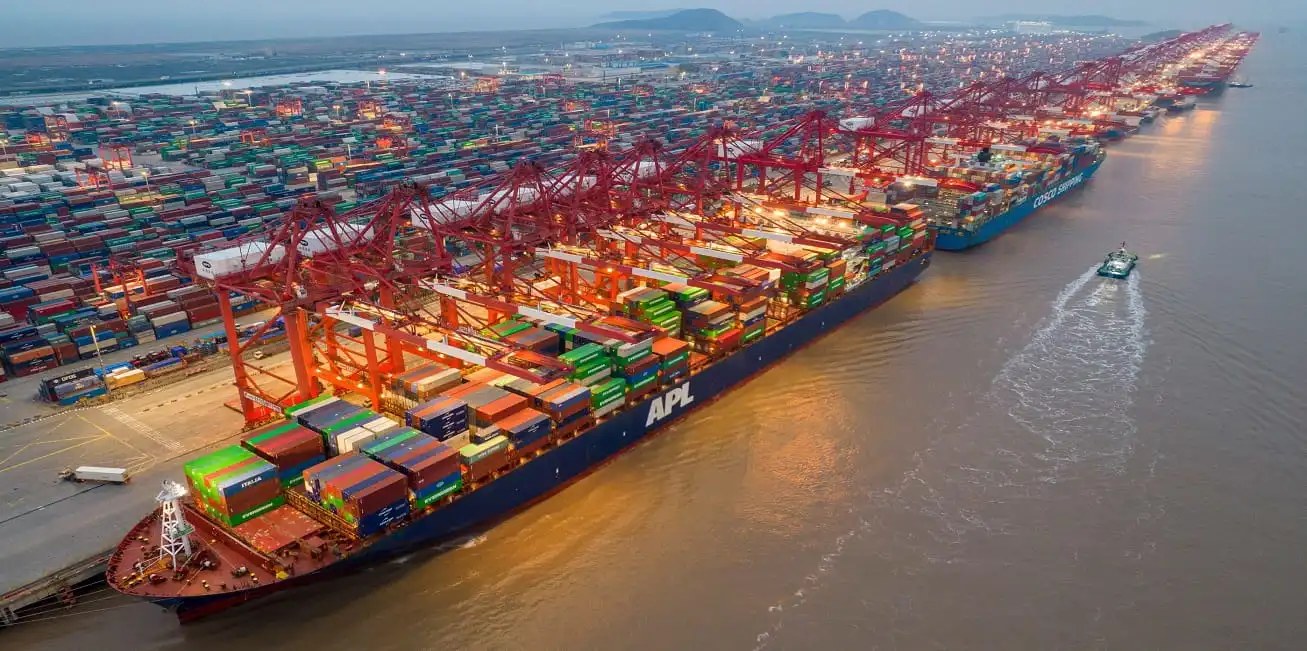
East Asian ports continue to dominate global container throughput despite supply chain disruptions, according to the World Bank.
In 2025, rerouting around the Red Sea, delays at the Panama Canal and wider shocks tested efficiency at the world’s busiest ports, reports Reuters.
Shanghai, China, handled about 49-50 million TEU; Singapore, Singapore, processed 39-40 million TEU; Ningbo- Zhoushan, China, managed 35-36 million TEU; Shenzhen, China, recorded 29-30 million TEU; Guangzhou, China, saw 25-26 million TEU; 25-27 million TEU; Busan, South Korea, handled 22-24 million TEU; Tianjin, China, processed 21-22 million TEU; Jebel Ali, UAE, managed 14-15 million TEU; Port Klang, Malaysia, recorded 14-15 million TEU; Rotterdam, Netherlands, handled 13-14 million TEU; Antwerp-Bruges, Belgium, processed 13-14 million TEU while Los Angeles lifted 10-11 million TEU.
Analysts said these ports rank highly due to their role as major manufacturing and export hubs, supported by deep-water berths and advanced infrastructure.
Strategic locations on global trade routes enable transshipment, while continuous investment in automation and intermodal links has strengthened resilience.
The dominance of East Asian ports reflects their central role in global trade, with China alone accounting for seven of the top 13.
Despite geopolitical tensions and rising costs, these ports remain critical to sustaining container flows worldwide.
Pakistan-UAE trade corridor gets major boost through Gulftainer Rehmat Shipping alliance
(PR)- In today’s fast-moving global trade environment, efficiency is no longer a competitive advantage-it has become a necessity.
The partnership between Gulftainer and Rahmat Shipping (Pvt) Ltd., represents a strong collaboration focused on enhancing trade connectivity between Pakistan and the Gulf region.
By combining local operational expertise with international logistics capabilities, both companies support efficient cargo movement and reliable supply chain operations.
Rahmat Shipping brings extensive knowledge of Pakistan’s maritime sector, operational coordiantion, and customer relationships, while Gulftainer contributes globally recognized expertise in port management, terminal operations, and advanced logistics systems.
Together, they create seamless and efficient logistics framework designed to meet the growing demands of regional trade.
This collaboration is centered around the trade route connecting Karachi, Pakistan (PKKHI), with Khorfakkan, UAE (AEKLF), with SAJAA serving as the final distribution hub.
The integrated network ensures smooth cargo handling, reliable inland connectivity, and efficient distribution across the UAE market.
By combining global standards with strong local market insight, Rahmat Shipping and Gulftainer are building a dependable trade channel that supports long-term regional growth and stronger business relationships.
Hapag-Lloyd announces results
German shipping line Hapag- Lloyd posted weaker earnings in the first quarter of 2026, citing lower freight rates, severe weather disruptions and the ongoing blockade of the Strait of Hormuz, reports St Petersburg’s Sea News.
The company recorded EBITDA of US$494 million, EBIT of $157 million and profit of $256 million.
Chief Executive Rolf Habben Jansen described the performance as unsatisfactory, noting that supply chain disruptions and pressure on freight rates had weighed on results.
He said the Gemini network had proven resilient and the group would remain focused on Strategy 2030 and its merger with ZIM.
Revenues in the liner shipping segment fell to $4.8 billion, with the average freight rate dropping to $1,330 per TEU from $1,471 per TEU a year earlier.
Transport volume was 3.2 million TEU, nearly unchanged from the prior-year quarter, despite bad weather in Europe and North America and the Hormuz blockade.
EBITDA in the segment decreased to $447 million, while EBIT fell to $-174 million.
In the terminal and infrastructure segment, revenue rose to $168 million, supported by the full consolidation of J M Baxi’s container business and strong growth in Latin America and India.
EBITDA increased to $47 million, while EBIT reached $18 million.
Qatar Cargo ups freighter and belly capacity
Qatar Airways Cargo will expand its offered cargo capacity by 12 percent through new freighter services and increased belly hold space on passenger flights, reported London’s Air Cargo News.
The carrier has relaunched Boeing 777 freighter flights to Vienna and added a second 777F to Warsaw.
The Vienna service runs Doha-Budapest-Vienna- Doha, while the Warsaw freighter operates Doha-Budapest-War- saw-Doha.
Belly hold capacity is rising with new passenger routes.
A Caracas service via Bogota begins 22 July with 20 tonnes each way.
Flights to Helsinki restart 15 July with four weekly services, rising to seven in August, lifting belly capacity from 40 to 70 tonnes.
Tokyo Haneda returns 16 July with four weekly flights, increasing to seven in August, boosting belly capacity from 60 to 105 tonnes.
Frequencies are increasing across Africa and the Americas.
Addis Ababa flights now use 777s with 44 tonnes weekly capacity.
Tunis flights rose to 10 weekly with 105 tonnes.
In the US, Dallas flights grew to 10 weekly with 54 tonnes, Houston to five weekly plus two freighters totalling 228 tonnes, and New York to 14 weekly with 88 tonnes.
Sao Paulo flights increased to 14 weekly, alongside four freighters, giving 479 tonnes.
Asia capacity is also expanding.
Dhaka flights rose to 17 weekly with 315 tonnes.
Hong Kong now has 14 weekly passenger flights plus 42 freighters, totalling over 4,474 tonnes.
Kathmandu flights increased to 21 weekly with 270 tonnes.
Kuala Lumpur will rise to 21 weekly from 16 June, totalling 683 tonnes with freighters.
Shanghai flights increase to 10 weekly from 1 June, plus eight freighters, totalling 985 tonnes.
In Europe, Istanbul flights rose to 17 weekly plus two freighters, totalling 390 tonnes.
Vienna flights increased to seven weekly with 73 tonnes belly hold and 100 tonnes freighter capacity.
Warsaw now totals 273 tonnes weekly.
In the Middle East, Amman flights doubled to 14 weekly plus one freighter, totalling 291 tonnes.
Baghdad and Basra routes relaunched with combined capacity of 166 tonnes.
Beirut flights doubled to 14 weekly plus one freighter, totalling 275 tonnes.
Dammam flights increased to 21 weekly with 351 tonnes capacity.
Textile exports rebound 21pc
ISLAMABAD: Pakistan’s textile and clothing exports rebounded 21.27 percent year-on- year in April, a signal of recovery: in global demand following months of fluctuations.
This much-needed rebound breaks the sluggish trend because exports had largely remained in negative territory since October2025, barring an uptick in January, according to data released by the Pakistan Bureau of Statistics on Tuesday.
Pakistan’s textile and clothing exports fell by 7.06pc in March, 7.22pc in February, 8.56pc in December, 2.57pc in November and 0.57pc in October.
In January, exports grew 3.14pc on a year-on- year.
Official data showed that textile and clothing exports slightly rose to $1.480bn in April from $1.220bn a year ago.
The PBS data showed exports of readymade garments surged 15.90pc in value and 23.52pc in quantity in April, while knitwear increased 24.33pc in value and 23.56pc in quantity.
Bedwear surged 21.28pc in value and 23.59pc in quantity.
Oil import bill surges 68pc in April Towel exports slightly increased 5.13pc in value and 6pc in quantity in April, whereas cotton cloth went up 15.40pc in value and 22.03pc in quantity, respectively.
Yarn exports surged 109.06pc YoY in April.
The exports of made-up articles, excluding towels, increased by 15.24pc, while tents, canvas, and tarpaulin declined by 51.33pc in April FY26.
The import of synthetic fibre decreased 1.55pc, and the arrival of synthetic and artificial silk yarn fell by 0.75pc in April.
The import of raw cotton declined 61.33pc during the month from a year ago.
However, the import of secondhand clothes dipped 0.25pc.
Oil imports fall Pakistan’s oil import bill surged 67.63pc to $2.271bn in April from $1.354bn over the same month last.
Long Beach cargo off 5.7pc because of Hormuz
The Port of Long Beach reported a year-on-year decline in April container volumes as global volatility, rising fuel costs and geopolitical tensions continue to disrupt trade flows, reports Ventura, California’s gCaptain.
The port handled 817,992 TEU in April, down 5.7 percent from the record April of 2025.
Despite the drop, volumes remained historically strong as Long Beach retained its role as the nation’s busiest container gateway.
Port chief executive Noel Hacegaba said uncertainty was the only constant in the industry, warning that supply chain disruptions were reshaping cargo flows beyond short-term shocks.
He stressed the port’s role as a safe harbour amid instability.
The April figures followed a softer March, when throughput fell to 774,935 TEU.
Officials cited rising fuel prices, tariff uncertainty and geopolitical instability as key headwinds.
Security risks around the Strait of Hormuz have driven higher bunker costs, war-risk premiums and longer voyage routes.
Hacegaba warned that supply chain disruptions ultimately show up in consumer prices.
Analysts said spot rates on transpacific routes remain sharply above preconflict levels.
Xeneta chief analyst Peter Sand noted average rates from the Far East to the US West Coast were more than 50 percent higher than before the conflict, though they plateaued in recent weeks.
Mr Sand added that US shippers were delaying long-term contracts due to uncertainty over Middle East risks, wary of locking in elevated rates for the next 12 months.