
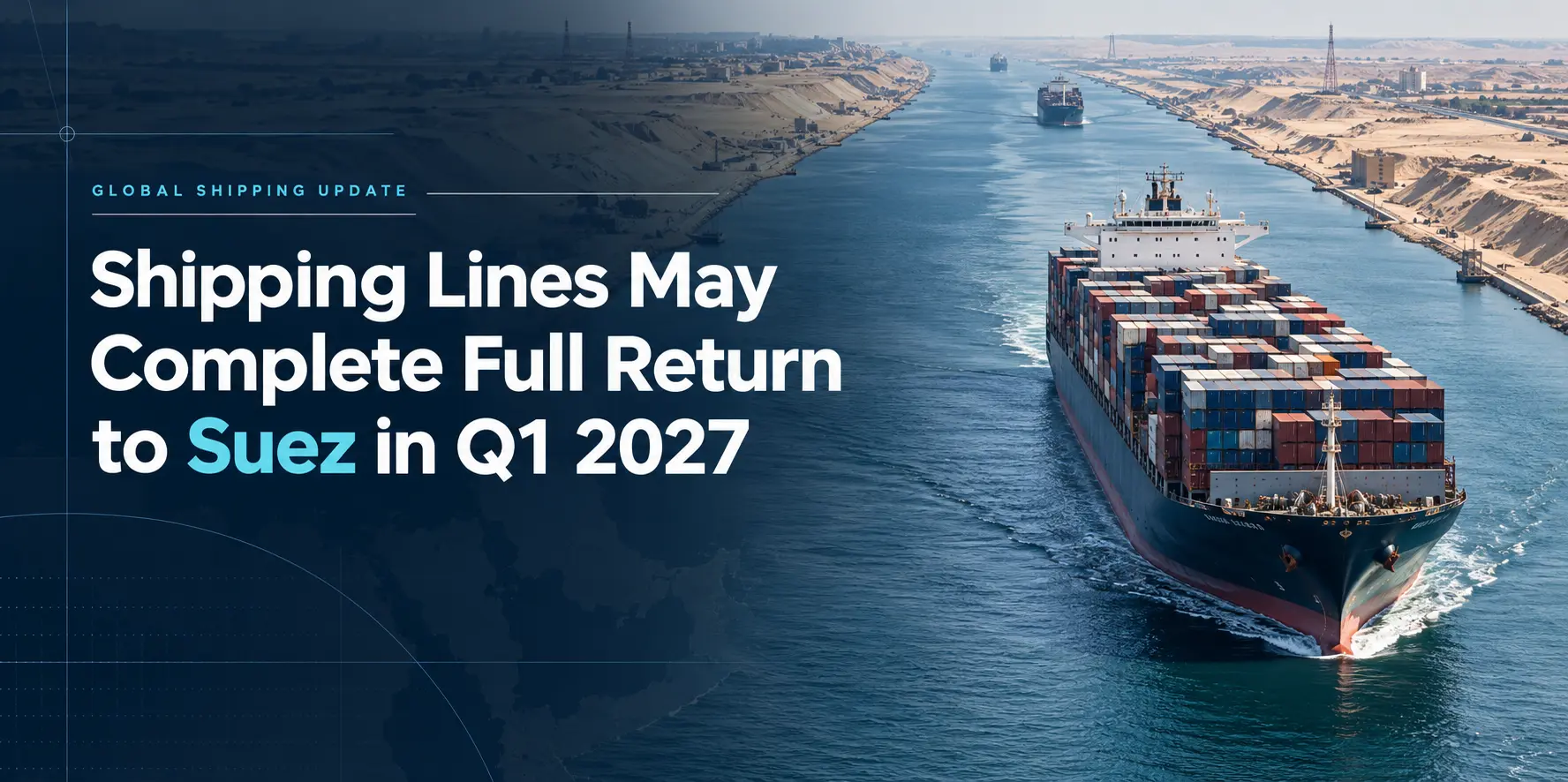
According to the latest data from BIMCO, weekly container ship capacity transiting the Suez Canal averaged 753,000 TEU during the first two weeks of October 2026, compared with 1.457 million TEU during the same period in 2023.
This marks the first time since the onset of the Red Sea crisis that weekly container capacity through the Suez Canal has surpassed 50% of precrisis levels.
The significance of this shift becomes more apparent when viewed against the trajectory of the past three years.
At the end of 2023, the Red Sea situation prompted a large-scale rerouting of container vessels around the Cape of Good Hope.
By the final week of 2023, weekly container ship capacity through the Suez Canal had fallen to approximately 330,000 TEU.
From February 2024 through mid-2026, weekly capacity averaged only around 141,000 TEU-equivalent to just 11% of the comparable 2023 level.
The current reading of 753,000 TEU represents a decisive return above the 50% threshold.
In terms of vessel numbers, MB Shipbrokers reports that 72 container ships transited the Suez Canal in the most recent week, up from a four-week average of 57 vessels per week.
Maersk and Hapag-Lloyd led the initial resumption of Suez routing on selected Asia- Mediterranean services in July of this year, with further route adjustments following in subsequent months.
BIMCO data indicates that since early July, 16 service announcements have been made regarding route realignment, spanning the Gemini Cooperation, Ocean Alliance, Premier Alliance, and MSC.
All four major alliances now operate regular west- bound Asia-to-Northern Europe services via the Suez Canal.
ONE and HMM are identified as the next carriers likely to join the return.
According to Linerlytica, the major carriers yet to complete the transition at that point would be primarily Evergreen, and Yang Ming.
Linerlytica projects that a full resumption of Suez routing could materialise in the first quarter of 2027.
The number of container vessels of 4,000 TEU and above transiting the Red Sea weekly has already exceeded 50, and the pace of route restoration continues to ‘accelerate.
The implications for the global container market are becoming increasingly apparent.
BIMCO estimates that the extended Cape of Good Hope diversions added approximately 10% to global container ship demand.
As vessels progressively return to Suez routing, that incremental demand is dissipating.
In practical terms, the same pool of vessels that previously covered longer distances around Africa is now increasingly transiting Suez, and effective capacity will be released accordingly.
However, recent congestion at Asian ports may offset some of this effect, and the ultimate impact on supply-demand dynamics and freight rates warrants continued observation.
Suez Canal throughput remains below pre-crisis norms, but the recovery from 11% to over 50% represents a material shift in the market’s trajectory.
Should major carriers complete their return in Q1 2027 as projected, voyage distances, vessel utilisation, and effective capacity on Asia-Europe trades could undergo another significant round of adjustment.
Drewry: The World Container Index increased 2% this week 43-2026
In accordance with the assessment of Drewry Supply Chain Advisors, the container rates continue the increasing tendency.
As it is mention their composite World Container Index increased by 2% to $4,585 per 40-foot container.
Freight rates from Shanghai to Rotterdam increased by 3% or $207 to $3,632, and Rotterdam to Shanghai increased by 1% or $7 to $646 per 40-foot container.
The rates from Shanghai to Genoa increased by 5% or $249 to $4,152, while Shanghai to Los Angeles increased by 2% or $123 to $8.007.
As it is also reported, those on Shanghai to New York increased by 1% or $91 to $10,166 per 40-foot container.
Meanwhile, the rates from Los Angeles to Shanghai increased by 2% or $14 to $847, and Rotterdam to New York increased by 3% or $106 to $3,181 per FEU.
Furthermore, the freight from New York to Rotterdam this week increased by 2% or $28 to $1,158 per 40-foot container.
CMA CGM Takes Stake in Moroccan Terminal, Targeting 2027 Operational Launch
CMA CGM’s strategic positioning across North African port infrastructure has advanced with a significant transaction.
Marsa Maroc, the Moroccan port operator, has announced the completion of an equity acquisition by CMA Terminals CMA CGM’s dedicated terminal operating subsidiary in the Nador Container Terminal.
Following approval by the relevant regulatory authorities, the two parties have formally concluded the share transfer.
The new terminal is planned to reach an annual handling capacity of 1.8 million TEU, with operations scheduled to commence in 2027.
For freight forwarding enterprises monitoring the North African market, the project’s subsequent operational development and shipping line deployment merit continued attention.
CMA Terminals maintains a global asset portfolio encompassing 66 terminal assets, with container throughput of approximately 52 million TEU in 2025, positioning the operator among the world’s eight largest container terminal operators.
Nador Container Terminal serves as the concession entity for container operations at the western terminal of Morocco’s Nador West Med port.
The completed acquisition represents the concrete realisation of a cooperation agreement signed by both parties in 2025.
According to information published by Marsa Maroc, the post-transaction shareholding structure of Nador Container Terminal is as follows: Marsa Maroc holding 51% and CMA Terminals holding 49%.
Under the development plan, the terminal will feature 900 metres of quay length, an 18-metre water depth, and 37.5 hectares of container handling and storage yard, with a target annual handling capacity of 1.8 million TEU and a planned operational commencement date of 2027.
Nador West Med is situated along Morocco’s Mediterranean coastline.
As the new container terminal advances through construction toward its planned operational launch, the port’s future role within regional container transport and transhipment networks warrants close observation. For freight forwarding enterprises, three areas merit particular focus in the period ahead.
The first is whether shipping lines announce new service deployments.
CMA CGM’s completion of the equity investment does not, in itself, constitute an announcement of new services or additional port calls.
Any future adjustments in this regard must be assessed against shipping line service announcements, vessel schedules, and port call plans as they are published.
The second is the terminal’s actual handling capacity and operational efficiency upon launch.
While the terminal is planned to achieve an annual handling capacity of 1.8 million TEU, cargo handling efficiency, yard throughput capability, and vessel waiting times following commencement of operations will require further observation based on live performance data.
These factors will directly influence cargo ingress and egress, as well as transport connectivity.
The third is whether the local container transport network continues to develop.
Following the terminal’s entry into service, the quality of connectivity between the port and its hinterland transport network? as well as the terminal’s effective positioning within the regional transhipment system? represent information streams that freight forwarding enterprises evaluating North African logistics strategies would benefit from monitoring on an ongoing basis.
East-West Gate welcomes first CMA CGM container train
East-West Gate has received its first CMA CGM container train at Fényeslitke, Hungary, as the inland terminal expands its role in maritime logistics.
Maersk’s container depot and dry port services earlier this year.
EWG Group said other major ocean carriers were also showing interest in the region.
The development comes four years after the terminal began trial -operations in early 2022.
Its original business model centred on Belt and Road Initiative rail freight between China and Central and Eastern Europe, routed through Ukraine.
Disruption to rail freight routes through Ukraine left that intended transit corridor effectively unavailable, requiring EWG Group to find alternative markets and reshape the terminal’s role in European supply chains.
The group now identifies two sources of demand: container imports for eastern Hungary’s growing electromobility and battery industries, and interest in containerised agricultural exports from Ukraine.
According to EWG, industrial growth in eastern Hungary is generating substantial inbound container volumes.
Comparatively limited exports, however, are increasing equipment imbalances and pressure on the cost of repositioning empty containers.
Changes to Ukraine’s established agricultural export routes have encouraged interest in using containers for grain and other agricultural commodities tradition transported in bulk.
East-West Gate sits where Ukraine’s broad-gauge railway network meets Europe’s standard gauge system.
EWG said it was developing technological solutions to bring conventionally transported commodities into containerised supply chains and connect these different freight systems.
Alongside this work, the group coordinates the requirements of shipping lines, industrial shippers, agricultural exporters and freight forwarders.
It aims to connect customer and cargo flows that have generally operated separately.
EWG intends to build close partnerships with international shipping lines and other industry participants with Fényeslitke serving as a connection point for maritime logistics, continental intermodal services and conventional rai freight.
The group said the terminal future no longer depended on the reopening of traditional Eurasia freight corridors, whose restoration remains uncertain.
Established in early 2022, EWG Group comprises the terminal business, railway undertaking and intermodal operator EWG Rail Plc, and EWG Customs Agency Plc.
The East-West Gate facility covers 850,000 square metres in north-eastern Hungary, near the Ukrainian border.
EWG Rail operates 12 locomotives and more than Vessel 300 wagons, while the custom agency handles clearance and brokerage services.
Together, the three businesses provide terminal handling, rail transport and customs services as the group develops its activities beyond the transit traffic envisaged when East-West Gate was conceived.
Global Liner Slot-Sharing Patterns Undergo Structural Shift
When freight forwarders arrange ocean bookings, a single trade lane will typically carry services from multiple carriers – yet the operational networks behind those services are not always as distinct as the branding suggests.
Analysis published by maritime consultancy Sea-Intelligence indicates that the degree of sharing across global liner services is declining.
The data reveal that market sharing reached its peak between 2014 and 2016, when an average of 4.12 carriers marketed a single operated liner service under their respective brands.
By August 2026, that figure had fallen to 2.65 carriers per service.
Vessel-sharing agreements represent a longstanding form of cooperation among liner operators, allowing carriers to pool capacity on a given service, share operating costs, and extend their port and route coverage.
For shippers and freight forwarders, the practical implication has been that services offered under different carrier brands may, in fact, be carried on the same vessels along the same routing.
Sea-Intelligence data show that the total number of deep-sea liner services worldwide has grown from approximately 250 in 2012-2013 to close to 380 in 2026.
Yet over the same period, the average number of carriers selling each operated service has declined.
The global liner network, in other words, is expanding in scope – while the practice of multiple carriers jointly marketing a single service is becoming less prevalent.
Sea-Intelligence Chief Executive Alan Murphy has noted that liner networks are moving toward a more specialised operating model.
A reduced reliance on shared capacity means carriers must independently assume a greater share of operational risk.
This does not signal the end of inter-carrier cooperation, nor does it imply that all services will be operated on a standalone basis.
Vessel-sharing agreements remain a feature of the liner market; however, aggregate data confirm that the extent to which a single service is sold by multiple carriers has diminished.
As the operational differences between competing branded services become more pronounced, rate comparisons demand a correspondingly greater level of diligence.
Carriers operating on the same trade lane may differ meaningfully in port rotation, direct versus transshipment routing, sailing frequency, and effective transit time.
When selecting an ocean service, shippers and forwarders should verify the actual vessel, routing, and estimated arrival time – not rely on the carrier brand alone as a proxy for service quality or equivalence.
For cargo with firm delivery requirements in particular, brand recognition cannot substitute for an assessment of the specific voyage.
Services that once appeared broadly similar in operational terms may, going forward, exhibit increasingly divergent performance characteristics.
The directional shift identified in the data is clear: the global liner network continues to expand, while the degree to which carriers share a single operated service is contracting.
The operational differences between branded offerings are increasingly likely to manifest directly in booking decisions.
Maersk Hapag-Lloyd Optimise Gemini service
Maersk has issued two announcements conffoning further optimisation of the Gemini network operated in partnership with Hapag-Lloyd, with adjustments spanning the AE2, AE11, AE12, AE18, AE19, and ME2 services.
Following the structural realignment of Asia-to-Mediterranean services completed earlier, Maersk has confirmed the introduction of the new AE18 service as a further reinforcement of the Gemini network.
AE18 will operate alongside AE19 to consolidate coverage across existing West Mediterranean hubs.
The specific adjustments are as follows:
New AE18 service.
The service absorbs coverage previously provided by the AE2, AE12, and AE11 services at Tanger Med and Algeciras, and adds a call at Xiamen.
The updated port rotation is: Shanghai – Xiamen – Tanjung Pelepas – Algeciras – Tanger Med -Algeciras – Xiamen.
AE2 service.
Rotterdam replaces Tanger Med on the westbound leg, strengthening direct connectivity from Ningbo and Shanghai to Rotterdam.
AE11 service.
Salalah is added on the westbound leg, with Port Said replacing Tanger Med, while a new dedicated Salalah rotation is introduced.
AE19 service.
Guangzhou Nansha replaces Shanghai to broaden Asia-to-Europe coverage, with an additional call at Damietta introduced to the rotation.
ME2 service.
A new call at Jeddah, Saudi Arabia, is added to the service.
The updated port rotation is: Ennore – Colombo – Suez Canal – Algeciras – Rotterdam London – Hamburg – Tanger Med – Suez Canal – Jeddah – Colombo.
AE12 service.
The updated port rotation is: Ningbo – Shanghai – Tanjung Pelepas – Suez Canal-Port Said East – Koper – Rijeka – Port Said East – Suez Canal – Colombo – Singapore.
MSC Cancels Two Voyages on European Service, Affecting Ningbo, Shanghai, Nansha and Yantian
Mediterranean Shipping Company has issued a customer advisory announcing capacity adjustments on its Asia-North Europe trade lane in response to sustained market challenges.
The company will blank two consecutive sailings on its Britannia service: voyage QB645 W in week 45 and voyage QB646W in week 46.
Under the ISO week calendar, week 45 runs from 2 to 8 November, and week 46 runs on from 9 to 15 November.
The Britannia service calls at the following ports: Ningbo – Shanghai-Nansha – Yantian – Cai Mep Singapore – Colombo – Felixstowe – Rotterdam – Zeebrugge – Antwerp – Gdansk – Gdynia – Klaipeda – Antwerp-London Gateway – Mundra – Colombo -Port Klang – Singapore.
MSC has confirmed that bookings may continue through normal channels, and that the company is arranging alternative services and contingency measures.
The capacity adjustment represents a proactive optimisation of network deployment in response to prevailing market conditions.
Shippers and freight forwarders with cargo on the affected voyages are advised to monitor subsequent arrangements closely.
Parties holding bookings on the cancelled sailings are urged to verify whether their shipments are affected and to confirm the name of the substituted vessel along with its revised estimated departure and arrival times.
For cargo subject to transhipment or tight delivery windows, shippers should review end-to-end transport connectivity in full, allowing sufficient lead time for any necessary adjustments in order to minimise supply chain disruption arising from the blank sailings.