
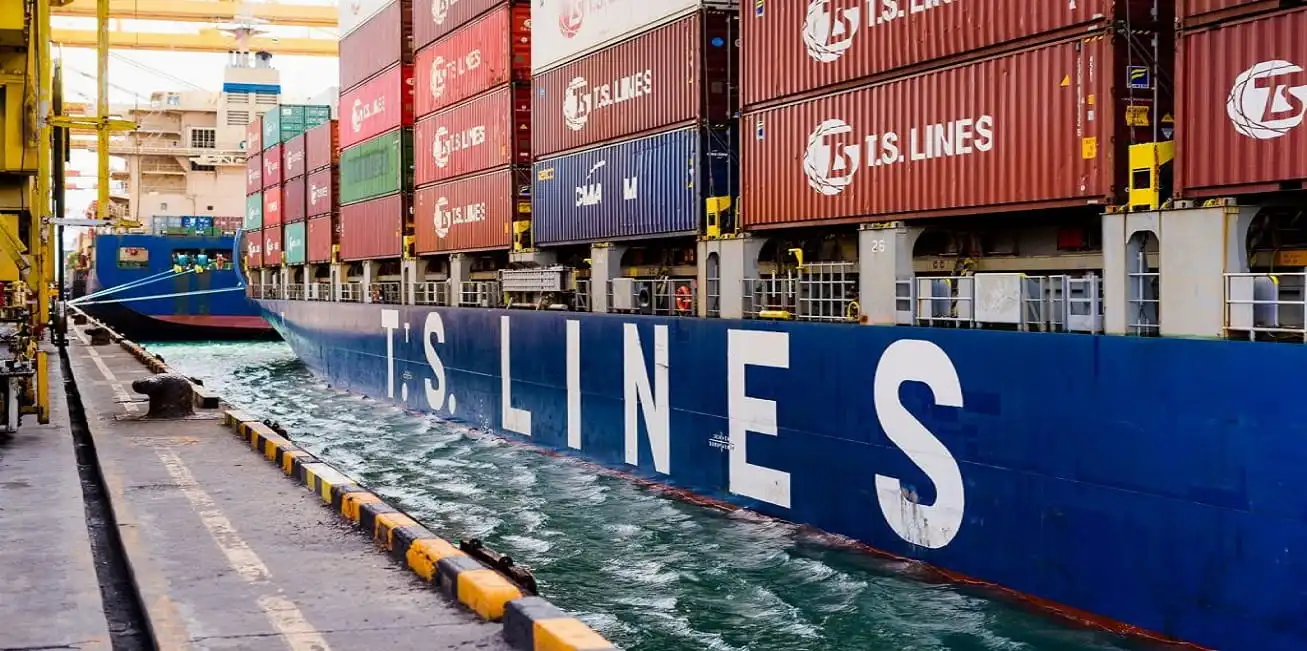
The other day T.S. Lines announced its financial results for the first half of 2026, reporting a net profit of US$230 million, a 23.2% increase year-on-year.
Operating revenue reached US$660 million, up 3.0%, while gross profit rose 31.8% to US$170 million, with a gross margin of 25.4%. Earnings per share stood at US$0.14.
Despite a slight 0.9% decline in cargo volumes to 811,000 TEUS, the company achieved a 3.6% increase in average freight revenue per TEU to US$741, driven by route optimization, strategic capacity reallocation, and yield management.
T.S. Lines’ Board of Directors has declared an interim dividend of US$0.07 per share.
The company posted a net profit margin of 35.2%, ranking among the most profitable liner operators globally, behind SITC International (36.9%) and ahead of Wan Hai Lines (25.1%) and Regional Container Lines (19.3%).
With a fleet of 44 vessels (37 owned, 7 chartered), T.S. Lines operates 47 routes, including nine self-operated, 25 joint-service, 11 slot-exchange, and two slot-purchase routes.
The company primarily serves the Asia-Pacific region but has expanded into Asia- Mexico, Middle East, East Africa, and Red Sea trade lanes, diversifying its revenue mix.
It ranked 20th globally in capacity, with 118,692 TEUS, and has an orderbook of 16 newbuild vessels, adding 76,542 TEUS for future growth.
The global container shipping market in early 2026 experienced challenges from tariff policies, supply chain restructuring, and geopolitical factors.
T.S. Lines adapted by optimizing its route network and capacity deployment, reinforcing its position in the Asia- Pacific while advancing into mid- and long-haul markets.
These measures strengthened operational resilience and minimized exposure to market volatility.
In the second half of 2026, T.S. Lines expects to enhance its capabilities with the delivery of new 7,000-TEU vessels, deploying them based on market conditions to improve route efficiency and fleet flexibility. The company will monitor trade dynamics, tariff shifts, geopolitical developments, and shipping corridor security to adjust its network and mitigate risks.
Committed to sustainable growth, T.S. Lines aims to capitalize on its growing fleet and market position to drive long-term success.
China's ports hit record 161.1 million TEUS in H1 2026
Global container trade rose 5.2 percent year on year in the first six months of 2026, according to a review of the world’s top 30 ports compiled by Alphaliner.
Driven by strong export growth in high-tech and manufactured goods, alongside a successful diversification drive, volumes at China’s seaports reached 161.1 million TEUs, up 5.8 percent and a new six-month record.
Shanghai defended its title as the world’s busiest container port, handling 28.74 million TEUs, up 6.2 percent.
Ningbo-Zhoushan moved up from third to second place, processing 22.9 million TEUS, up 8.8 percent.
Throughput rose 4.7 percent to 22.74 million TEUS at Singapore though the port slipped to third place, down from second.
Alphaliner expects Ningbo Zhoushan and Singapore to continue competing for the position of second-busiest port, as both proceed with major terminal expansion projects.
Shenzhen and Qingdao held their fourth and fifth places, handling 18.56 million TEUs, up 7.7 percent, and 17.56 million TEUS, up 7.2 percent, respectively.
Six of the top 10 ports globally were Chinese.
Throughput at and Busan fell 0.7 percent to 12.6 million TEUS due to a decrease in transhipment cargo, dropping the South Korean port a notch to eighth place.
Los Angeles and Long Beach held ninth place, processing 9.97 million TEUs, up 2.8 percent.
Port of Tokyo container volumes hit 367,388 TEUS in May
The Port of Tokyo handled 367,388 TEUs of containers in May, up 0.1 percent year on year, according to preliminary statistics released by the Tokyo Metropolitan Government (TMG)’s Bureau of Port and Harbor.
The total comprised 263,288 TEUS of loaded containers, down 0.9 percent, and 104,100 TEUs of empty containers, up 2.7 percent.
Loaded exports fell sharply. down 10.4 percent to 57 409 TEUs, while loaded imports rose 2.1 percent to 205,879 TEUs.
On the empty side, 102,658 TEUs were exported, up 1.9 percent, and 1,442 TEUs were imported, up 114.9 percent.
Domestic containers totalled 41,936 TEUs, down 12.3 percent. Combined loaded exports and imports came to 281,943 TEUs, down 0.9 percent, while combined empties reached 127,380 TEUs, down 2.3 percent.
Over the first five months of the year, loaded exports and imports totalled 1.28 million TEUS down 1 percent, split between 314,704 TEUS of exports, down 1.6 percent, and 965,921 TEUS of imports, down 0.8 percent.
Empty containers came to 480,390 TEUs, up 4.6 percent, comprising 475,993 TEUS of exports, up 5.1 percent, and 4,397 TEUS of imports, down 31 percent.
Domestic containers over the same period stood at 93,385 TEUS of loaded units, down 1.9 percent, and 123,824 TEUS of empties, down 15.3 percent.
Combined loaded international and domestic containers reached 1.37 million TEUS down 1.1 percent, while total empties came to 604,214 TEUS down 0.2 percent.
Signs of Recovery Emerge at Piraeus as Red Sea Diversion Pressures Gradually Ease
As a growing number of container vessels return to the Suez Canal route and the volume of ships rounding the Cape of Good Hope progressively declines, throughput at the Phase II and Phase III container terminals of Greece’s Port of Piraeus is showing renewed signs of recovery. Positioned along the critical Asia- Mediterranean-Europe trade corridor, the port is well placed to capitalise on this shift as forward momentum builds.
Public data indicate that Piraeus handled approximately 352,000 TEUS in July 2026, compared with 345,000 TEUS in the corresponding period of the prior year -a modest but meaningful positive gain that reflects easing of the freight pressure attributable to Red Sea diversions. For the January-to-July 2026 period, cumulative throughput reached 2.347 million TEUS, against 2.4 million TEUS recorded in the same period last year, representing a year-on-year decline of 2.2 percent.
While cumulative figures remain within a recovery trajectory, the directional trend is one of gradual stabilisation.
Several factors continue to shape the operating environment.
From 20 July 2026, Houthi forces announced a targeted maritime blockade directed exclusively at tankers linked to Saudi interests.
Concurrently, the European For Union’s Operation Aspides has maintained its existing risk assesment, affirming that vessels assciated with Israeli and United States interests continue to facelevated navigational risk in Re Sea waters and the surrounding region.
Together, these developments define the prevailing maritime security landscape in the Red Sea and introduce a degree of uncertainty into the near-term throughput outlook for Piraeus underscoring that while recovery signals are emerging, the path forward remains contingent on broader geopolitical conditions.
ONE Restructures China-Red Sea Service
Ocean Network Express (ONE) has announced a strategic realignment of its China-Red Sea service arrangements, signalling a deliberate reconfiguration of its regional deployment to strengthen operational efficiency and port coverage across this key trade corridor.
Under the revised structure, ONE will withdraw from the RCS service-currently operated in slotsharing cooperation with Global Feeder Shipping, Wan Hai Lines, and TS Lines- and transition slot purchase arrangement on the RES/CRX service, jointly operated by Sinolines and Sinokor Merchant Marine. ONE will market this capacity to the trade under the commercial designation RC2.
Service Structure Realignment: From RCS to RES/CRX Slot Access
The adjustment represents a change in slot-charter partnership and routing arrangement, rather than the independent deployment of ONE-operated tonnage. Under the RC2 banner, ONE will continue to access the service as a slot charterer, offering customers consistent coverage across the China- Red Sea trade lane under a newly designated commercial product.
The RC2 service will maintain calls at the three principal Red Sea gateways – Jeddah, Aqaba, and Sokhna -preserving continuity of destination coverage for cargo owners and freight forwarders serving these markets. On the China side, however, the port rotation undergoes meaningful revision: Qingdao and Shenzhen Shekou will no longer feature in the itinerary, while Ningbo is introduced as a new port of call.
The revised RC2 rotation is structured as follows: Shanghai – Ningbo – Nansha – Jeddah-Aqaba – Sokhna – Shanghai.
This reconfiguration consolidates the China-side coverage into a three-port framework s Shanghai, Ningbo, and Nansha replacing the previous multi-port combination spanning both North and South China.
Port of Shanghai Sets Global Record with 8,016-Tonne Biomass Methanol Bunkering
The Port of Shanghai has set a new global record in green marine fuel supply, delivering 8,016 tonnes of domestically produced biomass methanol to a single container vessel in one continuous operation-the largest bunkering of its kind recorded to date.
SIPG Energy, a subsidiary of Shanghai International Port (Group) Co., Ltd. (SIPG), carried out the operation on 15-16 August 2026, fuelling the CMA CGM OSIRIS, a 13,000-TEU methanol dual-fuel container vessel operated by the CMA CGM Group. The delivery more than doubled the previous global benchmark of 3,643 tonnes, a record set by the same SIPG Energy team in March 2026.
The operation stands as the largest single biomass methanol bunkering at a Chinese port to date. By supplying more than 8,000 tonnes in a single uninterrupted transfer, SIPG Energy demonstrated the operational capacity to serve the growing fleet of methanol-powered vessels calling at major global hubs.
The milestone reflects the Port of Shanghai’s expanding role in integrated green-fuel bunkering services.
As one of the world’s busiest container ports, Shanghai has steadily expanded its alternative marine fuel capabilities, positioning itself as one of the leading facilities equipped to support the shipping industry’s transition to lower-carbon fuels.
The achievement also underscores the coordination now taking shape across the maritime fuel supply chain.
Delivering biomass methanol at this scale required close collaboration among fuel producers, port operators and vessel operators-an alignment that industry observers view as essential to moving alternative marine fuels from pilot projects toward routine, large-scale adoption.